Auburna vulgare
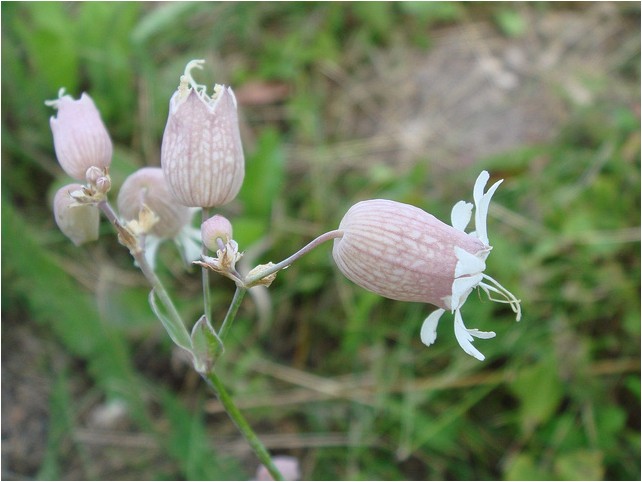
Auburna vulgaris is one of the plants of the family called Cloveaceae; in Latin the name of this plant would be as follows:
Oberna behen (L.) (Silem cucubalus Wib., S. latifolia (Mill) Rendle, S. venosa Aschers., S. vulgaris (Moench) Garcke). As for the name of the common oberna family itself, in Latin it will be: Caryophyllaceae Juss.
Description of oberna vulgaris
Auburna vulgaris is known under numerous popular names: lungwort, blekota, blue-blue, buglossa, saplings, ruddy and many others. Auburna vulgaris is a perennial, bare herbaceous and rough-haired plant, the height of which will fluctuate between forty and one hundred centimeters. The stem of this plant is erect, and at the top it will be branched. The leaves of the common oberna can be either lanceolate or ovate-lanceolate in shape, their length will be about four to ten centimeters, and the width will be one to three centimeters. Such leaves will be sharp and sessile. Oberna vulgare flowers are heterogeneous; they are located on pedicels and in loose semi-umbrellas, which in turn are located at the ends of stems and branches. The calyx of this plant will be ovoid, swollen and glabrous, its length will be about thirteen to eighteen millimeters, and its width will be seven to ten millimeters. The petals are painted white, and the box is almost spherical.
Oberna vulgare blooms from July to October. Under natural conditions, this plant is found in all regions of the European part of Russia, Belarus, Ukraine, the Far East, Central Asia, the Caucasus, Western and Eastern Siberia. For the growth of aubernai, the common plant prefers places near streams, meadows, sparse forests and vegetable gardens.
Description of the medicinal properties of oberna vulgare
Auburn is endowed with very valuable healing properties, and it is recommended to use the herb of this plant for medicinal purposes. The concept of grass includes inflorescences, leaves and stems.
The presence of such valuable healing properties should be explained by the content of organic acids, lychnose, isolychnose, sucrose galactosides, alkaloids, silenoside, vitamin C, tannins, flavonoids and tannins in this plant. The grass will contain tannins, organic acids, triterpene saponins, flavonoids and coumarins. The leaves contain alkaloids, vitamin C and triterpene saponins.

Auburn is endowed with a diuretic, emollient and calming effect. A ten percent tincture prepared from the herb of this plant is recommended for use in chronic gastritis. Dry grass of obernata should be brewed and then used as tea for gastritis, chronic bronchitis, dysentery, as well as for various diseases of the bladder and kidneys. It is recommended to treat lichen with a decoction based on the herb of this plant. Fresh juice of the herb of this plant is used for conjunctivitis.
It is noteworthy that in the spring, young leaves of oberna vulgare can be eaten as a salad. Externally, a decoction based on the herb of this plant is used for dermatomycosis and erysipelas.
The following remedy is used as an expectorant: to prepare it, take a tablespoon of dry crushed herb per glass of boiling water. This mixture is boiled for a couple of minutes, left for one hour, and then carefully filtered. Take this remedy based on oberna vulgaris three times a day, one to two tablespoons.





