Lime
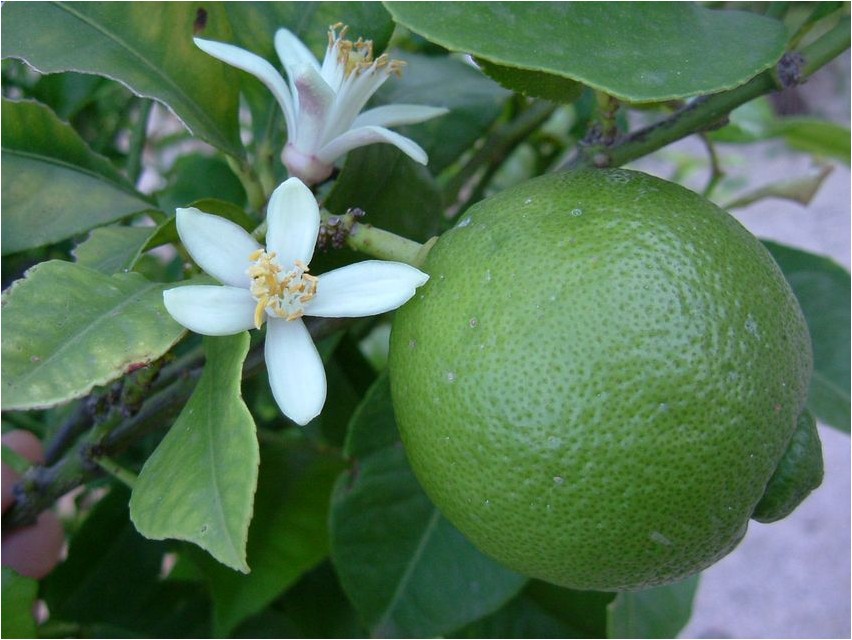
Lime (Latin: Citrus aurantiifolia) is a species of citrus plant genetically similar to lemon, belonging to the extensive Rutaceae family.
Description
Lime is a relatively small shrub or tree, ranging in height from one and a half to five meters. Its crown is quite dense, and its branches are covered with numerous short spines.
Lime”s axillary and rather intricate inflorescences contain one to seven flowers, and this plant is distinguished by its remontant (i. e., continuous) flowering.
Lime”s ovoid fruits are characterized by their relatively small size—their diameter ranges from 3. 5 to 6 cm. Incidentally, their aroma is noticeably different from the familiar aroma of lemons. The flesh is very tart, incredibly juicy, and slightly greenish. The peels of fully ripe limes are very thin, and their color can be green, yellowish, or greenish-yellow. The most valuable lime varieties typically have few seeds—from 0 to 4.
Both flowering and ripening of the fruit occur throughout the year. However, the main flowering period occurs during the rainy seasons (approximately May and June). The majority of the harvest usually occurs in August, September, and October. Juicy limes keep well for up to one and a half to two months at a relative humidity of 85-90% and a temperature of around eight to ten degrees Celsius.
Distribution
The colorful Malay Peninsula is considered the birthplace of these citrus fruits. Limes were first cultivated in the 1870s on the island of Montserrat, part of the Lesser Antilles. Limes are currently widely grown in Myanmar and Indonesia, Sri Lanka, India, Venezuela, and Brazil, as well as several West African countries.

Limes are most often imported to the international market from the Antilles or Cuba, as well as from India, sunny Egypt, and distant Mexico.
Cultivation and Care
Lime trees grow best in tropical zones located at altitudes up to 1, 000 meters above sea level.
In general, lime is a fairly unpretentious crop in terms of soil conditions — it is able to grow and develop well on rocky and even sandy and rather poor soils. However, it is much more sensitive than most other citrus crops to extremely unfavorable soil and climatic conditions. The best soils for growing lime are light loams with excellent drainage and a very deep arable horizon.
As for resistance to low temperatures, lime can safely be awarded one of the lowest places in terms of this indicator.
Application
Lime is consumed mainly fresh. In addition, its segments are often preserved. Lime also produces a very rich juice containing 6 to 8% citric acid. An excellent oil is also obtained from these juicy fruits — it is used in the manufacture of a wide variety of soft drinks as a flavoring.
This fruit has also been used in cosmetology. Lime is a real salvation for oily skin: it helps tighten pores, get rid of blackheads and control sebum secretion. You can also use it to whiten the skin (especially on the back and neck). Lime is also an excellent helper for strengthening nails and hair — it quite actively promotes their growth. It is quite possible to use it to treat papillomas with warts or abscesses, as well as herpes and closed comedones.
In folk medicine, lime is also respected. This wonderful fruit perfectly calms too frequent and very strong heartbeats and has an excellent effect on the stomach. In addition, lime will definitely help cure colds, relieve sore throats and easily cope with various infectious ailments.





