Gorichnik Crimean
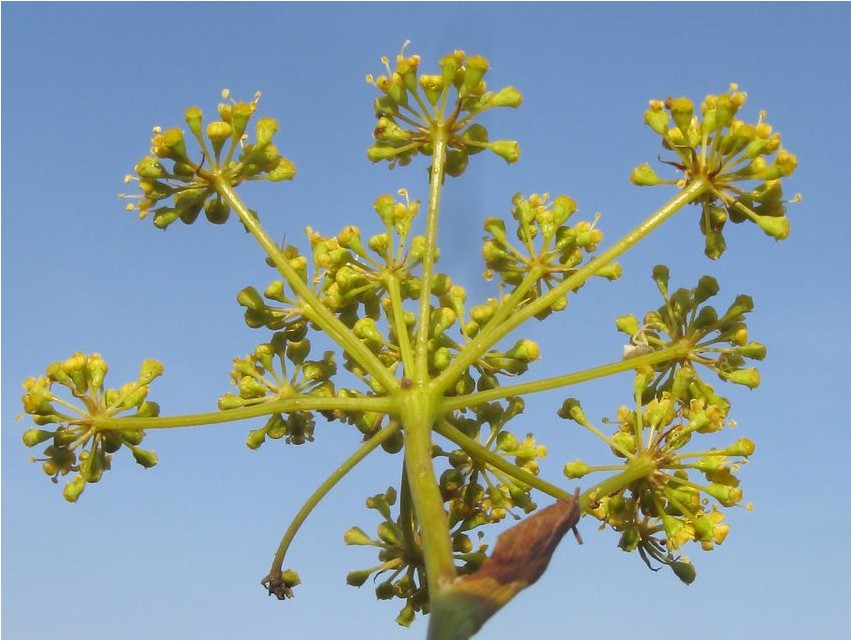
Crimean gorichnik is one of the plants of the family called Umbellaceae; in Latin the name of this plant will be as follows: Peucedanum tauricum.
As for the name of the Crimean gorichnik family itself, in Latin it will be like this: Apiaceae Lindl.
Description of the Crimean gorichnik
Crimean gorichnik is a perennial herbaceous plant, endowed with numerous cylindrical stems that are branched in the upper parts. The height of such stems will be about forty to eighty centimeters. The root of this plant is quite thick, its thickness can reach one and a half centimeters. The stem of the Crimean gorichnik is grooved and straight; the umbrella reaches three to eight centimeters in diameter. And the umbrellas themselves will be about eight to ten millimeters in diameter, the petals of this plant will be light yellow in color, they are also broadly ovoid, and their length is approximately one and a half millimeters. The fruits will be elliptical, their length is four to five millimeters and their width is two and a half millimeters.
Flowering of the Crimean gorichnik occurs in the period from July to August, and fruiting occurs in September. For growth, this plant prefers pine forests and dry rocky slopes. Under natural conditions, Crimean gorichnik can be found not only in the Crimea, but also in the Caucasus.
Description of the medicinal properties of Crimean gorichnik
Crimean gorichnik is endowed with very valuable healing properties, and it is recommended to use the roots of this plant for medicinal purposes. The roots of this plant should be harvested in early spring or after the seeds ripen in the autumn.
The presence of such valuable healing properties is explained by the content of essential oil, furocoumarin peucedanin and flavonoids in the plant. It is noteworthy that the fruits of this plant contain peucedanin, and in the autumn the content of this substance increases very significantly. It should be noted that Crimean gorichnik was proposed as a new raw material plant intended for the production of furocoumarin. A drug called atamantine, which belongs to the furocoumarins, is quite often used to treat coronary insufficiency, as well as peptic ulcer of the duodenum and stomach, with dysfunction of both the urinary tract and the gastrointestinal tract.

As for traditional medicine, a decoction prepared from the roots of this plant is used to treat headaches, coughs, epilepsy and, in addition, as a remedy that has the ability to improve digestion. This decoction is used as a lotion and for rinsing purulent wounds, and this decoction is also used to rinse the mouth for toothache and bad breath.
For prolonged coughs, the effectiveness of the following remedy based on Crimean gorichnik has been proven: to prepare it you will need to take ten grams of crushed roots per liter of water. The resulting mixture should be boiled over fairly low heat for ten to twelve minutes, and then left to infuse for one hour. After this, this mixture should be carefully filtered. In order for this remedy to be especially effective, it is recommended not only to follow all the preparation rules, but also the order of administration itself. For long-term cough, it is recommended to take this remedy based on Crimean gorichnik about one tablespoon four to five times a day.
It should be noted that this is not all the beneficial properties of such a plant as Crimean gorichnik.





