Irga
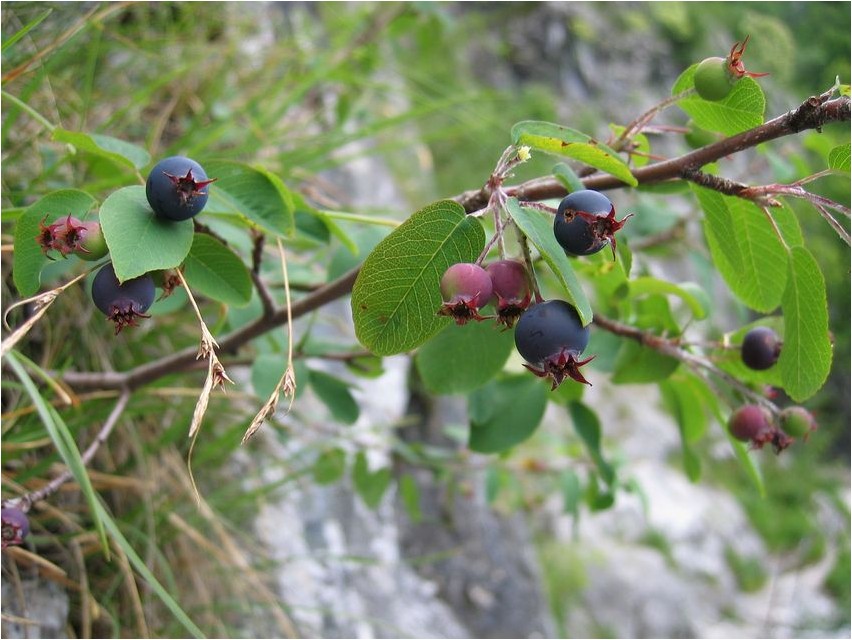
Irga (lat. Amelanchier) is a famous berry crop; tree of the Rosaceae family. It grows under natural conditions in the United States, Africa, European countries, the Caucasus, Japan and Russia.
Description
Irga is a high-yielding deciduous shrub or tree, reaching a height of up to 6 m. The crown is dense, the bark of the trunk and branches is velvety, dark brown, and hard. The leaves are simple, whole, oval or round, dark green on the outside, with a whitish tint on the inside.
The flowers are inconspicuous, numerous, can be white or cream, collected in corymbs of several pieces (usually up to 12 pieces). Flowering occurs in the first — second decade of May and lasts 7-10 days. The fruits of serviceberry are small, spherical, sometimes oval in shape, reach 6-10 mm in diameter, can be purple or black with a blue tint, and are always gray.
The fruits ripen in July-August and have a pleasant sweet taste. Irga is a fast-growing plant that produces abundant root shoots. The root system of the crop is powerful, some roots go to a depth of 2-3 m. Irga actively bears fruit from three years old to 40 years old.
The crop is not popular in gardening; it is rarely grown for its berries. After all, the fruits of the crop do not ripen at the same time, and birds willingly eat them, not allowing them to harvest. On the territory of the Russian Federation, the plant is most often used as decoration or protective strips.
Subtleties of cultivation
Irga cannot be called a whimsical crop; neither location nor soil composition plays a special role for it. Irga is able to grow normally on almost all soils, although it does not like damp areas and lowlands. The plant will also not like swampy and saline soils. Irga is light-loving; sunny areas yield more. In addition, in the sun the berries have a richer and sweeter taste. The plant is frost-resistant, neutral to winds and drought. Temperatures above 35C also do not affect plant development.

Reproduction and planting features
The irga is propagated by seed, cuttings and root shoots. The third method is considered the most common. Cuttings and propagation by root shoots are carried out either in early spring or autumn. Immediately after planting, the plants are watered and mulched abundantly.
Seeds are sown immediately after harvesting. First, the ripe berries are collected, laid out in a single layer on a plate, and stored for seven days. Next, the seeds are separated, dried, and sown in seedling containers filled with a nutritious and moist mixture consisting of fertile soil, peat, and river sand. Seedlings emerge a couple of weeks after sowing.
Pricking out is done when the plants have formed 4-5 true leaves. With this method, the plant begins to bear fruit in the fifth year, which is a significant drawback. Experienced gardeners often graft the berry onto a rowan or hawthorn, and sometimes even onto a pear tree.
Care
During the first 10 years after planting, the plant requires regular weeding, loosening the soil, and fertilizing. Formative pruning is performed in the 10th or 11th year, removing thickening branches and shoots with weak growth. When thinning, leave only 10-12 healthy stems. Excessively tall bushes are trimmed back.
Fertilize serviceberries in the fall, applying both mineral and organic fertilizers to the soil. Without fertilizing, plants produce low-quality harvests. To reduce the risk of birds pecking at the fruit, the bushes are protected with a special mesh material.
Although serviceberries are rarely affected by insects and diseases, they require preventative treatment with 1% Bordeaux mixture. Leaf rollers and swamp weevils can cause minor damage. To combat them, it is recommended to use organophosphorus preparations, applying them to the bushes before flowering or when larvae are detected.





