Artemisia tauride
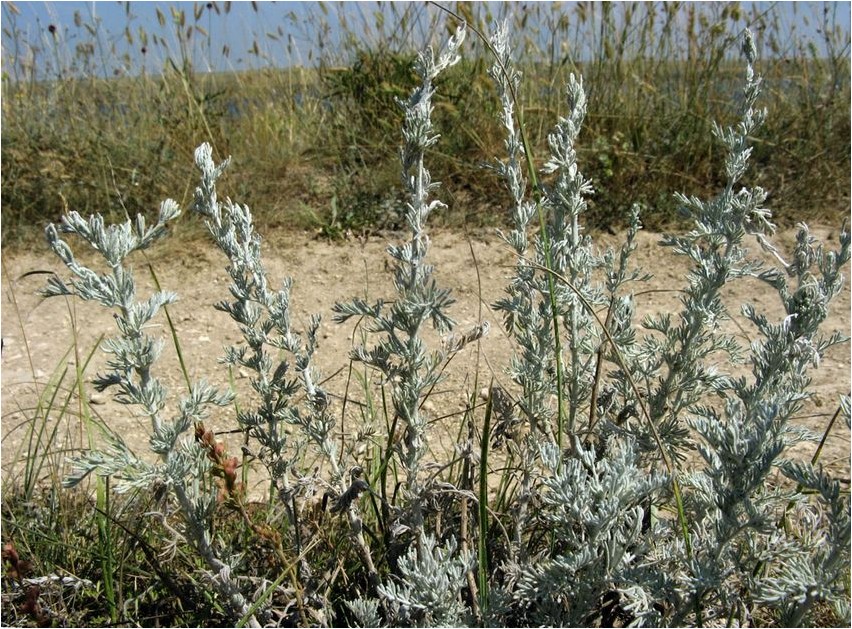
Tauric wormwood is one of the plants of the family called Asteraceae or Asteraceae; in Latin the name of this plant will be as follows: Artemisia taurica Willd.
As for the name of the Taurida wormwood family itself, in Latin it will be: Asteraceae Dumort. (Compositae Giseke).
Description of Tauride wormwood
Tauride or Crimean wormwood is a subshrub, the upper part of which will die off every autumn, and will grow again in the spring of next year. The roots of such a plant will be woody, few-branched, thick and taplike. The whole plant can be either whitish or gray-felt due to the abundance of covering hairs. The above-ground part of this plant will, in turn, consist of greatly shortened sterile shoots and stems. The stems of wormwood are ribbed and straight, and in the upper part they will be branched and flower-bearing. The leaves of the sterile shoots of this plant, as well as the lower stem leaves, will be petiolate, and the blade is thrice straight dissected or twice straight dissected. The root lobules of the leaves of wormwood will be thread-like and thin, and their length is about three to five millimeters. The upper stem leaves of this plant are less dissected, almost sessile, while the bracts are linear-filamentous and simple. Tauride wormwood flowers are located in baskets of six to eight pieces, they will be tubular, and numerous small-sized baskets are located on branches and a paniculate inflorescence is formed. This inflorescence is endowed with branches directed obliquely upward and is narrowly pyramidal in shape.
Tauride wormwood blooms from August to September. This plant grows on the territory of the Taman Peninsula, the North Caucasus, the Rostov and Volgograd regions, the Caspian steppes to Dagestan, as well as in the steppe part of the Crimea. For growth, this plant prefers dry steppes, semi-deserts, clayey and saline areas. Tauride wormwood grows in small thickets or spots among other types of wormwood.
Description of the medicinal properties of Tauride wormwood
Tauride wormwood is endowed with very valuable healing properties. The presence of such medicinal properties is recommended to be explained by the content of the essential oil in the herb of this plant, and the main component of such an oil will be the sesquiterpene lactone tauremisin. Such a healing substance will be present in the grass of this plant, which was collected throughout the entire budding period.
It should be noted that tauremisin is used for various cardiovascular diseases, similar to camphor preparations. However, unlike camphor, this healing agent is used intravenously and in cases where urgent assistance is necessary. In addition, tauremisin is endowed with the ability to exert an stimulating effect on the central nervous system and diuresis, and also has cardiotonic and vasotonic effects. As already mentioned, tauremisin can be a substitute for camphor, and is also low-toxic and does not cause any side effects.

After frosts and until the beginning of spring, tauride wormwood serves as food for all types of livestock. For this reason, this plant is one of the most important dwarf plants for winter pastures located in the Eastern Ciscaucasia. However, it should be noted that after the leaves of Taurida wormwood bloom, this plant cannot be used as food for animals. This should be attributed to the fact that until the autumn frosts this plant will cause poisoning in animals.





