Asparagus officinalis
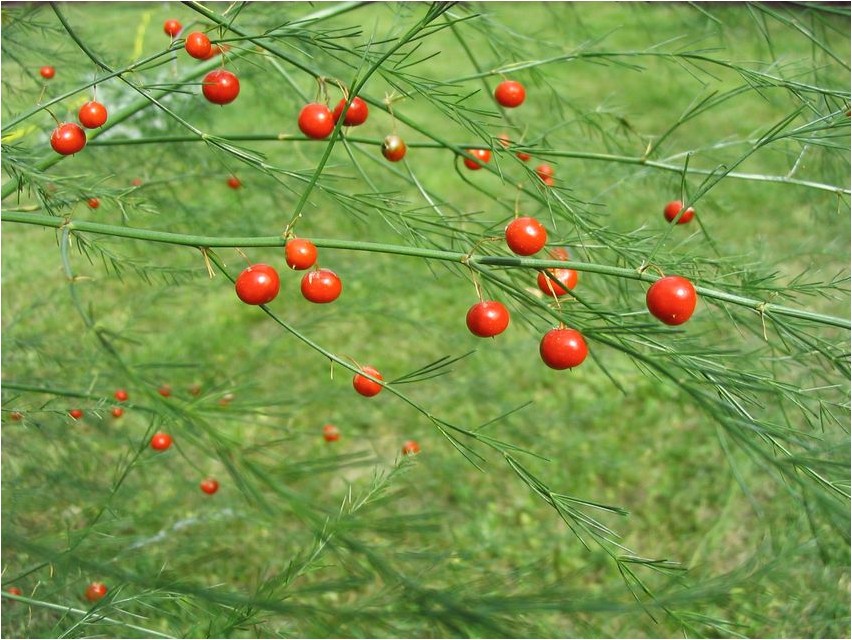
Asparagus officinalis (lat. Asparagus officinalis) is a species of herbaceous perennials of the genus Asparagus (lat. Asparagus) from the family Asparagaceae (lat. Asparagaceae).
The name of the plant itself speaks of its healing abilities. In addition, young shoots of Asparagus officinalis have been part of the human diet for three thousand years, helping them maintain health and vitality for many years.
What’s in your name
The Latin generic name of the plant has very deep linguistic roots, going back centuries, when completely different languages dominated the Earth. After all, the friendship between man and plant began a long time ago.
The following chain can be traced: the modern Latin word “asparagus” is based on the medieval Latin word “sparagus”, which in turn is based on the Greek word “asparagos” or “aspharagos”, and the Greek word comes from the Persian “asparag”, which is equivalent to the Russian word “sprout”. This is almost a detective story.
With a specific epithet the situation is simpler, since the Latin word “officinalis” in Russian means “medicinal”.
The wide growing area of Asparagus has given rise to many popular names. For example, the shape of the plant gave birth to the Turkish name, which in Russian sounds like this: “The bird cannot land.” In Vietnamese and Thai, Asparagus is called “European bamboo shoots” and its green shoots are widely used in national dishes.

Description
The powerful rhizome of Asparagus officinalis is overgrown with numerous adventitious roots that go deep into the soil to obtain nutrients, and vertical underground shoots, which are of interest to humans.
The smooth stems grow up to half a meter in height, acquiring numerous branches with scale-like leaves. From the axils of scale-like leaves, so-called cladodes are born – flattened, modified shoots that act as leaves of ordinary plants.
The whitish-yellowish small female flowers (asparagus is a dioecious creature of nature) transform into red berries.
Uses of Asparagus in Ancient Times
The subtle aroma of asparagus and its diuretic properties have been used by people for the benefit of their health since ancient times. On an Egyptian frieze, which scientists estimate to be 5, 000 years old, Asparagus is depicted as an offering.
Asparagus officinalis has been known since ancient times in Spain, Syria, Greece and Rome. The Romans and Greeks ate Asparagus fresh when it was in season to ripen, and also dried it for future use so that it would be with them in the winter.
The founder of the Roman Empire, Octavian Augustus, who lived at the turn of two eras (born in 63 BC, died in 14 AD), even created a flotilla to transport asparagus. The ships were so fast that the emperor coined the expression for them: “faster than the time it takes to cook asparagus.”
Chemical composition and healing abilities
It should be noted that young shoots of Asparagus officinalis are used for food and healing procedures. As soon as the buds begin to open, the shoots of the plant quickly become woody, losing their beneficial qualities.
The main component of Asparagus is the most valuable substance on the planet – water, which occupies 93 percent of all components. Therefore, Asparagus is a low-calorie food with very low sodium content.
The remaining 7 (seven) percent managed to contain many useful microelements (including chromium, which enhances the ability of insulin to transport glucose from the blood to cells) and macroelements, as well as vitamins “C” and “E”, beta-carotene, amino acids (including asparagine, which the body needs for the normal functioning of the nervous system and ammonia synthesis), dietary fiber.





