Milk Thistle
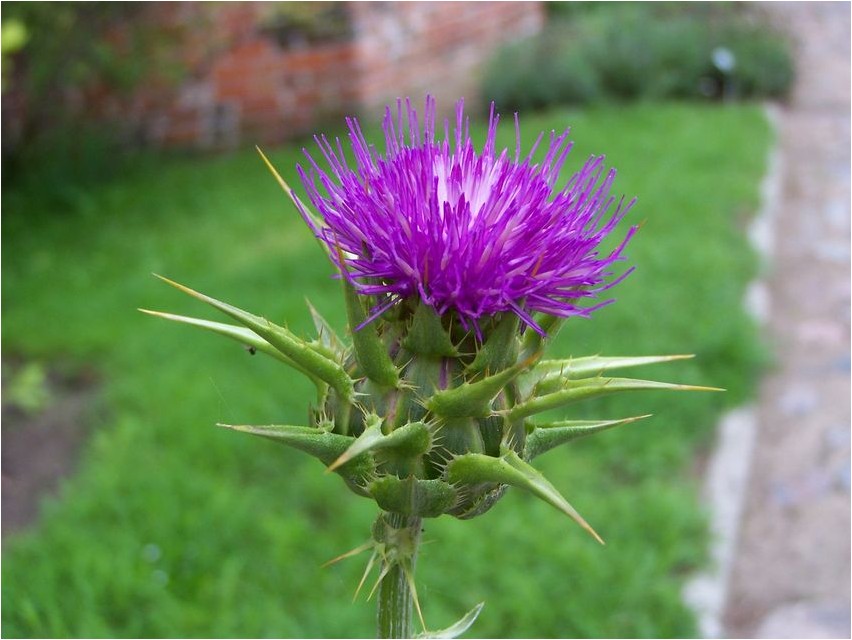
Milk thistle is a member of the Asteraceae or Compositae family. Its Latin name is Silybum marianum (L).
The Latin name for the milk thistle family is Asteraceae Dumort. (Compositae Giseke).
Description of Milk Thistle
Milk thistle is known by many common names: milk thistle, milk thistle, black elecampane, clump thistle, white thistle, maino ostopestro, and ostropester. Milk thistle is an annual or biennial prickly plant with a spindle-shaped stem and a straight, ribbed stem that reaches a height of one and a half meters. This stem is also covered with tufts of felted pubescence. Milk thistle leaves are somewhat glossy, leathery, alternate, and spotted with white. The lower leaves are broadly lobed and elliptical, while the uppermost leaves are clasping, lanceolate, sessile, and pinnately lobed, with serrated edges and yellow spines. The flowers are tubular, borne in fairly large heads with an imbricated wrapper consisting of spiny and also spiny green leaflets. The milk thistle fruit is a shiny, tufted achene colored in black and yellow tones.
This plant blooms from July until late autumn, while the fruit ripens from September to October. Milk thistle grows naturally in Central Asia, the southern regions of European Russia, Ukraine, Belarus, the Caucasus, and Western Siberia. This plant prefers vegetable gardens, orchards, wastelands, and weedy areas.
Description of the medicinal properties of milk thistle
Milk thistle has valuable medicinal properties, and its roots and seeds are recommended for medicinal purposes. Seeds should be collected between late August and early September, when the involucres on the vast majority of lateral flower heads have dried.
The presence of valuable healing properties is recommended to be explained by the content of resins, fatty oil, essential oil, flavonoids, tyramine, histamine, vitamin K in the seeds of this plant, and in addition the following micro- and macroelements: aluminum, lead, potassium, magnesium, zinc, chromium, strontium, selenium, calcium and vanadium.

As for traditional medicine, here this plant is quite widespread. Traditional medicine recommends the use of aqueous vitamins and alcoholic extracts from the seeds and fruits of this plant for various diseases of the liver, spleen, gall bladder, hemorrhoids, chronic constipation, chronic bronchitis and articular rheumatism.
It has been proven that preparations based on this plant have the ability to enhance the formation of bile and accelerate its excretion, increase the protective properties of the liver in relation to a variety of poisonings and infections, and will also protect prophylactically intact liver cells. For this reason, milk thistle is recommended for use in cases of cholecystitis, liver cirrhosis, cholangitis, acute and chronic hepatitis, and also for various functional disorders of the liver after poisoning with chemical compounds, including alcohol. Such healing agents are also used for diabetes mellitus and various chronic gastrointestinal diseases.