Barberry
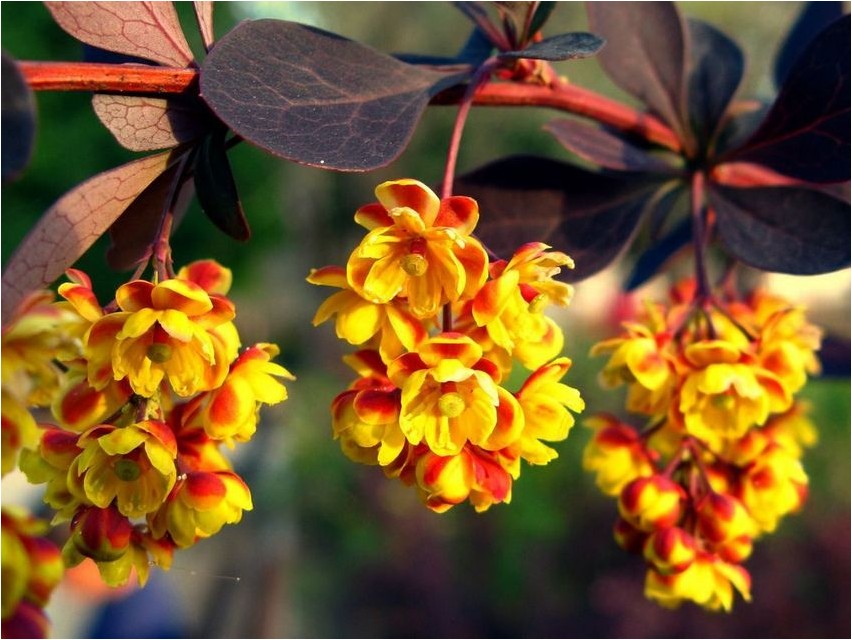
Barberry (lat. Berberis) is an ornamental shrub of the Barberry family.
Characteristics of culture
Barberry is a deciduous, evergreen or semi-evergreen shrub, less commonly a tree, with erect, thin, ribbed shoots that branch at an acute angle. The bark is brownish-gray or brown. The leaves are simple, ovate, elliptical or obovate, articulated with a short petiole, collected in bunches of 2-7 pieces, arranged alternately, depending on the variety, green, purple, yellow or variegated. The spines are simple, trifoliate, less often quintuple, located at the base of the buds or shortened shoots.
The flowers are small, golden yellow, and have a pleasant aroma. The corolla consists of six petals with nectaries. Flowering occurs in the second ten days of May, sometimes earlier. Barberry fruits are oblong, elliptical, spherical or ovoid in shape, red, purple or black. The seeds are ribbed, tapering at both ends, and are usually brown and shiny.
Barberry is widespread in Eastern Siberia, Crimea, the Urals, Kazakhstan, North America and the countries of southern and central Europe.
Species

*Common barberry (lat. Berberis vulgaris) — the species is represented by a thorny shrub up to 3 m high. At the beginning of development, it is vertical, later — drooping, fast-growing. The spines are green and change color to red or yellow-orange in autumn. The flowers are yellow and have a strong aroma. Common barberry blooms in mid-May. The fruits are elliptical in shape, dark red or orange-red in color, have a sweet and sour taste, and ripen in the second ten days of September. The species is resistant to drought and frost, and is not picky about soil. Prefers sunny or semi-shaded areas; dense shade should be avoided. Soils are desirable alkaline, in no case loamy or acidic.
*Thunberg barberry (lat. Berberis thunbergii) — the species is represented by a thorny shrub up to 2 m high. The spines are dense, light green in color, in the fall — fiery orange or scarlet. Flowers numerous, yellow. the fruits are oval, light red. The species is winter-hardy, prefers sunny or semi-shaded areas, with drained, neutral or acidified soils with a rich mineral composition.
*Ottawa barberry (lat. Berberis ottawensis) — the species is represented by a tall prickly shrub, externally similar to Thunberg barberry. The spines are green, turning purple in autumn. The flowers are yellow, the fruits are red and elongated.
*Narrow-leaved barberry (lat. Berberis stenophylla) — the species is represented by a free-growing shrub with arched drooping branches, up to 3 m high. The leaves are evergreen, blue-white on the lower part, dark green on the upper part. The flowers are small, narrow-leaved, golden-yellow in color, and have a pleasant aroma. The fruits are elongated, blue-black. Barberry angustifolia prefers sunny areas. The species is thermophilic and has a negative attitude towards frost.
*Amur barberry (lat. Berberis amurensis) — the species is represented by a shrub with a spreading crown up to 3 m high. The leaves are large, simple, green, with a sheen; in autumn they are golden or red. The flowers are light yellow, numerous. Flowering lasts 15-20 days. The fruits are red, edible, and remain on the branches for a long time. The species is drought-resistant, rarely susceptible to diseases and pests.
Reproduction and planting[/b]
The shrub is propagated by division, cuttings, root suckers and seeds. Sowing of seeds is carried out in the fall. Cuttings are taken in June.
Barberry is planted in the fall, usually at the end of September. Acidic soils are limed, after which they begin to prepare the planting hole. The size of the pit should be 40*40 cm. The soil removed from the pit is mixed with peat, humus and wood ash. Part of the soil substrate is lowered to the bottom of the hole, then the seedling is placed at a slight slope, compacted with the remaining soil, watered abundantly and mulched. For single plantings, the distance between bushes should be about 1. 5-2 meters; when creating a hedge — at the rate of two bushes per linear meter.
Care
Barberries need fertilizing with mineral fertilizers (especially nitrogen fertilizers) every three to four years, regular loosening and weeding. Watering is carried out once a week; during drought, the amount of watering is increased. Sanitary pruning of bushes and thinning of thickening branches are carried out annually. Barberry does not need shaping, but it accepts pruning and takes on various forms.
Application
Barberry has enhanced decorative properties, which is why it is widely used in ornamental gardening. The shrub is ideal for creating tapeworms, group plantings, hedges and borders. In addition to its decorative properties, planting barberries can protect a summer cottage/garden area from strong winds and rodents. Low-growing varieties and species are used to create rock gardens and other types of rocky gardens. The fruits of the bushes are edible and are often used in cooking.


