Karyopteris
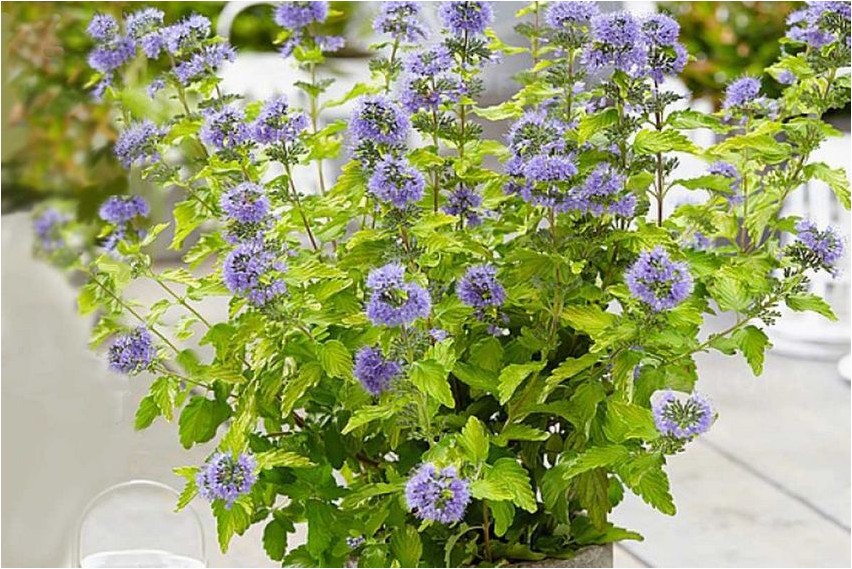
Caryopteris (lat. Caryopteris) is a genus of plants, represented in nature by deciduous shrubs, which appeared on the planet about fifty-five million years ago.
Since then, much has changed on Earth, which has had a detrimental effect on shrubs of this genus, and therefore there are fewer and fewer of them in the wild. Two of the dozen species existing in nature have attracted the attention of gardeners, and now Karyopteris can be found in summer cottages, unmistakably guessing the plant by the pleasant aroma exuding from its lilac-blue inflorescences.
Popular name
Many plants, along with the Latin name assigned to them by botanists, have names given to them by people far from science. So Karyopteris, growing freely in nature, is called by people “Nutwing” or “Bluebeard” for its long and abundant lilac-blue flowering.
Description
A deciduous shrub is distinguished by a large number of branches, which emerge into the world in strict order, forming a lush bush. The branches are easy to trim, contributing to the formation of the bush shape desired by gardeners.
Decorative carved leaves like to change color depending on the time of year. In spring they are bright green, celebrating the flourishing of life. Closer to autumn, the leaves begin to turn yellow or transform into the color of oranges. Some leaves turn brown. This variety of colors adorns the shrub during the absence of its fragrant flowers.
Purple-blue flowers bloom in abundant inflorescences, turning the bush into a kind of thick blue beard, exuding a pleasant aroma. The persistence of the aroma permeates the surrounding air for several meters around the bush, like a fashionista who passed by, and the aroma of her perfume lingers in the air for a long time, as if she does not want people to forget about her.

Two decorative species used in gardening
It so happened that out of a dozen species of shrubs of the genus Karyopteris, gardeners liked only two species, distinguished by their resistance to frost, not afraid of partial shade and giving the aroma of their sky-lilac inflorescences from mid-summer until the arrival of cold weather.
* Gray-haired Caryopteris (lat. Caryopteris incana) — you won’t pass by such a handsome man, growing up to 1. 5 meters, indifferently. Even its oblong-oval leaves, sporting a coarsely toothed frame and falling in late autumn, exude fragrance. When the greenery of a dense bush is complemented by lilac flowers collected in abundant inflorescences, the aroma increases tenfold, and the decorative effect becomes irresistible.
* Caryopteris clandonensis (lat. Caryopteris x clandonensis) — this species of Caryopteris owes its birth to the above-described species in collaboration with “Caryopteris Mongolian”, being their hybrid. In this way, Karyopteris Mongolian decided to stay longer on the planet, since, as an independent species, it is increasingly rare in nature, and therefore replenished the lists of the Red Book of the Russian Federation, which includes plants that need protection.
Like most children, the hybrid absorbed the best qualities of its parents into its genes. Flexible meter-long shoots form a lush, impressive bush. For lovers of compact bushes, breeders have developed a garden form of the hybrid, calling it “Karyopteris sky blue.”
The hybrid turned out to be quite cold-resistant, withstanding temperatures of minus 10 degrees. Even if its shoots freeze in the winter, the bush will show new shoots to the world in the spring.
The decoration of the hybrid is pubescent brownish-green leaves and lilac-blue flowers, collected in inflorescences.
Growing
Karyopteris”s tolerance to sunlight and partial shade is combined with its dislike of wind, and therefore it is necessary to protect the place where the shrub is grown from its intrusiveness.
Karyopteris is propagated by cuttings, planting rooted cuttings in open ground in the fall or spring. The plant”s unpretentiousness to soil, living in the wild on rocky areas, still has several exceptions. Karyopteris is not suitable for acidic soils, soils with excess moisture, or sandy soils. Water the plant only during prolonged drought.
It is better to maintain the relative cold resistance of Karyopteris by covering the bushes for the winter with available materials.
When planting more than one bush, a distance of up to 2 meters should be maintained between them, since the bush is distinguished by its enviable bushiness.