Abelia
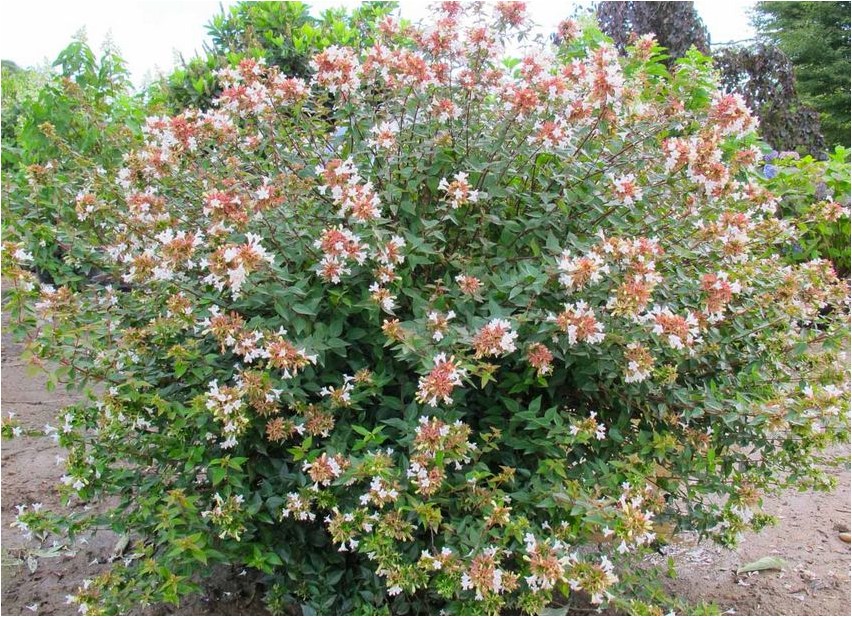
Abelia (lat. Abelia) is an ornamental plant; a genus of shrubs of the Linneaceae family; previously the genus was classified as a member of the Honeysuckle family. Under natural conditions, abelia grows in East Asia and Mexico.
The genus includes more than thirty species. The plant received its name in honor of the famous botanist, doctor and researcher Clark Abel.
Characteristics of culture
Abelia is a deciduous or evergreen, slowly growing shrub 1. 5-2. 5 m high; under favorable growing conditions it can reach a height of six meters. The leaves are opposite, pointed at the ends, oval in shape, dark green in color with a shine, arranged in pairs.
The flowers are tubular, bell-shaped or funnel-shaped, small or medium-sized, five-lobed, have a pleasant and distinct scent, and can be white, pink, purple or red. Flowering occurs from June to September, some species bloom until October. At the end of flowering, the leaves, densely located at the tips of the branches, fall off, and in their place remain reddish or purple sepals, thanks to which the plants retain their decorative properties until the onset of persistent frosts.
Growing conditions

Abelia is a light-loving plant that prefers well-lit areas. In hot climates, lightly shaded areas protected from northern winds are acceptable. For growing crops, well-drained, moderately moist soils with a rich mineral composition are desirable.
Reproduction and planting
Abelias are propagated by seeds, green and lignified cuttings, as well as root shoots. Most often, gardeners use the third method. During the growing season, the shrub is capable of producing a large number of root shoots; at the end of summer they are separated and planted in a permanent place.
An important factor in the successful propagation of abelia is maintaining an optimal temperature. If the temperature drops below 20C, young plants must be covered. Abelia is rarely propagated by seeds and cuttings, this is due to the difficulties of rooting.
Planting seedlings of the crop is carried out in early spring or autumn. The planting hole is prepared in advance; its depth should correspond to the size of the rhizome with the addition of 10-20 cm to the drainage layer in the form of pebbles or crushed stone. The soil taken out of the pit is thoroughly mixed with organic and mineral fertilizers and river sand.
Part of the resulting substrate is poured into the hole, then the seedling is lowered, covered with the remaining mixture, compacted, watered and, if possible, mulched. When planting in autumn, seedlings need shelter for the winter, otherwise they may die from frost.
Care
Abelia is an undemanding plant; caring for it does not take much time and can be done even by a novice amateur gardener. The main tasks in plant care are formative and sanitary pruning. To maintain the aesthetic appearance of the shrub, old, diseased and damaged branches should be removed immediately after flowering. Abelia can be given a special shape by cutting, but this procedure will have to be carried out quite often, since the plants grow very quickly.
During dry periods, abelias require moderate watering; if there is sufficient natural rainfall, the crop does not require watering. Fertilizing with mineral fertilizers is carried out in early spring. Since abelias are cold-resistant, there is no need for shelter for the winter.
An equally important procedure for caring for plants is the fight against pests and diseases. Abelias are often attacked by aphids; the pest leaves sugary secretions on the leaves, which subsequently lead to their blackening. To combat diseases and illnesses, it is recommended to use approved insecticides.
Application
Many types of abelia are often used in landscape design, since the plants are highly decorative not only during the flowering period, but also after it. Abelias are used in single and group plantings and in the design of recreation areas. Varieties distinguished by gracefully curved branches and fragrant flowers are an excellent addition to gazebos, benches and other garden decorative elements.
Abelias are often used as hanging plants; they are grown in large flowerpots that decorate porches, terraces and other rooms. Since the crop easily tolerates formative pruning, it is actively used in the design of hedges.