Mamoncillo
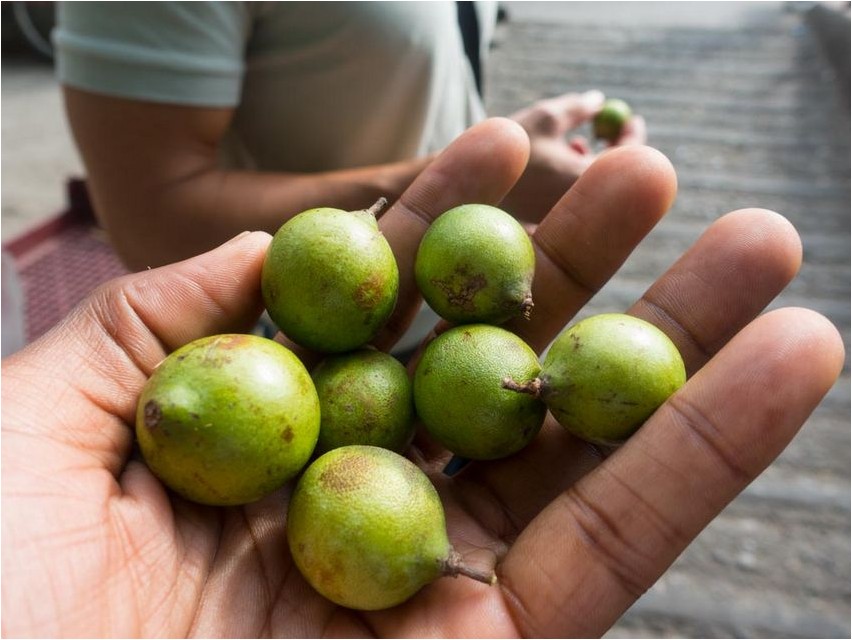
Mamoncillo (lat. Melococcus bijugatus) is a fruit crop, which is the brightest representative of the large Sapindaceae family and is sometimes called Melococcus bijugatus or Spanish lime.
Description
Mamoncillo is a tree with a smooth and straight trunk, from which many spreading branches extend. It can grow up to twenty meters in height. Mature trees are covered with grayish bark, while the bark of young branches is painted in pleasant reddish tones. As for the thickness of the trunks, it can sometimes reach 1. 7 meters. The length of the pointed elliptical leaves of mamoncillo ranges from five to twelve and a half centimeters, and their width ranges from 3. 25 to 6. 25 cm.
The white flowers of this plant, forming thin tassels, reaching a length of six to ten centimeters, are always very fragrant. As a rule, female and male flowers are located on different trees, but sometimes you can find specimens on which both flowers grow. Such trees are usually classified as an independent subspecies. All flowers are very attractive to a wide variety of insects (bees especially love them) and are considered excellent honey plants — incredibly fragrant dark honey is extracted from them.
The round fruits of mamoncillo are characterized by quite impressive weight and very high density. Unripe specimens are covered with a smooth green skin, while the surface of the ripened fruit boasts a firm, leathery texture. In appearance, mamoncillo is very similar to a lime — it is for this similarity that it is nicknamed the Spanish lime. The pulp of the fruit is yellowish or orange-pink, juicy, transparent and slightly jelly-like in consistency. As for the taste, it can be either sweet or sweet and sour. And inside the fruits you can find one or two large yellowish-whitish seeds.
Where does it grow
Mamoncillo is native to Colombia, French Guiana, Suriname, Guyana and Venezuela. In addition, this crop is grown in Ecuador, in a number of Central American countries, as well as in the Bahamas and Antilles. In 1914, mamoncillo was brought to Bermuda, but there the trees grew only nine meters high, and none of them bloomed.
Application
Mamoncillo can be eaten fresh, with the peel included. In addition, the pulp of these fruits makes excellent preserves, as well as jellies and jams. And in Colombia, wonderful canned juice is made from mamoncillo, which is subsequently supplied to other countries.

You can also eat fried mamoncillo seeds — their taste is very reminiscent of the well-known French fries. Such seeds will become indispensable helpers for diarrhea. And to get rid of a number of intestinal ailments, they do enemas with a decoction of mamoncillo fruits.
As for the leaves, they are excellent at repelling insects — the residents of Panama systematically place them in the corners of their houses to repel fleas.
Mamoncillo wood is also in demand. It is very practical, fine-grained and hard — these properties make it an excellent raw material for the manufacture of furniture and many other joinery products.
Contraindications
Mamoncillo is a rather allergenic fruit, and people prone to allergies should definitely take this into account.
Growing and care
Mamoncillo is a crop that is well adapted to dry subtropical and tropical conditions and boasts impressive drought resistance. This plant is completely undemanding when it comes to soil — it bears fruit equally well in a wide variety of soils. But Mamoncillo simply loves limestone, and it doesn’t matter at all whether these soils are enriched.
This crop can withstand minor frosts, but they have a rather detrimental effect on its yield. And mamoncillo propagation occurs not only by seeds, but also by vegetative means — it can easily be grafted even onto related trees.