Gray alder
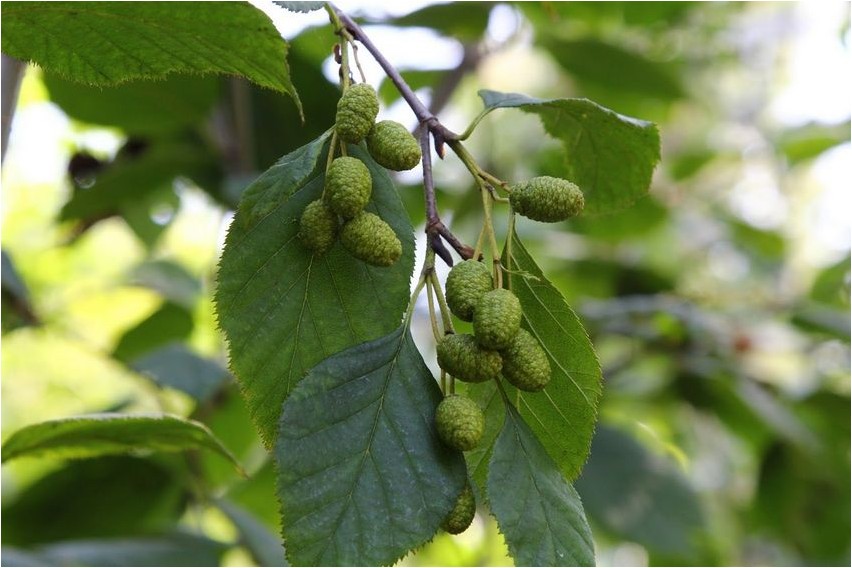
Gray alder is one of the plants of the birch family; in Latin the name of this plant will be as follows: Alnus incana (L.) Moench.
As for the name of the gray alder family itself, in Latin it will be: Betulaceae S. F. Gray.
Description of gray alder
Gray alder is a medicinal tree or a large shrub, the height of which can reach twenty meters. Such a plant will have light gray bark. The root system of this plant is superficial, the lateral roots will be thickened and coral-like branching with mycorrhiza. The leaves of gray alder are alternate and they will be located on soft-haired or tomentose-pubescent petioles. In shape, such leaves can be ovate, oval and broadly elliptical, and they will also be pointed, but less often they can be blunt, and they are double-serrate along the edge. When young, such leaves will be densely pubescent; later they turn out to be almost bare on top and hairy, and colored gray-green underneath. Gray alder flowers are in catkins and dioecious. Male earrings are long, they are collected in two or three pieces in the upper parts of the shoots themselves, while female earrings will be short and oval, and almost sessile; when ripe, they will turn into elliptical cones, the length of which reaches fifteen millimeters, and they will be colored black and brown. The fruit of this plant is a flat, single-seeded nut, endowed with rather narrow membranous wings.
The flowering of gray alder occurs in the period approximately in May-April even before the leaves appear, while the ripening of the fruits occurs in the period from August to October. Under natural conditions, this plant is found in Ukraine, Belarus, the European part of Russia and the Caucasus. For growth, this plant prefers the banks of rivers and lakes, the outskirts of swamps, forest edges, clearings in forest and forest-steppe zones.
Description of the medicinal properties of gray alder
Gray alder is endowed with very valuable healing properties, and it is recommended to use the fruits of this plant for medicinal purposes. It is recommended to harvest such medicinal raw materials in the autumn or winter, at a time when such alder cones will completely become lignified.
The presence of such valuable healing properties is recommended to be explained by the content of tannin, organic acids, gallic acid, alkaloids, hyperoside and quercitrin glycosides, flavonoids, as well as the following acids: chlorogenic, protocathesic and caffeic.

The cones and bark of this plant are endowed with very effective disinfectant, astringent, anti-inflammatory, diaphoretic and hemostatic effects. An infusion prepared from alder cones, as well as a decoction of the bark, is indicated for use in dysentery, acute and chronic enterocolitis, and also as an adjuvant in complex treatment with antibiotics. An infusion of sulfur alder cones will help reduce fermentation and putrefactive processes during colitis in the intestines, and will also quickly normalize stool.
It should be noted that the cones of this plant are part of stomach tea. As for traditional medicine, here this plant is used quite widely as a hemostatic and fixative for bleeding from the gums and nose. In addition, this remedy is used for gout, rheumatism and colds. It is recommended to gargle and gargle with a decoction based on the bark of this plant, which will help strengthen the gums.





