Buckwheat
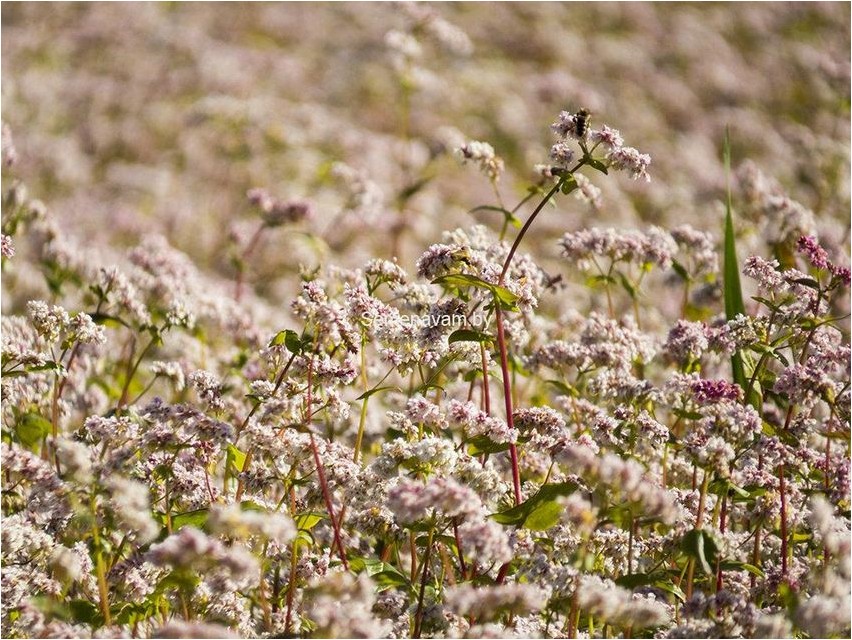
Buckwheat is one of the plants of the family called Buckwheat; in Latin the name of this plant will be as follows: Fagopyrum sagittatun Gilib.
As for the name of the buckwheat family itself, in Latin it will be: Polygonaceae Juss.
Description of buckwheat
Buckwheat is an annual herbaceous plant whose height will vary between fifteen and seventy centimeters. The stem of this plant is straight, while in the upper part it will be bare and branched, and such a stem can be colored in both green and reddish tones. The leaves are yellow, alternate and heart-shaped, they are endowed with an arrow-shaped base, as well as a checkered bell, which is located at the very base of the petioles of the lower leaves. The upper leaves of this plant will be sessile. The flowers are small and quite fragrant, fragrant and endowed with a simple perianth. The color of such flowers will be white and pink, such flowers are collected in brushes. The fruits are triangular achenes.
Flowering of buckwheat occurs during the period from June to July. It should be noted that buckwheat is cultivated as a cereal and honey plant in Russia, Belarus and Ukraine.
Description of the medicinal properties of buckwheat
Buckwheat is endowed with quite valuable medicinal properties, and for medicinal purposes it is recommended to harvest the tops of flowering leafy stems: seeds and grass. Such raw materials should be collected during the flowering of the plant and as the seeds ripen. Such buckwheat raw materials should be dried in the fresh air in the shade or in dryers, where the temperature is about thirty to forty degrees Celsius, and it is also possible to dry in attics, where there is very good ventilation.
The presence of such valuable healing properties is explained by the fact that the herb of this plant contains the glycoside rutin, as well as caffeic, gallic, chlorogenic and protocatechuic acids. Buckwheat grains contain protein, sugar, starch, fat, fiber, vitamins of groups B, P, PP, as well as malic and citric organic acids, and in addition the following minerals: iron, zinc, calcium salts, phosphorus, boron, nickel, iodine and cobalt.

The leaves and flowers of this plant are used similarly to vitamin P for the treatment of vitamin deficiencies, for the prevention and treatment of cerebral hemorrhages, as well as for the treatment of retinal eyes with a tendency to hemorrhages in the skin, hypertension, rheumatism, measles, scarlet fever, typhus. In addition, such drugs are also used for the prevention and treatment of vascular damage, radiation sickness, salicylates, arsenic compounds, and radiotherapy.
As for traditional medicine, buckwheat leaves, flowers and flour sifted through a fine sieve are widely used here. As an expectorant, it is recommended to prepare the following infusion from the flowers of this plant: at the rate of forty grams per liter of water. This remedy is used for dry cough, and an aqueous infusion of buckwheat flowers is used for leukemia and sclerosis. Fresh leaves of this plant can be applied to abscesses and festering wounds. In the form of baby powder, you can use dry flour, which is first sifted through a sieve.
If you are prone to hemorrhages, it is recommended to use the following remedy: to prepare it, take fifteen grams of the flowers of this plant per half a liter of boiling water. Then the resulting mixture is infused for two hours in a sealed container, after which the mixture is carefully filtered. It is recommended to take one third of a glass three to four times a day before meals.





