Kitagavia turpentine
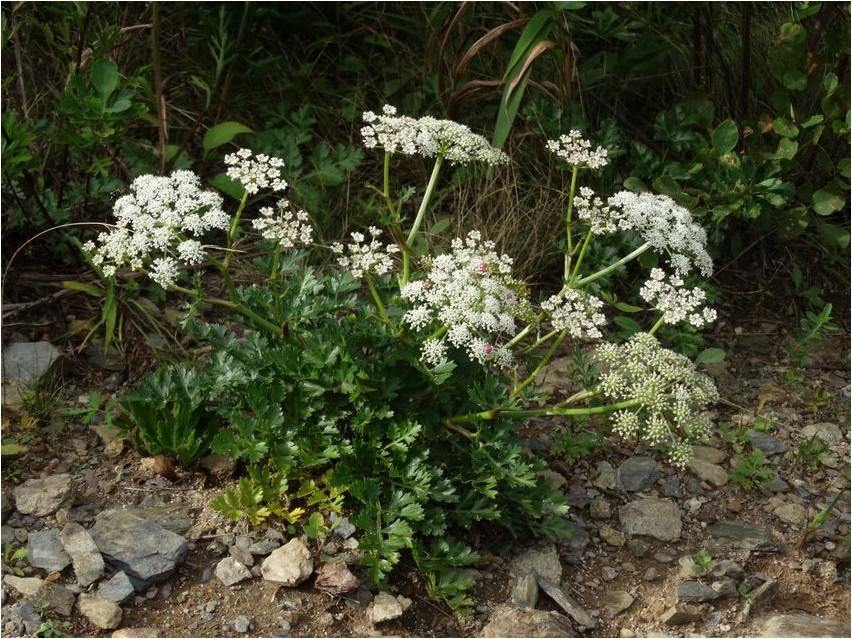
Kitagavia turpentine is one of the plants of the family called Umbellaceae; in Latin the name of this plant would be as follows:
Kitagavia terebinthacea (Fisch. ex Spreng.) M. Pimen. (Peucedanum terebinthaceae Fisch. ex Spreng., P. deltoideum Makino ex Vabe). As for the name of the Kitagavia turpentine family itself, in Latin it will be: Apiaceae Lindl.
Description of Kitagavia turpentine
Kitagavia turpentina is a perennial herbaceous plant whose height will vary between twenty-five and one hundred centimeters. The root of this plant is straight and quite thick, its thickness is approximately five to seven millimeters. The stems of this plant are round, their height is about forty to eighty centimeters, such stems will be endowed with longitudinal stripes at the top or almost from the very base. It is noteworthy that the stems of this plant will be more or less branched; under the inflorescence they are rough. The basal leaves of Kitagavia turpentine are on rather long petioles, their plate is double-pinnate and broadly oval, the length of such leaves is six to eight centimeters, and the width is about five to seven centimeters. The umbrellas of this plant are on the upper side with ten to thirty-five sharply rough rays, and in diameter this length will be about seven to fifteen centimeters. The diameter of the kitagavia turpentine umbrella will be about ten millimeters, the petals will be colored either pinkish or white, and the shape of such petals will be almost round. The length of the petals of Kitagavia turpentine will be about one and a half millimeters, the width will be equal to a similar value, and the midrib of such petals will be colored in yellowish tones. The fruits of Kitagavia turpentine are oval-round in shape, their length is three to four millimeters, and their width is about two and a half to three millimeters.
Kitagavia turpentine blooms from July to August. Under natural conditions, this plant is found in the Far East and in the Daursky region of Eastern Siberia. For growth, the plant prefers thickets of bushes, dry slopes, rocks, terraces, seaside cliffs and dry oak forests.
Description of the medicinal properties of Kitagavia turpentine
Kitagavia turpentine is endowed with very valuable healing properties, and it is recommended to use the herb of this plant for medicinal purposes. The term grass includes flowers, stems and leaves.
The presence of such valuable healing properties should be explained by the content of the steroid beto-sitosterol in the roots of this plant, as well as the following coumarins: peucedanin, marmesin and deltoin. The herb of this plant also contains coumarins, while the fruits contain marmesin and fatty oil, in turn, this oil also contains petroselinic acid.

As for Chinese medicine, a decoction prepared from the roots of this plant is quite widespread. This very effective healing agent is recommended for use in acute respiratory diseases and rheumatism, and also as a detoxifying agent. For colds, baths based on the herb Kitagavia turpentine will be effective. The leaves and flowers of this plant should be used as a poultice for paralysis and arthralgia.
For rheumatism and rheumatoid arthritis, it is recommended to use the following remedy: take ten grams of roots per three hundred milliliters of water. This mixture is boiled for seven minutes, left for an hour and filtered. This remedy should be taken one third of a glass five times a day before meals.





