Lambert Pine
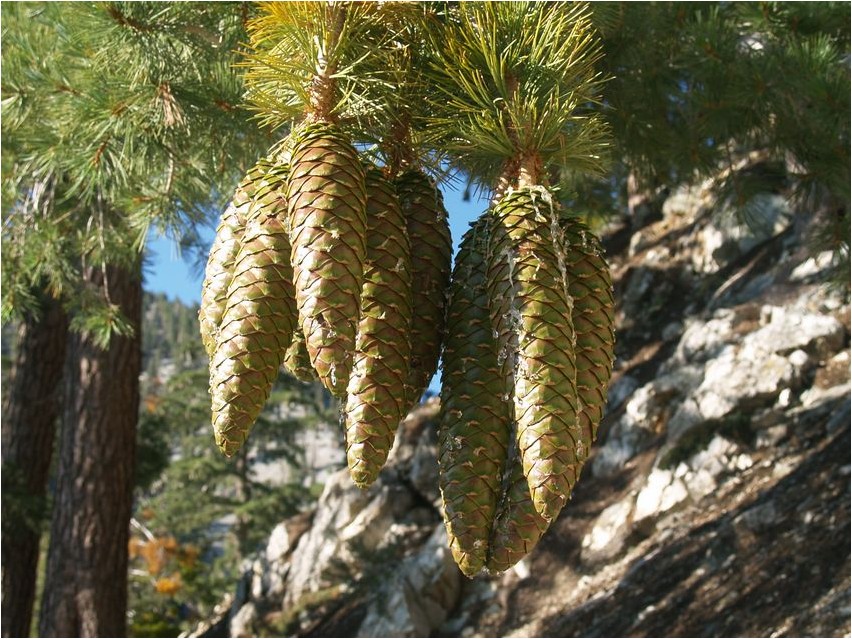
The Lambert Pine (Pinus lambertiana)—commonly known as the “Sugar Pine”—has been awarded several epithets beginning with the word “most.”
It is the tallest of all pine trees growing on Earth; it is the largest, most massive, and thickest-trunked of any known pine tree on the planet; the Lambert Pine has the longest cones of any conifer, though not quite as heavy as those of the Coulter Pine (Pinus coulteri). Inside these long cones are edible, nutritious nuts, similar to our popular pine nuts. The Lambert Pine is a respected species of the numerous genus Pinus in the Pine family (Pinaceae), whose vessels flow with sweet resin. What”s in a name?
In the generic name “Pinus” of numerous conifers, botanists, according to one theory, reflected the resinous nature of these plants, while another theory suggests the tree”s fondness for perching on steep cliffs, demonstrating its strength and resilience. After all, the Latin word “pix” means “resin,” and the Celtic word “pin” means rock, and both could well have served as the starting point for the genus name.
In the specific epithet “lambertiana,” Scottish botanist David Douglas, who named another pine, the ponderosa pine (Latin: Pinus ponderosa), commemorated another English botanist, Aylmer Bourke Lambert. Lambert wrote a number of works describing many coniferous species discovered by other botanists, including David Douglas. The common name “Sugar Pine” comes from the sweet resin that runs through the tree”s veins. Native Americans use the resin of the Lambert Pine as a sweetener for certain dishes. According to John Muir, a Scottish-American wildlife conservationist, the sweet resin of the Pine is preferable to maple sugar. Muir was a great admirer of the Lambert Pine, calling it the “king of conifers.”
Description
Unfortunately, it”s not just humans who love sweets; many insect pests do too. Unfazed by the plant”s strength and power, they readily attack even the largest pine tree, the Sugar Pine. Officially registered at 82. 05 meters tall, the Sugar Pine, the second-tallest pine on record, fell victim to bark beetles, dying in 2007 from their voracity.
The tallest tree, currently living, grows in Yosemite National Park in California. It stands 83. 45 meters tall.
The long, straight branches of the Sugar Pine are covered in clusters of leafy needles, each consisting of five needles ranging from 6 to 11 centimeters in length. Large cones are located at the ends of the branches, the weight of which causes the branches to bend slightly toward the ground. A particularly notable feature of the Pine is its large cones, which range from 25 to 50 centimeters in length, reaching up to 66 centimeters in exceptional cases. These are the longest cones of all conifers, but are lighter than those of the Coulter Pine (Pinus coulteri). Although the latter reaches a maximum length of 37 centimeters, Coulter Pine cones weigh up to 5 kg, which cannot be said for the cones of the Sugar Pine. In any case, standing under these pine species with an unprotected head is dangerous to a person.

The seeds (nuts) are also quite large, up to 1. 2 centimeters long. In composition, they are similar to our homegrown nutritious pine nuts and are also edible.
Pines — drzewa niezwykłe. Odcinek 5.
Lambert”s Pine
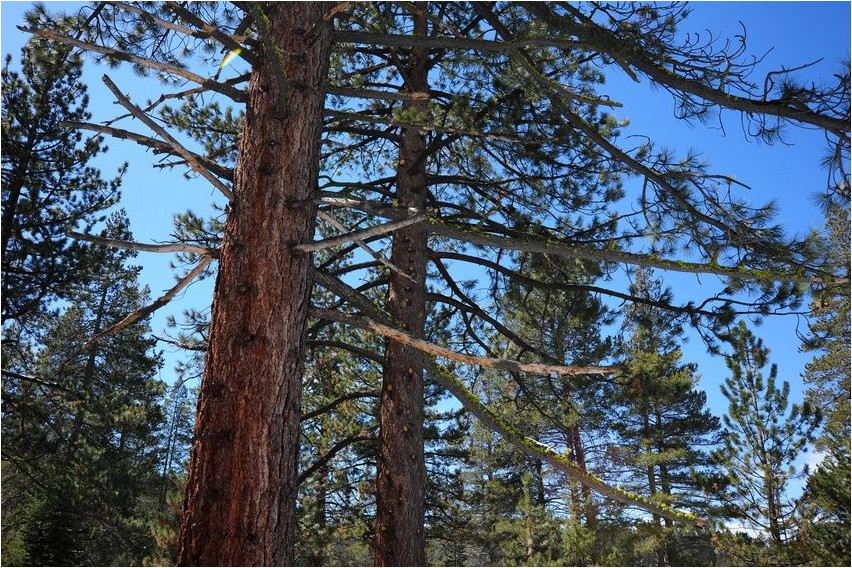
Lambert”s Pine





