Daphne mesereum L.
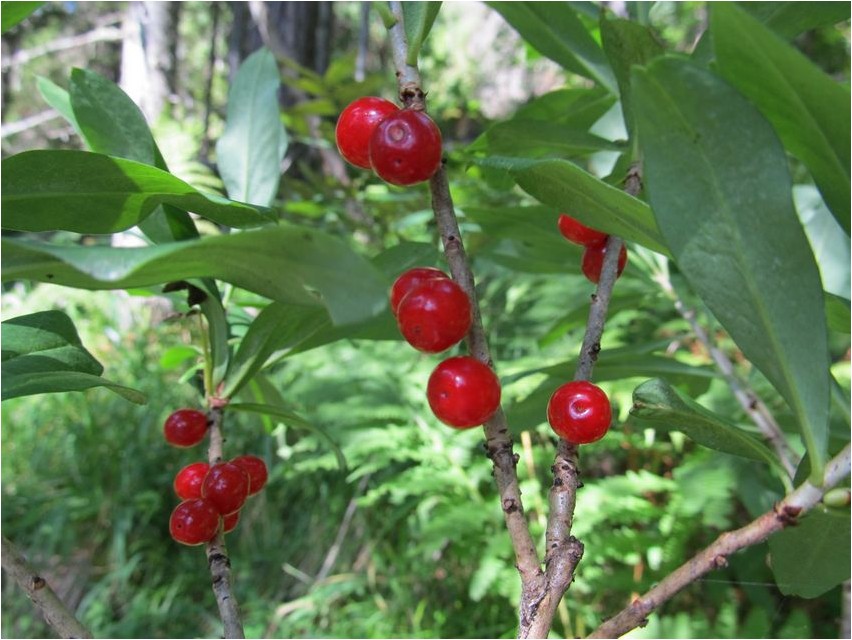
Daphne mesereum L. is a member of the Daphne family. Its Latin name is Thymelaeaceae Juss.
Description of Daphne mesereum
Daphne mesereum L. is a shrub that grows to a height of approximately thirty centimeters (about two meters). The bark is yellowish-gray and wrinkled. The stems are erect, and the leaves are alternate, clustering toward the ends of the branches. These leaves are bluish-dark green and oblong-lanceolate in shape.
The flowers are dark pink, quite fragrant, and open before the leaves emerge. The perianth is simple and corolla-shaped, tubular with a four-lobed limb. There are eight stamens, and the pistil is quite small with a capitate stigma. The fruit is a juicy, oval, red drupe.
Dwarf wolfberry can be found throughout Ukraine, Belarus, the Caucasus, and the European part of Russia, with the exception of the Black Sea and Lower Volga regions. This plant is found throughout Western Siberia, as well as in the Angara-Sayan region of Eastern Siberia. It prefers shady, moist coniferous and deciduous forests, as well as clearings, river valleys, limestone and gypsum outcrops, and also shady mountain forests from the lower mountain belt to high-altitude sparse forests. In fact, this plant sometimes forms thickets. Common wolfberry is a honey plant and insecticide, and is distinguished by its particularly decorative appearance. It’s worth noting that this plant is also poisonous.
Description of the medicinal properties of wolfberry
The leaves, fruits, branches, and roots of this plant are recommended for medicinal purposes. Wolfberry contains catechins, sucrose, flavonoids, and the following coumarins: daphnin, daphnetin, and umbelliferone. In addition, the diterpenoids mazerein and daphnetoxin have been found in the plant. Traces of essential oil and coumarins, as well as fatty oil, alkaloids, coumarins, and diterpenoids, have been found in the fruits of this plant.
A decoction prepared from the roots of thistle is used as a hypnotic and also as an antiepileptic drug for malignant diseases. As for the decoction of the branches, it is used for various gastrointestinal diseases and colitis, which is due to the fact that the plant is endowed with protistocidal properties. In the old days, the crushed bark of this plant was applied to the bites of poisonous snakes and rabid dogs. The bark tincture is recommended for external use as an irritant for neuralgia, gout, rheumatism, tumors, paralysis, scrofulosis and boils.

As for scientific medicine, here the tincture of the bark of the branches of the cleft wolf is used as an antineuralgic agent. Also, tincture, ointment and extract of the bark of this plant are used both in homeopathy and in folk medicine for fever, toothache, cough, thrombosis, sore throat, stomach cancer, tumors of the esophagus and pharynx. This remedy also turns out to be especially effective for conjunctivitis, ascites, dermatomycosis and as a laxative.
As a laxative and for ascites, the following remedy is recommended: take half a liter of boiling water for one teaspoon of crushed leaves, and then infuse this mixture for two hours. This remedy should be taken once a day, one tablespoon.
Daphne blooms (Daphne mezereum), wolf’s bast, common wolfberry





