Eubothrioides graya
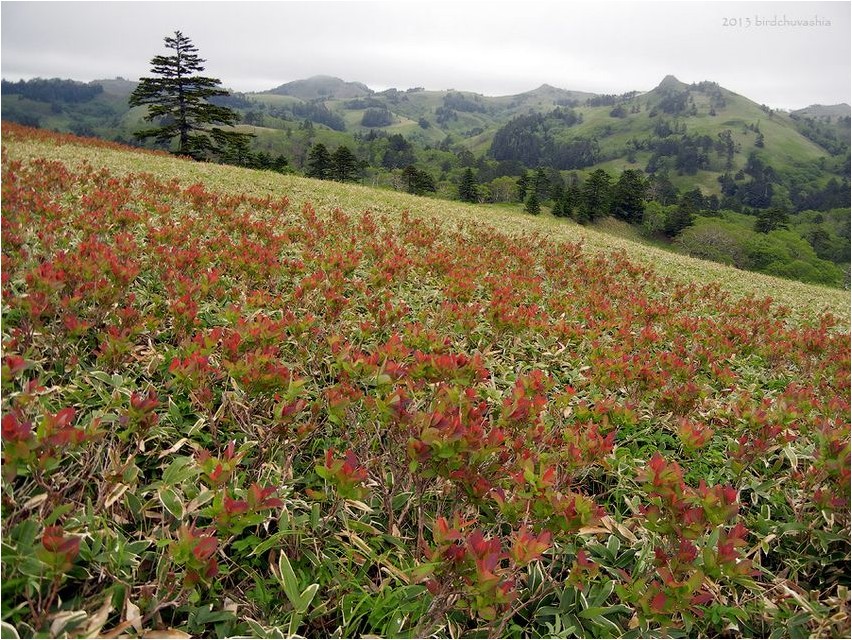
Eubotryoides grayana is one of the plants of the family called Ericaceae; in Latin the name of this plant will be as follows: Eubotryoides grayana (Maxim.) Naga.
As for the name of the Eubothrioides gray family itself, in Latin it will be: Ericaceae Juss.
Description of Eubothrioides gray
Eubotrioides graya presents itself as an erect and dichotomously branched shrub, the annual shoots of which are smooth and shiny, and ocher-yellow. The old branches of this plant will be sessile, they are colored in light gray tones, they will most often be elliptical in shape, and sometimes they can be either oblong or ovoid. The length of such branches will be about two to nine and a half centimeters, and the width can vary between one centimeter and six centimeters. Above, such branches will be bare, and below along the veins they are bristly and hairy. The length of the raceme is six to twelve centimeters, the raceme will consist of ten to twenty flowers, and in the upper axils there are single flowers. The length of the corolla is four and a half to six millimeters; the shape of such a corolla will be spherical, and the limb lobes will be triangular. The corolla of this plant is half as long as the tube itself; the diameter of the box is about four to five millimeters.
Bisexual small flowers can be colored either greenish-white or pinkish. The flowers are five-membered, they are endowed with an almost completely dissected calyx and a fused-petalled corolla, the tube of such a corolla is longer than the limb and the corolla contains ten stamens. The capsules of this plant are quite small, they are bare or pubescent, and also flattened-spherical.
Eubotrioides graya blooms from June to July, and fruiting occurs in August. Under natural conditions, this plant can be found in the Far East: namely on Sakhalin, the Kuril Islands, Shikotan and the Kunashir Islands. As for the general distribution, this plant can be found in Japan. For growth, this plant prefers places among birch and alder forests, broad-leaved forests, edges of dark coniferous forests and slopes up to the upper mountain belt. Sometimes the plant can form small thickets, which is made possible by the formation of rather long rhizomes.
Description of the medicinal properties of Eubotrioides graya
Eubotrioides grayii possesses valuable medicinal properties, and its leaves are recommended for medicinal purposes. A decoction and juice of its leaves should be used for leukoderma and scabies, and also as an antiparasitic, anthelmintic, and insecticidal agent. Experiments have shown that the leaves of this plant can paralyze the motor nerve endings and the respiratory center, and also lower blood pressure.

For scabies and leukoderma, the following Eubotrioides grayii-based remedy should be used in the form of lotions and compresses: to prepare this remedy, take one tablespoon of crushed leaves per glass of water. The resulting mixture should be boiled for three to four minutes, then left to steep for two hours, after which the mixture should be thoroughly strained. The following solution based on this plant is recommended as an insecticide: to prepare it, take five tablespoons of crushed leaves per liter of water. The resulting mixture is recommended to be boiled for five to six minutes, then left to steep for one hour, after which the mixture is thoroughly strained.
DANGEROUS DISEASES: WHITE MOLD and GRAY MOLD





