Hazel
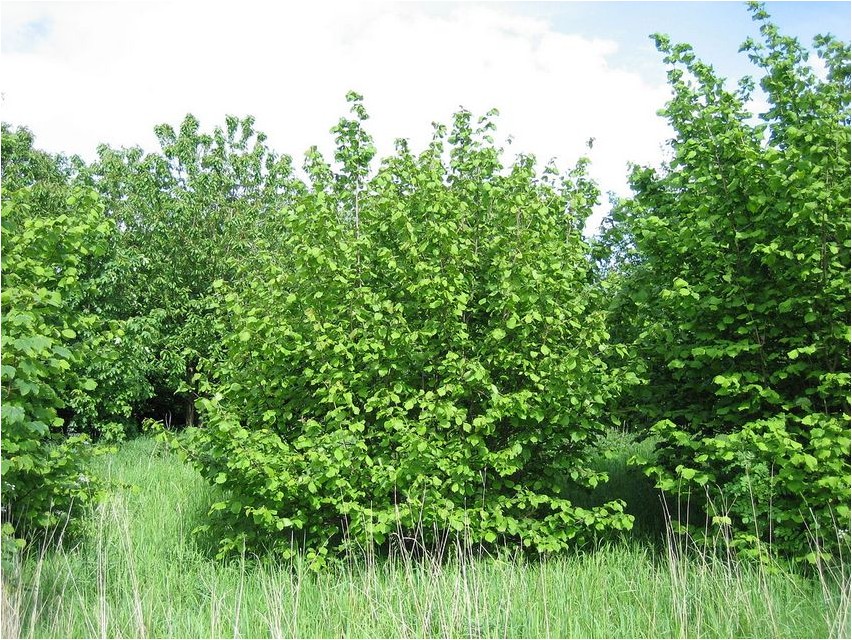
Hazel (lat. Corylus) is a nut crop; shrub or tree of the Birch family. Another name is hazel. Under natural conditions, hazel grows in coniferous-deciduous forests in Eurasia and North America.
Currently, the species that is especially popular among gardeners is the common hazel. In the Crimea and the Caucasus, large hazel, or Lombard nut, is widely cultivated. In total, about 20 species are known. Many species are used not only as nut-bearing plants, but also for landscaping garden plots and parks.
Characteristics of culture
Hazel, or hazel, is a deciduous shrub or tree 4-10 m high, sometimes up to 25 m, with beautiful broad-oval leaves and elegant catkins formed in the spring, valuable wood and nutritious nuts in the fall. With the onset of warmth after a long winter, the buds of the plants burst and quickly open with an obvious crack of the bud scales, heard throughout the entire area. The leaves are simple, large, similar in appearance to the body of a fish, or rather a bream, which is where the name of the culture comes from. In autumn, the leaves turn yellow, orange or red, and varieties with golden and purple leaves have recently been developed. Some forms are distinguished by intricately curved branches, which makes them even more decorative.
The advantages of the crop are considered to be early fruiting, relatively rapid growth and longevity. Under favorable growing conditions, hazels bear fruit for 80-150 years. Plants have a powerful root system, so they are often used to strengthen ravines and slopes. Hazel is frost-resistant; only the flowers can be damaged by spring frosts. Hazel pollen is a strong allergen. The flowers of the crop are unisexual: the male flowers are collected in thick cylindrical catkins located on short petioles, and the female flowers are collected in bud-shaped inflorescences sitting in the axils of the bracts. The fruit is a single-seeded, woody nut surrounded by a plus, formed from one bract and two pre-leaves of the female flower.
Growing conditions

Hazel is not demanding in terms of growing conditions and is not whimsical in many respects. However, it develops better in illuminated areas with fertile, well-moistened, slightly acidic or alkaline soil. Hazel does not accept saline and waterlogged soils.
The crop is also sensitive to compacted soils, which is directly related to the superficial root system. The plant is shade-tolerant and can easily grow in semi-shaded areas with diffused light. Forms with red leaves become less bright in the shade, but in general the appearance does not change.
Reproduction and planting
Zinnias are propagated by seeds, root suckers, layering, shoots and dividing the bush. Some forms are also propagated by cuttings and grafting. Kidney vaccination is carried out in early August, this is the most optimal time. Cuttings are harvested in the fall. Other types of propagation are also carried out in the fall, or rather a couple of months before the onset of stable frosts, otherwise the planting material will not have time to take root and will die.
When propagating hazel by seed, the nuts are sown in the ground immediately after harvest. They are pre-moistened in kerosene, this is necessary so that they are not damaged or eaten by rodents. In regions with arid climates, seeds are stratified and planted in the ground in late autumn under cover.
Spring sowing is not prohibited. The nuts are soaked in water for about five days, after which they are stratified for four months in sand in a cool room with a temperature of 0-5C. At the end of stratification, the nuts are placed in snow and then planted in the ground. Overdried nuts are stratified for about a year, otherwise they will not sprout.
Care
The soil in the tree trunk zone is regularly loosened and mulched. Every year the plants are fed with mineral fertilizers; nitrogen and phosphorus fertilizers have a good effect on the growth and productivity of the crop. Excess potassium fertilizers lead to a decrease in nut yield. Organic matter is added once every three years. Watering is rare, during drought. Thinning pruning is carried out in the fifth year, formative and rejuvenating pruning — annually in March.
It is better to grow hazel as a standard tree; this approach simplifies care and increases productivity. In winter, the lower branches of the plants are bent to the soil surface and covered with snow. Hazel is prone to various diseases and pests, the most dangerous for the crop are: gray rot, anthrocnose, nut weevil and bud mite.