Paris
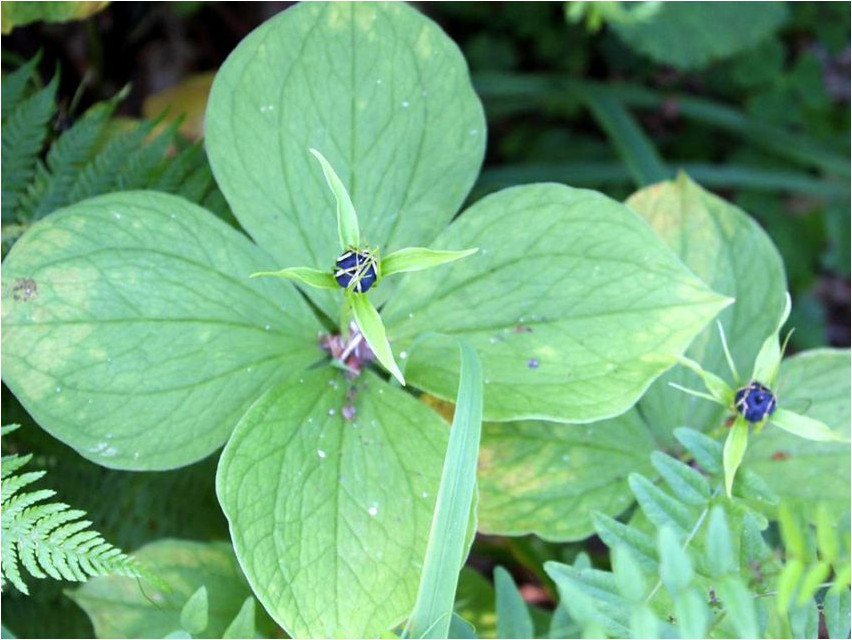
Paris (lat. Paris) is a small genus of the Liliaceae family. The more popularly known name is raven eye. Typical places of growth in nature are wet forests and bushes.
It is found most often in European countries and some regions of Asia. A peculiarity of the genus in question is its family ties with Trillium (a genus of perennial plants of the Melanthiaceae family).
Characteristics of culture
Paris is represented by perennial plants no more than 50 cm high, endowed with a creeping elongated rhizome and stems crowned with a whorl of foliage that forms at the top. The perianths of paris are separate, consisting of eight leaflets – outer and inner. The fruits are in the form of multi-seeded berries, black in color with a bluish bloom. Absolutely all representatives of the genus are classified as winter-hardy; they feel great even in the conditions of Siberia and the Urals. However, in cold, snowless winters, plants need to mulch the root system with insulating material.
It is worth noting that during the summer, parises grow only one (maximum two) shoot, and with the onset of cold weather it dies. The advantage of the plants is their ability to develop in the shade and in damp areas; accordingly, they can and should be planted to decorate empty areas on the shady side of the house or fence. The main thing is to provide a drainage layer and add organic fertilizers (humus or rotted manure is best).
Paris are long-lived and, given a humid climate and warm weather, they form huge colonies. A different situation occurs with prolonged drought, heat and a complete lack of irrigation. By the way, parises do not bloom abundantly; they can only be used for landscaping voids. The plants form only one flower with bright yellow ray-shaped petals that look very similar to spokes.
Types of Paris
Among the famous species, it is worth noting the axial paris (lat. Paris axialis). It is represented by low-growing plants, the stem of which is crowned with heart-shaped foliage with purple petioles, often with a reddish tint. The plant is also characterized by a short peduncle, which rises above the leaves and pleases with yellow petals.

No less interesting is the appearance of Farges’s Paris (Paris fargesii). He, like the previous representative of the genus, cannot boast of tall growth, but he is characterized by rather large foliage with sharp tips. As a rule, the foliage is sessile, less often petiolate. The flowers are yellow, with a green tint.
Paris Maire (lat. Paris mairei) is one of the most attractive species. It is characterized by blue-green foliage, equipped with wavy edges and green, clearly visible veins. The flowers, like most paris, have yellow spoke-shaped petals and purple bracts. Externally, the species in question is similar to the Luguan paris, however, its foliage has silvery veins.
Paris multileaf is very common in China. This is a relatively tall representative of the genus compared to other species. Often its height exceeds 50 cm. The plant is crowned with narrow foliage, which flaunts on a short stem, and a flower consisting of greenish-yellow thread-like petals in the amount of 4-6 pieces.
The paris verticillata (lat. Paris verticillata) cannot be compared with the above-described species. It is dwarf in height, usually not exceeding 20 cm. It is characterized by blue-green foliage that has a pale stripe in the central part. The flowers are yellow with a green tint, and have petals turned down.
The most common species in Russia is considered to be the common paris (lat. Paris quadrifolia). People call it the raven’s eye. It is fashionable to capture it in nature in Siberia, the Urals and the Caucasus. Mainly grows in the taiga zone. It is a plant up to 35 cm high with obovate leaves, collected in a whorl and sitting on shortened petioles.





