Palmyra palm
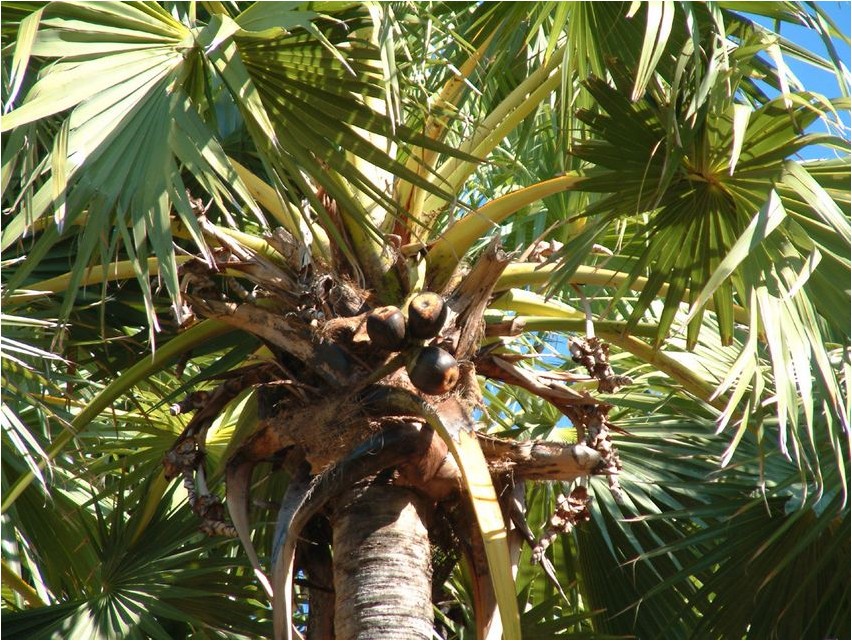
Palmyra palm (lat. Borassus flabellifer) is a fruit crop belonging to the large Palm family.
Description
The palmyra palm is a woody plant that grows up to twenty meters in height. And if conditions are especially favorable for its growth, it can stretch thirty meters upward. Each tree is endowed with bluish-greenish leaves and incredibly dense crowns, and their life expectancy almost never exceeds a hundred years. Immediately, as soon as such a palm tree sprouts from a seed, it grows extremely slowly, but as it matures, the intensity of its growth also increases.
The fruits of the palmyra palm reach from four to seven centimeters in diameter. Outwardly, they are somewhat reminiscent of coconuts, and on top they are covered with a rather peculiar husk, which can have either a purple or dark red or almost black color.
Where does it grow
The palmyra palm originates from Sri Lanka and distant India — it is there that it has been cultivated since time immemorial, since in these states it is assigned a colossal economic role.
Application
People mainly consume the fibrous outer layer of the fruit — it is eaten fresh, and also fried or boiled. And from the sweet juice of the plant they make excellent palm sugar.
However, this plant is mainly used to obtain a very healthy drink, “toddy,” which is extracted directly from the trunks (by analogy with the well-known birch sap). In Ayurveda, such juice is considered a very effective remedy for curing diseases of the spleen and liver.

The fruits of this crop are very rich in all kinds of microelements and vitamins — this “richness” makes them an excellent remedy for healing various gastrointestinal diseases. And their systematic use helps to quickly restore strength after quite serious mental or physical overload.
The peel of the fruit is rich in anthocyanins, which makes it an incredibly effective preventative against cancer (especially breast cancer). Moreover, it will provide invaluable assistance in curing such ailments.
Until humanity had neither medicines nor a vaccine for the ill-fated chickenpox, the juicy fruits and juice of this palm tree were considered for quite a long time the only effective medicine against the fever caused by this condition — the temperature of those who became ill quickly dropped, and in general the recovery process was much faster.
Regular consumption of these unusual fruits helps reduce the amount of white discharge in women. Furthermore, these fruits are beneficial for hyperacidity in the stomach, as well as various digestive problems and constipation.
The leaves of this palm tree have been used as paper since ancient times. To obtain paper, they are dried and cut. Typically, up to four pages of papyrus can be obtained from a single palmyra palm leaf.
The spiny stems of the leaves make excellent fences. And if you remove the surface parts of the stems, you can obtain excellent raw material for weaving rope.
Recently, this plant has also begun to be used in the cosmetics industry — substances that help close pores have been discovered in the surface parts of the stems and leaves. Contraindications
Palmyra palm fruits don”t have any specific contraindications, so in this case, it would be advisable to focus solely on individual intolerance.
Indoor palm tree care🌴 Apartment landscaping with hitsad
https://www. youtube. com/watch? v=wmF1rmikSpU
Palmyra palm