Pineapple
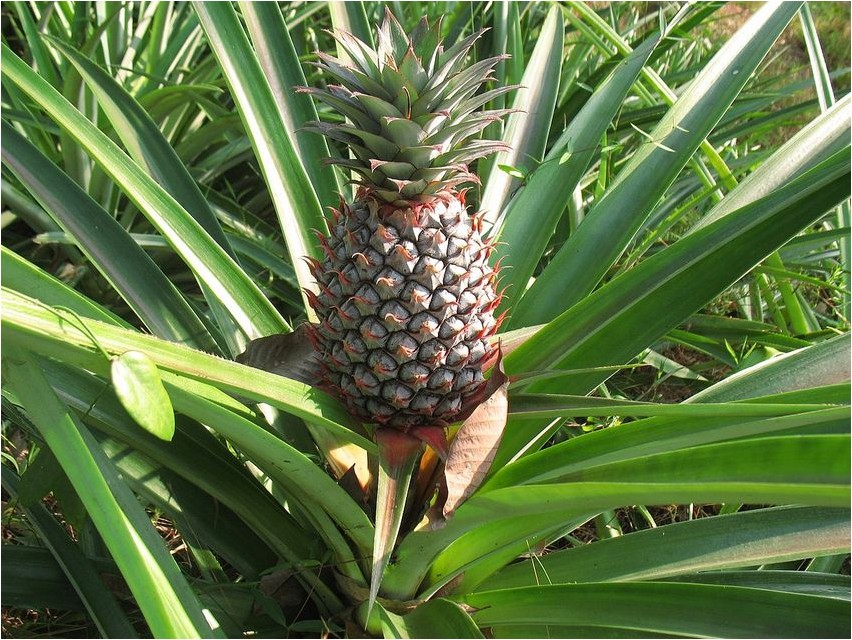
Pineapple (lat. Ananas) is a genus of herbaceous tropical succulent plants with spiny stems and leaves, a member of the Bromeliaceae family (lat. Bromeliaceae).
Today, the fruit, or rather the fruit, of the Pineapple plant is available to any Russian, since this important fruit crop has long crossed the borders of tropical countries, filling the store shelves of countries with a long winter period. For cultivation, a species called “large-tufted pineapple” is used, the apex of which is decorated with a picturesque tuft of short and spiny leaves. Many Pineapple fans manage to grow fruits indoors.
What’s in your name
Since the most aromatic fruit came to Europe from the South American tropics, where the local Indians in the Tupi language called it “nanas”, which translated meant “excellent fruits”, botanists named the genus of plants that gives people these wonderful fruits, consonant with the word “Ananas”.
English-speaking Europeans, having discovered tropical fruits in South America in the middle of the 17th century, called Pineapple “Pineapple” for the similarity of the plant’s fruit with the reproductive organs of coniferous trees, which literally translates as “Pine apple”, and is currently called “Pine cones”. In Spain, for example, today, along with the name “Anana” (Pineapple), you can also hear the name “Pina” (Pine cone).
Description
The Pineapple plant is a herbaceous perennial up to 1. 0-1. 5 meters high, although under favorable conditions it can grow higher.
The short, squat, thick stem of the plant is surrounded by hard, waxy, fleshy leaves that have a very pragmatic structure. Under the hard surface there are plant tissues that can absorb moisture for future use, which will be useful to the plant during periods of drought. The number of narrow long leaves can exceed 30 pieces. The edge of the leaf is protected by sharp spines. The trough-shaped shape of the leaves helps to collect moisture in the axils, where roots appear, pumping the water thus collected into the leaves.

After a year and a half, the top of the stem turns into a spiny inflorescence up to 15 centimeters long, consisting of numerous, spirally arranged, trimeric flowers, the number of which reaches 100-200 pieces, although some large-fruited varieties are capable of exceeding this limit. The color of the flowers varies from lavender or light purple to red.
Once pollinated, the ovaries of each flower develop into berries, which join together to create a masterpiece of natural creativity – the dense fruit of the Pineapple. Pineapple fruits are arranged in two interconnected spirals: 8 in one direction and 13 in the other. Each spiral is built according to the principle of the Fibonacci number (a number sequence where the sum of the two previous numbers gives rise to the next number, that is, 0, 1, 1, 2, 3, 5, 8, 13..). But, if life, which has a beginning and strives for an ideal, is not capable of achieving this ideal, then the Pineapple gives us complete perfection in its fruit.
When the first fruit is ready for consumption, side shoots (“suckers” or “sprouts”) are born in the leaf axils of the main stem, which can become additional fruits of the plant, or gardeners remove them to create a new plant. The shoots that appear on the stem of the main plant are planted in new places, maintaining the necessary distance between individual plants.
Usage
In the Bromeliad family, the Pineapple plant is the most economically significant, giving people a tasty and healthy delicacy. Pineapple fruits are consumed fresh; juice is prepared from them, which is served as a separate drink or is one of the main components of cocktails; preserve the juicy pulp to make preparations for future use or for export of products; They also make preserves and jams from the pulp, so that residents of northern countries can also enjoy the healthy fruit. Pineapple pieces are added to fruit salads, pizza toppings, yoghurts and ice cream.
The main chemical components of the fruit to which Pineapple owes its popularity are manganese and vitamin C. A 100-gram serving of fresh fruit provides 44 percent of a person’s daily requirement for manganese and 58 percent of vitamin C.