Pyrethrum red
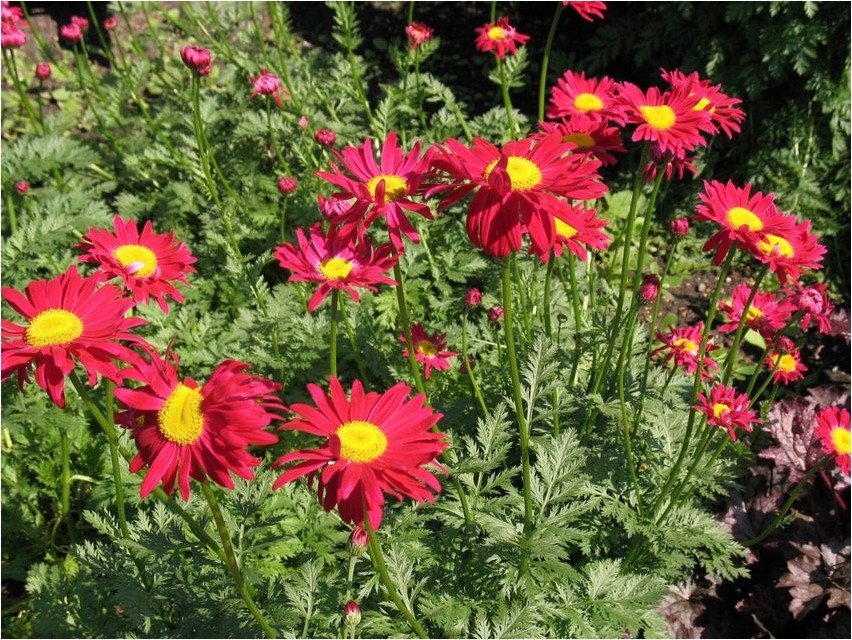
Red pyrethrum is one of the plants of the family called Asteraceae or Asteraceae; in Latin the name of this plant will be as follows: Pyrethrum coccinium (Willd.) Worosch. (P. roseum (Adam.) Bieb.).
As for the name of the red pyrethrum family itself, in Latin it will be: Asteraceae Dumort. (Compositae Giseke).
Description of red pyrethrum
Pyrethrum red is a perennial herbaceous plant, the height of which will fluctuate between twenty and sixty centimeters, such a plant will be endowed with a more or less branched oblique rhizome, which in turn is most often naked. The stems of such a plant will be either erect or ascending at the very base, and they are also simple and slightly leafy. The leaves of red pyrethrum are usually bare, without noticeable pinpoint glands, while the length of the basal and lower stem leaves will be about fifteen centimeters, and the width will be equal to four centimeters. Such leaves are located on rather long petioles, the blades will be oblong in outline, and the leaves are pinnately dissected. The baskets of red pyrethrum will be single, and sometimes they can be present in the amount of two or three pieces. Reed flowers are painted in pink tones of various shades, with a corolla tube the length will be about one or two millimeters, and with a bend this length will be equal to twelve to twenty-five millimeters. The achene of red pyrethrum is endowed with approximately five to eight longitudinal ribs; the length of the achene will be approximately two to three millimeters.
Red pyrethrum blooms from July to August. Under natural conditions, this plant is found in the Caucasus. It should be noted that red pyrethrum will be cultivated as an insecticidal or medicinal plant in some regions of Russia and in all southern regions of Ukraine. In addition, the plant is also very decorative.
Description of the medicinal properties of red pyrethrum
Red pyrethrum possesses valuable medicinal properties, and its inflorescences and herb are recommended for medicinal use. The term “herb” includes the leaves, stems, and flowers of this plant. These valuable medicinal properties are attributed to the plant’s content of thiophenes, the sesquiterpenoid pyrethrosine, sulfur-containing compounds, heterocyclic oxygen, monoterpenoids, the flavonoids diosmin and diosmetin, as well as formic and propionic acids.
The aerial parts of this plant and its inflorescences are used to prepare so-called “Persian powder,” while infusions and extracts prepared from red pyrethrum are recommended as highly effective insecticides and anthelmintics.

It is noteworthy that red pyrethrum is also widely used in veterinary medicine. Here, this plant is used for pediculosis in pigs, scabies in sheep and horses, and is also used to combat so-called ectoparasites in poultry. An aqueous extract based on red pyrethrum leaves exhibits highly effective activity against gram-negative bacteria; notably, this highly effective property of this plant has been experimentally proven. It is worth noting that this remedy is highly effective, and the positive effect is noticeable quite quickly when used correctly and appropriately.





