prickly pear
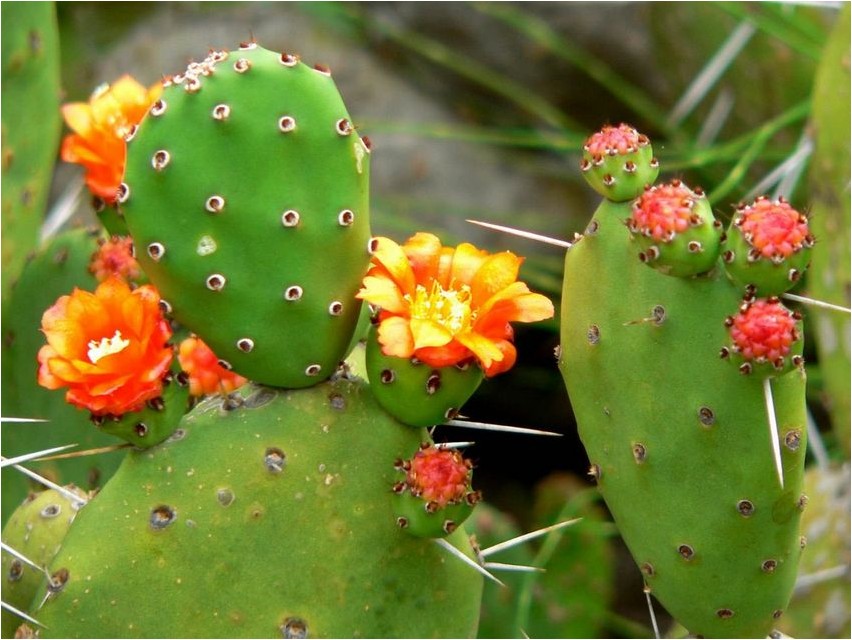
Opuntia (lat. Opuntia) is a genus of prickly plants of the Cactus family (lat. Cactaceae). The Opuntia genus includes about two hundred species, being the largest plant community in the spiny Cactus family.
His juicy oval “palms” just beg for a person to enjoy their flesh. But don’t rush to take advantage of the offer, because in addition to noticeable thorns, there are many very thin and sharp needles on their surface, which are not easy to rid your outstretched hand for a treat. However, the natives of America have long adapted to the customs of Opuntia and willingly eat the delicacy, and also use its healing abilities to maintain health.
Resident of the American tropics
Although today representatives of the Cactus family can be found anywhere on our small planet, in the wild they appeared in the tropical territories of two American continents. Opuntia especially liked the Mexican soil, where a good half of all species of the genus grow.
The first “written” evidence of human use of shoots, flowers and fruits of Opuntia for nutrition dates back to the 8th — 1st centuries BC, when on the territory of a modern state called Peru there was a civilization that went down in the history of Mankind as the “Paracas Culture”.
Prickly pear served not only as a human food product, but also as a source for the dye “carmine,” famous for its red-purple hue. The craftswomen of Paracas decorated fabrics with bright patterns, which today are considered the best examples of the art of American aborigines of the pre-Columbian era. Such fabrics served as clothing for burial mummies.
What”s in your name
One of the names of the plant by which the Aztecs, the natives of America, called it is “nopalli,” meaning “tree on which fruit grows.”

As for the Latin name of the genus “Opuntia”, it is based on the name of the city in Ancient Greece — “Opus”. The ancient Greek philosopher Theophrastus, who lived in the 4th — 3rd centuries BC, when describing Opus, mentioned an edible plant that city residents propagated by rooting its leaves. It is this method of reproduction that was taken as the basis for the name of the genus, since Opuntia reproduces in a similar way. True, that part of the plant that is called “leaves” in Opuntia is not leaves in the botanical sense.
Description
The round, appetizing “cakes” of Prickly Pear, commonly called “leaves,” are modified shoots of the plant. These shoots take root very easily, grow quickly, forming an impressive bush, spectacular and very prickly. A hedge made from such bushes is a reliable protection against encroachments on your own territory.
If the sharp prickly spines, forming small groups of several pieces on the body, are visible to the naked eye, and therefore you can somehow protect yourself from their warlike appearance, then it seems unrealistic to dodge the thin and small needles called “glochidia” without protective gloves. They are just waiting for the touch of a human hand to dig into the skin, like a wasp sting. It is very difficult to remove them later.
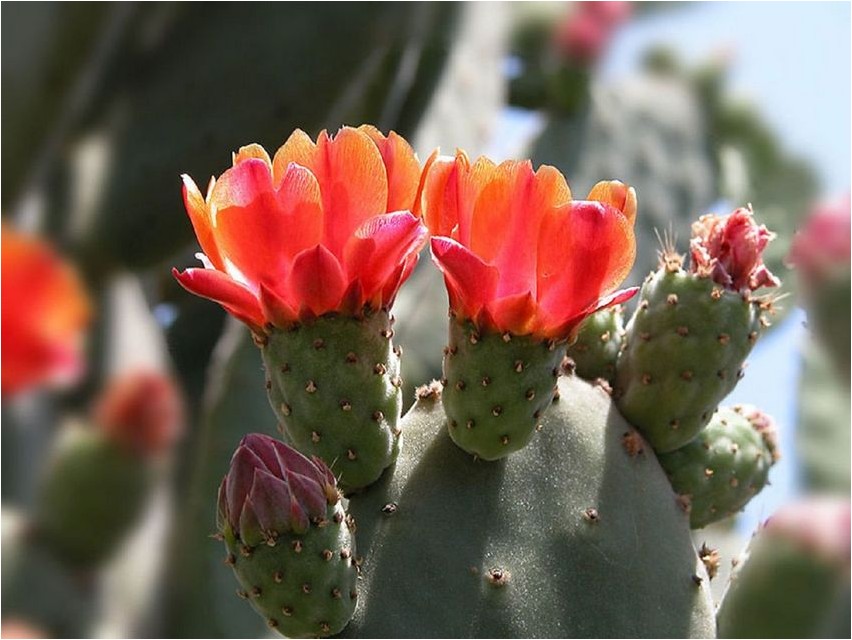
Opuntia blooms with large, showy flowers, the petals of which can be bright yellow or red. The green sepals form a very modest small cup, on which the corolla spreads its large petals. In the center of the flower, a green pistil, surrounded by numerous stamens, stands out noticeably.
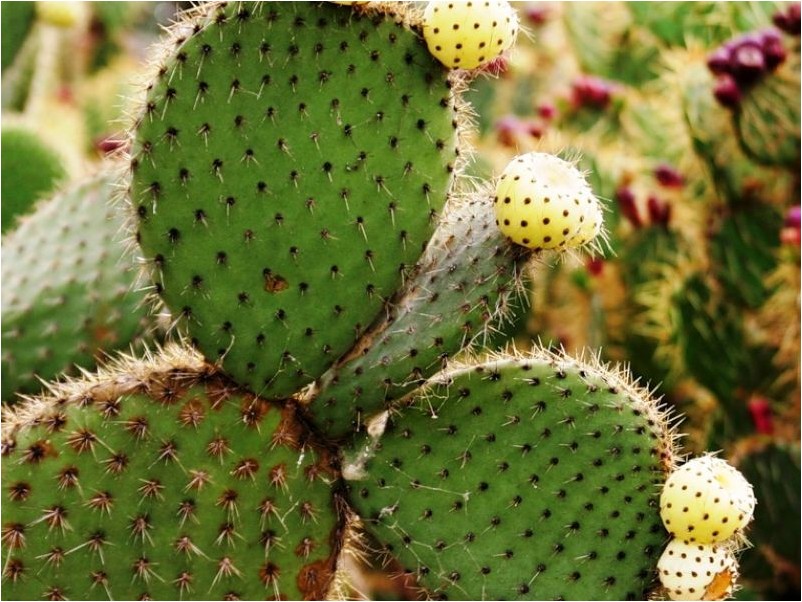
The pollinated flowers are replaced by green fruits, their shape somewhat similar to a pear, which gave rise to the name of Opuntia as “Prickly Pear”. As they ripen, they acquire an increasingly rich purple color.
Under the thin skin of the fruit lies sweet and sour pulp and numerous seeds. And the outer side of the skin, which seems smooth at first glance, is equipped with glochidia, ready to sacrifice themselves for the well-being of the plant, digging into anyone who wants to feast on the fruits. Therefore, harvesting is carried out in protective clothing.
Healing abilities
The pulp of ripe fruits is rich in vitamins, including vitamin C, and therefore is readily eaten by people and turtles.
The succulent “leaves” are also edible. Alcoholic drinks are also made from them. In addition, they help fight pneumonia and measles.
Juice from the “leaves” helps relieve inflammation on the skin and also promotes faster healing of wounds.