Lychee
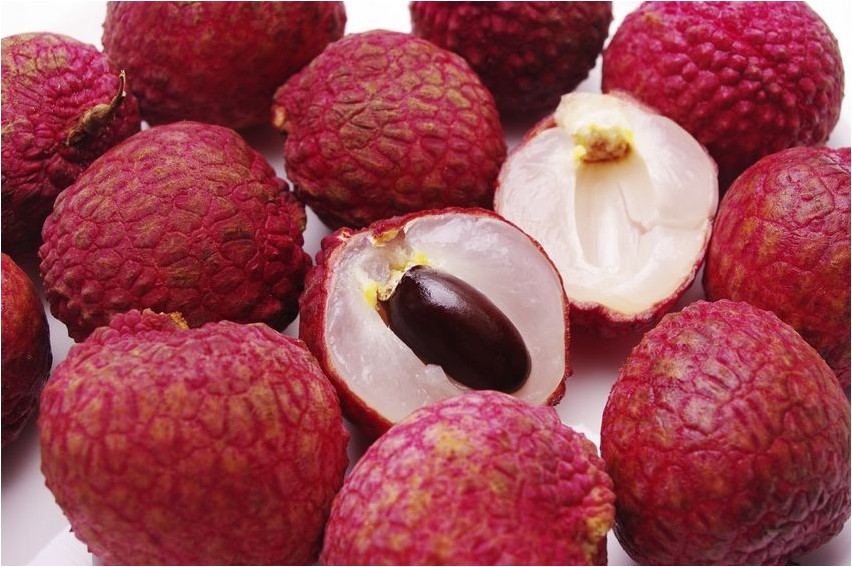
Lychee (lat. Litchi chinensis) is a flowering fruit tree belonging to the Sapindaceae family.
History
In the II century. BC e. The ancient Chinese ate lychees with great pleasure. According to one of the many legends, Wu Di, the great Chinese emperor, was very annoyed and angry at the failed attempt to introduce this southern Chinese plant into cultivation in Northern China, as a result of which all the gardeners were executed.
After some time, lychees began to be cultivated in neighboring countries. And now in Southeast Asia it is one of the most popular fruits.
In Europe, the first mention of lychee dates back to the mid-17th century. And the Chinese plum began to be called a wonderful fruit thanks to Juan Gonzalez de Mendoza, who noted that this fruit is similar to a plum that is completely easy on the stomach, which can be consumed in absolutely any quantity.
Description
Lychee is an evergreen tree with a rather spreading, luxurious crown, the height of which reaches from ten to thirty meters (on average fifteen meters).
Paripinnate (occasionally they can also be imparipinnate) compound leaves are formed by four to eight leaves with pointed tips, distinguished by a lanceolate or elongated ovate shape. On the upper sides, the entire leaf blades are painted in dark green tones and shine, and below they are usually grayish-green.

Equipped with greenish or soft yellowish calyxes, lychee flowers are devoid of petals and are collected in incredibly lush and amazingly beautiful umbrella-shaped inflorescences, each of which can reach a length of seventy centimeters. In this case, most of the flowers from each inflorescence almost always fall off, and from the remaining flowers only three to fifteen fruits develop.
The oval fruits of this crop are characterized by relatively small sizes: their length ranges from two and a half to four centimeters. The red skin of these fruits is densely dotted with countless pointed tubercles, and the jelly-like light flesh of the fruit is easily separated from the peel and has a pleasant sweetish taste with an unobtrusive wine tint. The bizarre lychee fruits are slightly astringent and vaguely resemble the familiar grapes in taste. And in the very center of each fruit you can find an oval dark brownish bone.
In the subtropical zone, lychees are usually harvested in May or June.
Application
Lychee fruits are most often eaten fresh or all kinds of sweet dishes are prepared from them (delicious ice cream, jelly, etc.). And peeled fruits, preserved with sugar, are currently exported to most countries of the world. However, sometimes this fruit is also used to produce traditional Chinese wine.
In addition, whole fruits are also dried — their skin in this case becomes quite hard, and inside all dried lychees the dried pulp with the stone easily moves. By the way, these interesting fruits are often called lychee nuts.
Lychee fruits are very rich in vitamin C, as well as valuable pectin substances and even carbohydrates. This fruit also contains an impressive amount of vitamin PP (that is, nicotinic acid), which actively prevents the development of atherosclerosis.
These fruits are also popular in folk medicine — they are excellent for coughing and severely enlarged tonsils. In India, powdered lychee seeds are used for various intestinal problems, and in China, the seeds of these fancy fruits are used as a painkiller, as well as for various types of neuralgia.
Growing
Lychee grows best in subtropical climates with very cool and fairly dry winters. And in equatorial climates, which are more humid, they usually do not bear fruit. This plant should be planted on fertile and thoroughly moistened soils, and propagation of lychee occurs either vegetatively or with the help of seedlings. All trees are characterized by extremely slow growth, while seedlings begin to bear fruit only in the eighth to tenth year, and if propagation occurred vegetatively, then after four to six years.





