Galinsoga parviflora
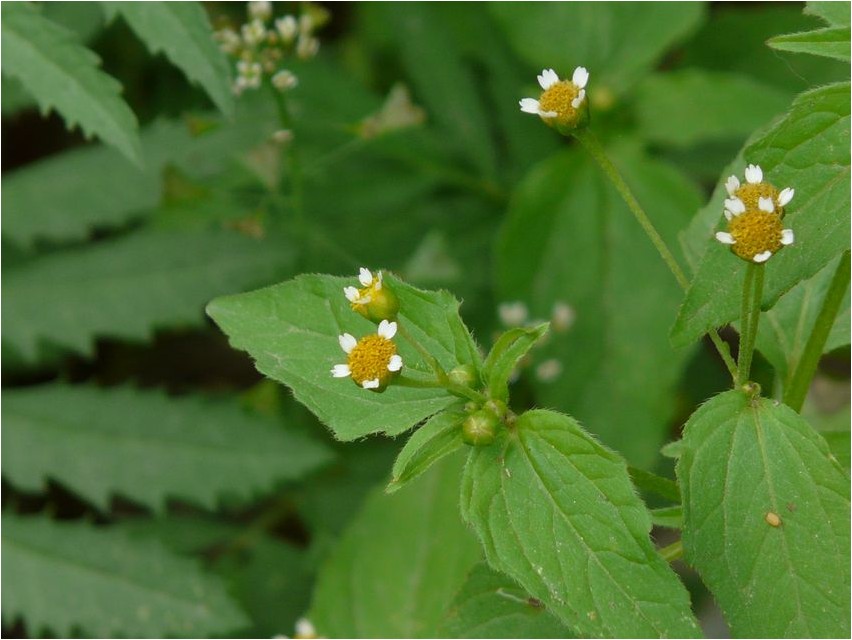
Galinsoga parviflora is one of the plants of the family called Asteraceae or Asteraceae. In Latin, the name of this plant will be as follows: Galinsoga parviflora Cav.
As for the name of the small-flowered galinsoga itself, in Latin it will be like this: Asteraceae Dumort.
Description of Galinsoga parviflora
Galinsoga parviflora is an annual herbaceous plant, the height of which can range from ten to one hundred and thirty centimeters; such a plant is covered with rather small hairs. Most often, the stem of this plant is branched from the very base, and its roots will be fibrous. The leaves of this plant will be ovate in shape, and along the edges they are wavy or bluntly toothed. The baskets of Galinsoga parviflora are numerous, they are located on thin stalks of varying lengths, as well as in loose semi-umbrellas. The width of such baskets will be about three to five millimeters, while the reed flowers reach about three millimeters in length. The achenes are about one to one and a half millimeters long.
The flowering of small-flowered Galinsoga begins in July and continues until the autumn. Under natural conditions, this plant can be found in Belarus, Ukraine, the Caucasus, as well as in the Far East, Central Asia and the European part of Russia. For the growth of Galinsoga parviflora, it prefers crops, meadow steppes, meadows, as well as gardens and vegetable gardens.
Description of the medicinal properties of Galinsoga parviflora
Galinsoga parviflora is endowed with quite valuable medicinal properties; it is recommended to use the roots and herbs of this plant for medicinal purposes. The concept of grass includes the leaves, flowers and stems of this plant.
Such valuable medicinal properties are due to the content of rubber and stigmasterol in the plant. The roots of this plant contain the following polyacetylene compounds: dihydrofalcarinone and falcarinone. The leaves of Galinsoga parviflora contain triterpene saponins, tannins, caffeic acid, flavonoids and inulin. It should be noted that in folk medicine, a decoction prepared from the herb of this plant has become quite widespread, which is recommended for use for goiter, ascites and anemia. A decoction of the roots of Galinsoga parviflora should be drunk for fever. It is recommended to chew fresh herbs of this plant for stomatitis, gingivitis, scurvy and damage to the oral mucosa. In the Far East, Galinsoga parviflora herb is often used as a wound healing agent, as well as a hemostatic for uterine bleeding, and also as an antihypertensive agent.

For ascites, you should prepare the following remedy: to prepare it, it is recommended to take one tablespoon of Galinsogi parviflora herb per glass of water. This product should be boiled for about three to four minutes over fairly low heat, and then the resulting mixture should be infused for about one hour in a warm place. After this, the mixture should be thoroughly strained. Take this remedy one or two tablespoons.
The following remedy also turns out to be effective: to prepare it, take one tablespoon of crushed dry roots of Galinsoga parviflora per one glass of water. This mixture should be boiled for about four to five minutes, and then left to infuse for about one hour, and then strained very carefully. This remedy should be taken one or two tablespoons three to four times a day during a feverish state. In addition, the product is also effective in the form of a lotion as a wound-healing agent.





