Kalmia buxifolia
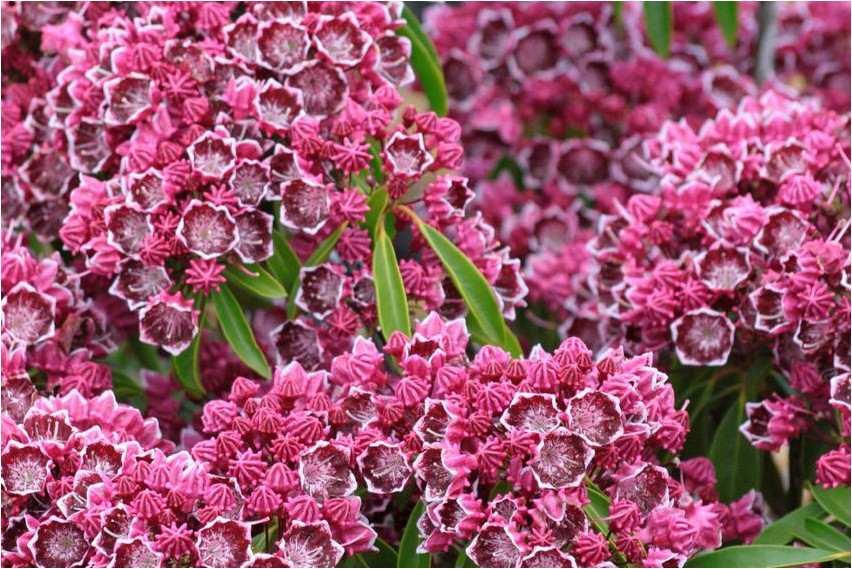
Kalmia buxifolia is an evergreen shrub that often misleads botanists and laypeople with its wide variability in the wild.
Although botanists have attempted to classify this species as a separate genus, genetic data indicates it belongs to the genus Kalmia, which belongs to the Ericaceae family. The plant is distinguished by its small stature but wide branching, leathery leaves, and dense clusters of small pinkish-white or pink flowers.
What”s in a name?
The plants owe their Latin genus name, Kalmia, to Carl Linnaeus, who decided to perpetuate the name of the botanist (Per Kalm), his student and collaborator in the study of our planet”s flora. Per Kalm brought back many exotic plants from his trip to distant America, including some belonging to the genus Kalmia. He gave them a chance to thrive on European soil, and they seized the opportunity successfully.
Before molecular and morphological studies, which became possible only in the late 20th and early 21st centuries, this plant was classified under the name “Leiophyllum buxifolium.” Based on these studies, the plant was reclassified into the genus Kalmia. However, according to long-time admirers of the plant, it bears no resemblance to other plants of the genus Kalmia, other than the poisonous nature of all parts. The photograph below shows a species of Kalmia boxifolia, characterized by tiny white flowers borne atop a branch covered in succulent, small leaves.
The plant”s specific name, by adding the adjective “buxifolia” (“box-leaved”), clarifies the shape of Kalmia boxifolia”s leaves. However, in the wild, this species of Kalmia tends to change its appearance, often misleading not only casual flower enthusiasts but also those closely involved in the study and classification of plant species.
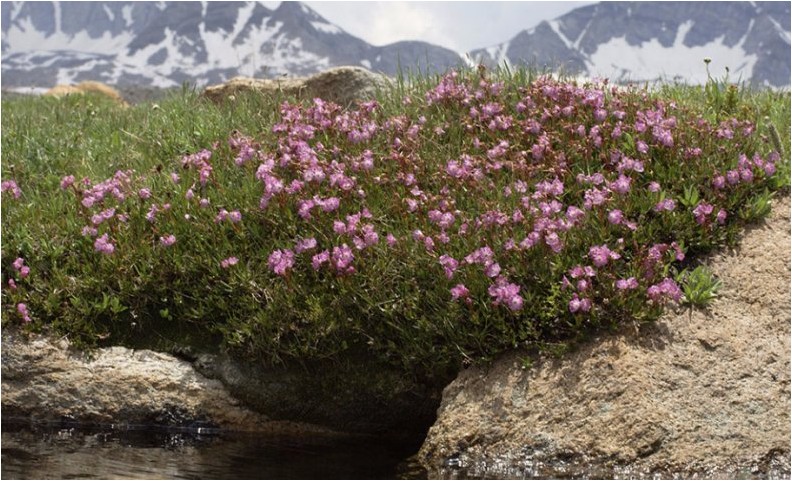

The plant”s varied appearance gives rise to many non-Latin names. For example, the common name “sandmyrtle” or “Ledum buxifolium” (Latin: “Ledum buxifolium”) likely stems from its resemblance to plants of the genus Ledum, also part of the Ericaceae family.
Description
An evergreen perennial shrub of short stature (from 10 to 100 cm) spreads its thin slender stems widely. The slightly cylindrical branches of the shrub may be bare or covered with sparse hairs.
The leathery, shiny dark green leaves that cover the stems in the warm season turn bronze in the cold winter. They can be located in different ways on the stem, including being alternate or opposite. The leaves can be attached with short (0. 1 to 2 mm) petioles, or be petiolate. Narrow-lanceolate leaf blades are ovoid or oval in shape.
In mid-spring, corymbose or umbrella-shaped inflorescences, collected from white or light pink flowers with green lanceolate sepals, are born from pink flower buds in mid-spring. One inflorescence has up to 18 flowers.
The crown of the vegetative cycle is a naked fruit in the form of a box or capsule with two, three or five nests. Elongated, wingless seeds are located in nests, awaiting their turn to reproduce on the planet Kalmia boxifolia.
This species of the Kalmia genus naturally grows on sandy soils among oaks and pines, and can also be found on rocky peaks.
All parts of the plant, like other plants of the Kalmia genus, are toxic, and therefore you should resort to protective agents when working with Kalmia boxifolia.
Kalmia latifolia Keepsake &