Bagryannik
Cercidiphyllum (lat. Cercidiphyllum) is a spectacular decorative foliage plant belonging to the Cercidiphyllum family. Other names are roundleaf or gingerbread tree.
Description
Bagryannik is a very attractive deciduous tree with a wide pyramidal crown, densely covered with round-ovate opposite leaves from five to eight centimeters long. The height of these trees varies on average from ten to eighteen meters (occasionally you can see thirty-meter trees), and quite often they have a multi-stemmed shape. And their trunks are covered with fissured bark of black and brown shades. Annual branches are covered with smooth reddish bark, and perennial branches are framed with olive-brownish-grayish bark.
The small flowers of the scarlet plant are devoid of perianths and are collected in bizarre bunches. In this case, flowers appear on trees almost simultaneously with leaves (and sometimes even before they bloom) — usually this happens in April. And the fruits of this plant look like assembled leaflets.
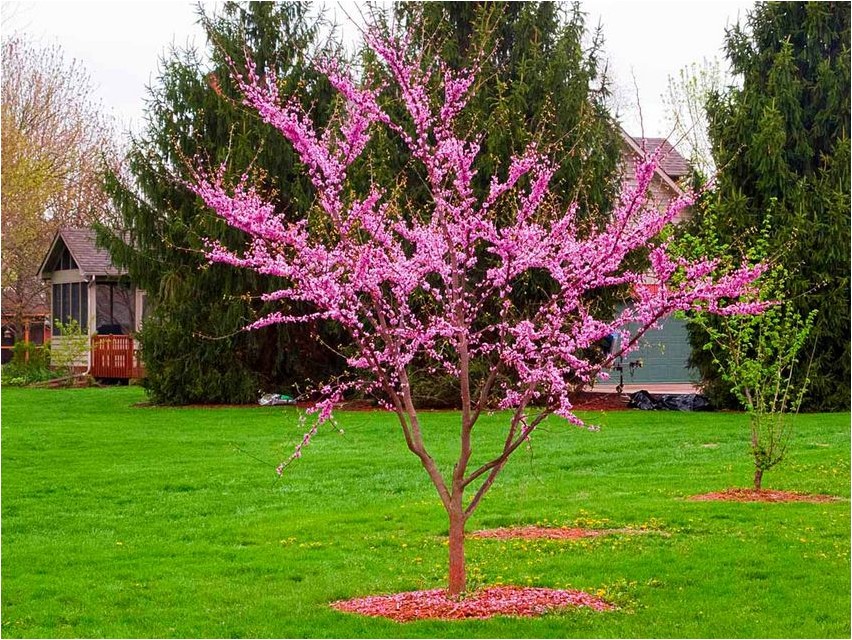
Sometimes the purple plant is confused with the no less spectacular cercis, but upon careful examination these plants can be easily distinguished by their leaves: in the purple plant they are opposite, while in the cercis they are alternate. And in general, these plants are not relatives — they belong to different families and different genera.
Where does it grow
Currently, the scarlet can be found mainly in China and Japan, in deciduous forests. And more than eighty million years ago, it quite happily occupied very vast territories in North America and Eurasia. The scarlet plant is now quite widespread in the Mediterranean, as well as in East and Southeast Asia.
Usage
Bagryannik is a magnificent park tree, which is ideal for both group or single plantings, and for creating spectacular compositional groups. With the onset of autumn, the leaves of this plant not only turn into wonderful bright shades, but also begin to exude a rather unique, slightly spicy aroma — it is for this feature that in Germany the scarlet plant is called the gingerbread tree.

Growing and care
The crimson tree feels great in sunny areas, on fertile, moist soils with a slightly acidic or neutral reaction. By the way, these trees boast impressive winter hardiness!
During dry seasons, trees need additional watering, and with the onset of spring, it is recommended to feed the scarlet plant with high-quality complete mineral fertilizers. Pruning will not be superfluous either — shrunken and diseased branches must be removed in a timely manner.
Purple grass is propagated either by sowing seeds in the fall, or by winter cuttings or layering. Cuttings are usually cut in the summer, making sure that the length of each piece is about fifteen centimeters and that each cutting has two internodes. Cut cuttings are immersed in a previously prepared nutrient substrate, after which they are placed in greenhouse conditions and systematically sprayed. As for rooting, in this case approximately half of the total volume of cuttings takes root successfully.
It is quite acceptable to purchase ready-made seedlings, but it is important to ensure that they are already a little grown up and their root system is closed.
The crimson plant is also good because it is characterized by increased resistance to a wide variety of pests and ailments. In addition, he is not at all afraid of even very strong air pollution!