Oriental Plane
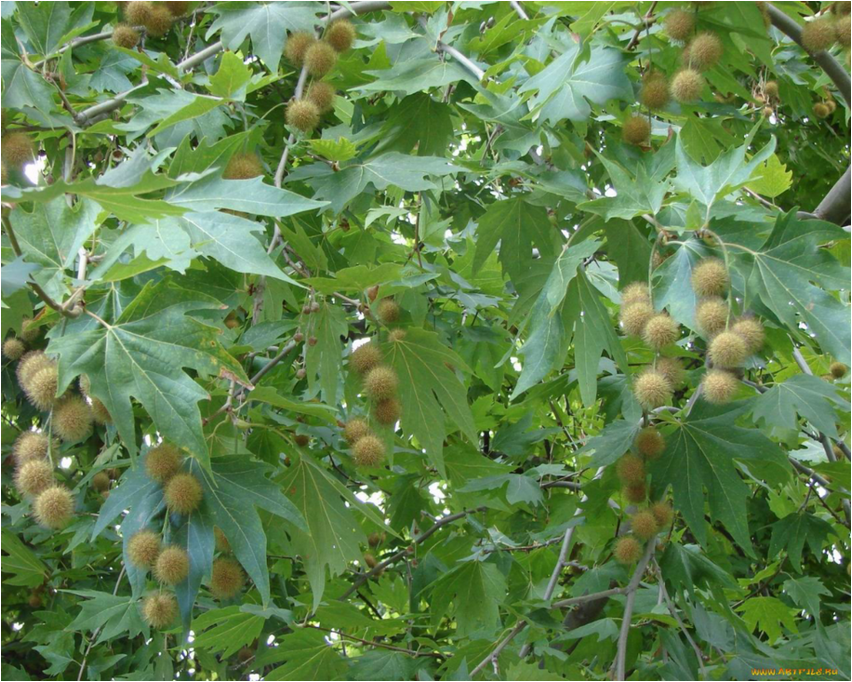
The oriental plane is a member of the sycamore family, and its Latin name is Platanus orientalis L. (P. digitata Gord., P. digitifolia Palib., P. orientalis Dode).
The family name of the oriental plane is Platanaceae Dumort.
Description of the Oriental Plane
The oriental plane, or sycamore, is a tree whose height ranges between fifty-five and sixty meters. The bark of this plant is light green, peeling off in large, irregularly shaped sheets. The leaves of the oriental plane are approximately ten to twenty centimeters wide, deeply lobed and broadly wedge-shaped at the base. The lobes are five to seven times longer than they are wide, and the leaves are entire and glabrous, sometimes with sparse teeth. The fruit heads of this plant are two to three per stalk, and their thickness is two to two and a half centimeters. The nuts of this plant are endowed with long hairs and a conical apex. It is noteworthy that this plant is also heat-loving. In the wild, the oriental plane tree is found in the Caucasus, but it is cultivated in Crimea and Central Asia.
Description of the medicinal properties of the oriental plane tree
The oriental plane tree has very valuable medicinal properties, and the leaves, roots, and bark of the trunks of this plant are recommended for medicinal purposes. The presence of such valuable medicinal properties is believed to be explained by the sitosterol and triterpenoids found in the bark of this plant’s trunk, while the leaves contain the following phenolic acids: caffeic and p-coumaric, as well as flavonoids, and hydrolyzed anthocyanins, delphinidin, and cyanidin. The fruits contain sitosterol, higher aliphatic alcohols and their derivatives, and the higher aliphatic hydrocarbon p-heptriacontane.
A decoction prepared from the roots of this plant is recommended as a hemostatic agent and for snake bites. The bark of young trunks of the oriental plane tree is widely used in homeopathy as an anticancer remedy. For flu, toothache, diarrhea, and dysentery, boiled bark of young trunks with vinegar should be used.
An infusion based on the leaves of this plant is indicated for use in blepharitis and conjunctivitis, and is also used as an anticancer agent. It is noteworthy that in Western Europe this plant is considered a substitute for tobacco.

As a hemostatic agent, it is recommended to use the following healing agent based on this plant: to prepare such a healing agent, you will need to take twenty grams of crushed roots of the oriental plane tree in one glass of boiling water. The resulting healing mixture should be boiled in a water bath for about twenty minutes, after which this mixture should be filtered very carefully. After this, boiled water should be added to the resulting medicine up to the original volume. Take this healing remedy three to four times a day, one to two tablespoons, as a hemostatic agent. It is noteworthy that in addition to this, such a medicine can also be used as an antidote for snake bites: this medicine is taken two to three times a day, half a glass or one third of a glass.
Sycamore eastern sycamore





