Horseradish
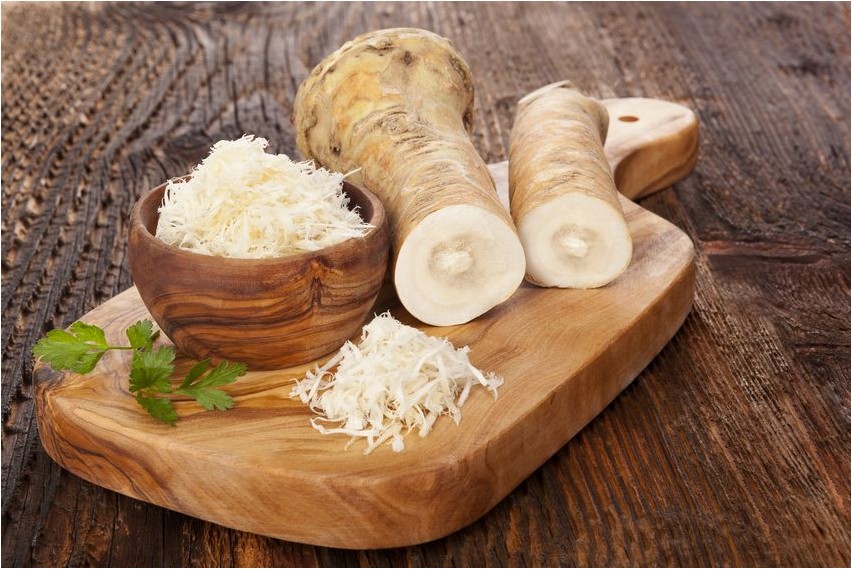
Horseradish (lat. Armoracia) is a genus of herbaceous plants of the Cruciferous or Brassica family. It is one of the oldest plants in the world.
Horseradish is widely distributed throughout Europe, Africa, Asia and North America. The plant is currently grown in Greenland. In nature, horseradish is found in the Caucasus, CIS countries, the Far East and Siberia. Typical places of growth are damp meadows, banks of rivers and streams.
Characteristics of culture
Horseradish is a perennial herbaceous plant with a straight branched stem up to 120 cm high and a long thickened root. The basal leaves are large, entire, oblong or oblong-oval, up to 60-70 cm long; middle ones — pinnately divided; the upper ones are linear-lanceolate. The flowers are regular, bisexual, white, collected in multi-flowered racemes forming paniculate inflorescences. Horseradish blooms in May-June. The fruit is an oblong, oval or ovoid swollen pod. The seeds are arranged in two rows. The closest relatives of horseradish are considered to be watercress, radishes and mustard. Horseradish is characterized by rapid growth; in a short time it can fill a large part of the garden plot.
Growing conditions
Areas for cultivation are preferably fertile, well-moistened, and filled with organic matter. Sandy loam or loamy soils and drained peat bogs with a neutral or slightly acidic reaction are optimal. It is not recommended to grow horseradish on heavy clay, waterlogged, saline and waterlogged soils. The location is preferably sunny, partial shade is not prohibited.
Soil preparation and planting
The area for the crop is prepared in the fall: the soil is dug up, compost or manure is added (at the rate of 2 buckets per square meter). In spring, the soil is loosened and fed with potassium chloride (20 g) and superphosphate (50 g). Strongly acidic soils are preliminarily limed. Fertilizers are applied before digging or during loosening. Horseradish is a perennial crop, but many gardeners grow it as an annual. Horseradish is planted in early spring and harvested in the fall. Long-term cultivation is undesirable, since over time the roots of the plant branch, become lignified and become smaller, and subsequently become unsuitable for food.
For planting, use cuttings of one-year-old roots approximately 30 cm long. When planting, it”s important not to confuse the top and bottom of the cuttings, so mark the portion adjacent to the root during harvesting, for example, by making a perpendicular cut. Before planting, remove lateral roots and buds with burlap, leaving only the buds located along the edges of the cuttings. Plant the cuttings in pre-prepared ridges of soil and water thoroughly. The top of the cutting should be 2-3 cm below the top of the ridge.

Care
Horseradish care is standard: weeding, watering, and loosening the soil. As soon as the leaves appear, the plants are earthed up; 2-3 earthings should be performed over the summer. The plant responds well to fertilizer; one feeding in midsummer is sufficient. For these purposes, you can use urea (20 g per square meter), superphosphate (40 g), and potassium chloride (15 g).
Harvesting
Horseradish rhizomes are dug up in October, and the leaves can be harvested from July to August. The leaves can be used as a spice for pickling or salting cucumbers and tomatoes. The rhizomes are dug up with a pitchfork and then sorted by hand. The yield of horseradish rhizomes is 1-2 kg per square meter.





