Nertera
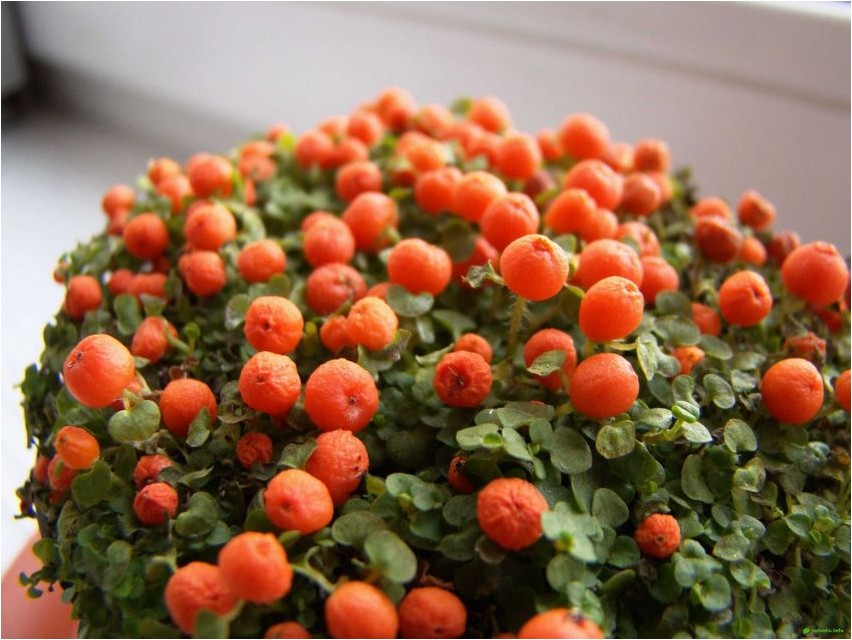
Nertera (lat. Nertera) is a luxurious ornamental fruit flowering plant from the Rubiaceae family.
Description
Nerthera is a herbaceous perennial of relatively medium size, endowed with numerous creeping stems. The bright green and spectacularly shiny leaves of this plant are characterized by an oval shape and reach half a centimeter in diameter. With proper care, nertera can easily grow to thirty-five or even forty centimeters in diameter.
Single white flowers of Nertera are usually four- or five-membered. They bloom at the very end of spring and are equipped with funnel-shaped or tubular green corollas.
The main highlight of nertera is the presence of a huge number of spectacular bright berries. The size of these fleshy fruits varies from eight to ten millimeters, and inside each berry you can find as many as two seeds. As for their color, it can be not only red, but also white, orange or yellow. By the way, it is because of these fruits that the nertera received its second name — it turns out that it is often called coral moss.
Where does it grow
Nertera can be found mainly in South American territory. She feels especially good in subtropical or tropical zones. This plant can often be seen in the vast expanses of New Zealand, Mexico, Australia and Southeast Asia.
Usage
In most cases, Nertera is grown as a houseplant.

Growing and care
Growing nertera as a potted plant is not difficult; cultivating it as a perennial is much more difficult. This beauty can be grown on any windows, with the exception of northern ones, but it is advisable that the winter heating in the room does not provide any special warmth.
In general, the nertera is very undemanding when it comes to soil; the most important thing is that it is as nutritious and loose as possible. This plant can be safely planted in any universal ready-made earthen mixtures intended for beautifully flowering crops.
Lighting for the successful development of nertera should be diffused, but at the same time quite powerful. At low temperatures it is quite acceptable to keep it in direct sunlight, but in hot weather their exposure to the beautiful plant should be limited.
In winter, it is recommended to keep Nertera at fairly cool temperatures; however, if it is grown as a potted plant, then a slight decrease in temperature is quite acceptable, and if Nertera is cultivated as a perennial, it is important to try to maintain the temperature in the range of ten to twelve degrees. A plant growing in warm conditions is often too exhausted, and disruption of the dormant period generally often leads to its death.
Summer watering of the nerter must be plentiful (the soil should always be slightly moist), and in winter it should be infrequent and not too generous: the number and volume of watering is increased only after new young growth appears on the plant. As for spraying, in hot weather they are required, but at low temperatures they can be omitted.
The room in which nertera grows needs to be ventilated as often as possible. Ideally, if such an opportunity exists, it should generally be kept outdoors in the fresh air, brought indoors only after fruits begin to form on it. By the way, when all the berries fall off, nertera is often thrown away.
At the height of the growing season, the nertera is fed approximately once or twice a month, with high-quality combined fertilizers being the most suitable for feeding. And the nertera reproduces in the spring by dividing the bushes.





