Late denticula
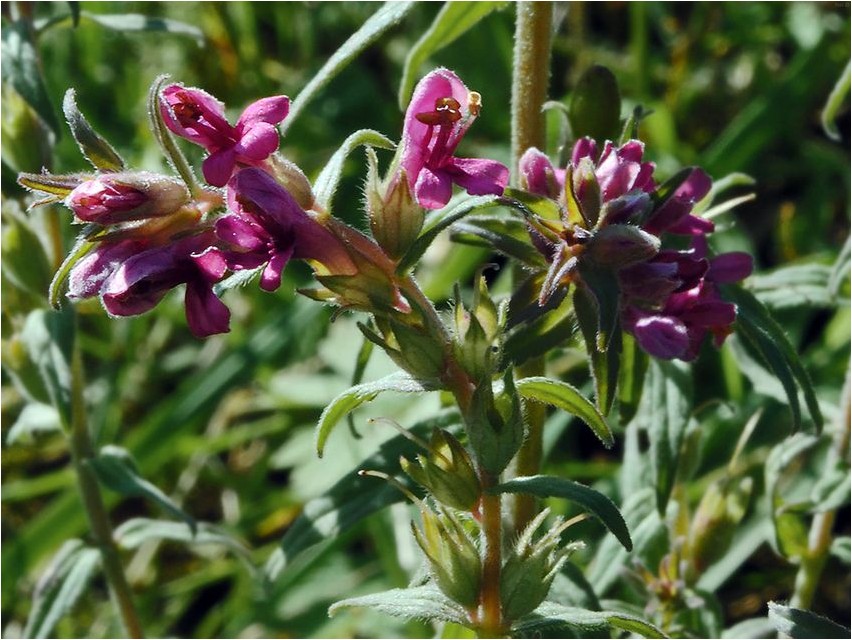
Late toothwort is one of the plants of the family called Noricaceae; in Latin the name of this plant will be as follows: Odontites serotina (Lam.) Dum.
As for the name of the late serrata family itself, in Latin it will be: Scrophulariaceae Juss.
Description of the late serration
Late toothwort is an annual herbaceous semi-parasitic plant, the height of which is about fifteen to thirty centimeters. The stem of this plant is erect, it is highly branched below, and less often it is also simple. The branches of the late serratus are arched and widely spaced; the stem and branches of this plant are covered with dense, downwardly inclined hairs. The leaves of the late serratus are sessile, they are lanceolate or linear-lanceolate, their length is one and a half to five centimeters, and their width does not exceed one centimeter. At the top, such leaves are pointed, while along the edge they are endowed with shallow and barely noticeable blunt teeth on each side, about two to seven pieces. Such denticles are also equipped with a head vein depressed at the top and protruding at the bottom, and they will be pubescent on both sides and at the edges. The flowers of this plant are quite small and two-lipped; they are collected in groups of eight to fifty pieces in dense, spike-shaped and single-colored inflorescences, the length of which is three to eighteen centimeters.
The length of the calyx of the late serrata is about four to seven millimeters, the calyx is tubular-bell-shaped and it is endowed with triangular teeth. The calyx will be densely pubescent with simple appressed hairs, and the corolla is colored in reddish-violet tones, while the corolla will be one and a half to two times longer than the calyx. The length of the style is six to eight millimeters, such a style will be hairy, and the stigma is capitate, the filaments are short-haired, and are also endowed with tufts of hairs that are located on the dorsal side. The fruit of this plant is an oblong capsule, the length of which is seven to eight millimeters, and the upper part of the capsule will be hairy. The seeds of this plant are not numerous, they are ovoid-elongated in shape, and their length can reach one and a half millimeters, while the width does not even reach one millimeter. The seeds will be transversely wrinkled, they are endowed with longitudinal ribs. In total, about fifteen thousand seeds can be formed on one plant.
The late flowering of the colt occurs in the period from July to mid-September. It is worth noting that this plant is also a valuable honey plant. Under natural conditions, the plant is found in the European part of Russia, as well as in the Caucasus and Ukraine, in the southern regions of the Far East and Siberia, in Belarus, Central Asia and Kazakhstan. For growth, the plant prefers places near roads and pastures, as well as meadows and fields.
Description of the medicinal properties of late clove
Late clove is endowed with valuable healing properties, and it is recommended to use the herb of this plant for medicinal purposes. The concept of grass includes the leaves, roots and stems of this plant.

It should be noted that drugs created on the basis of this plant can significantly reduce blood pressure, including experimental renal hypertension. Actually, in terms of their effect on the central nervous system, the effect of such drugs is similar to minor tranquilizers.
The herb of this plant contains glycosides, alkaloids, phenolcarboxylic acids, iridoids, saponins, tannins, ascorbic acid, iron, copper, chromium, molybdenum, essential oil and nickel. Products based on this plant are particularly effective for various heart diseases.





