Imbe
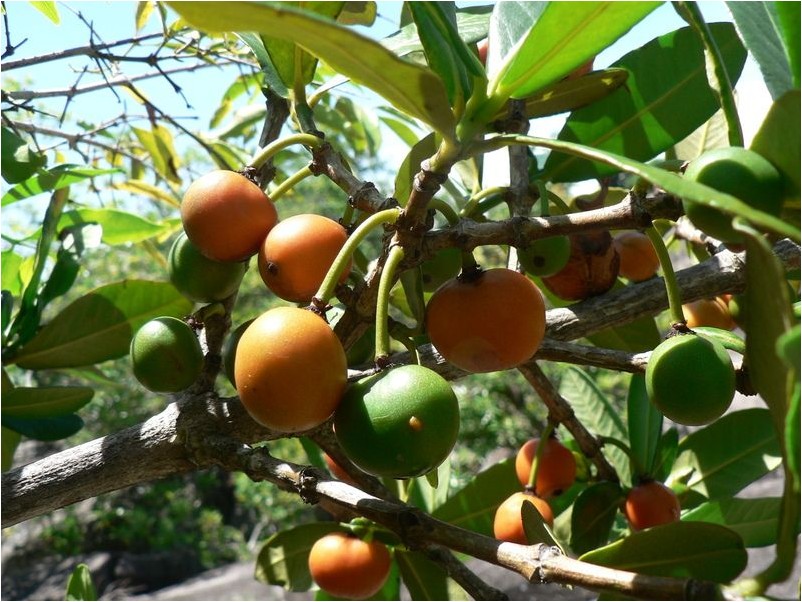
Imbe (lat. Imbe) is an exotic fruit, often called African mangosteen or Livingston”s garcinia. In fact, it is one of the varieties of garcinia.
Description
Imbe is a shade-tolerant, evergreen and slow-growing tree, rarely exceeding seven meters in height. The oval paired leaves of imbe are painted in bluish-greenish tones and are equipped with clearly defined whitish veins. They reach a length of six to eleven centimeters, and their width ranges from three to five and a half centimeters. And the leaves grow, as a rule, in whorls (three or four pieces) or in opposite pairs.
All imbe flowers, formed in clusters located on the stems, are collected in spectacular racemose inflorescences, each of which has from five to fifteen flowers. And the color of the flowers can be yellowish, whitish or greenish.
The spectacular pinkish-orange fruits of imbe, famous for their coloring effect, are usually very small — their size rarely exceeds three centimeters. The skin of the fruit is very thin, and the flesh is sweet, juicy and fibrous. Each fruit contains one very large seed. The taste of imbe is sweet and sour, very rich and bright. As for the aroma, it is somewhat reminiscent of the aroma of apricots.
The pulp of the fruit contains a small amount of latex, which causes the stickiness of the juice they secrete, which some people sometimes really don’t like. True, in view of the excellent taste, this small drawback can be easily tolerated.
Where does it grow
It will not be difficult to try imbe in the vast expanses of distant Africa, and its homeland is East Africa. The southern Florida climate is ideal for growing imbe. Unfortunately, this fruit is practically not imported into other countries — this is due to its incredibly thin skin, which is not difficult to damage. And fruits with damaged skin immediately begin to deteriorate — this factor is the main obstacle to its movement over considerable distances.

It is noteworthy that the capital of Mozambique is decorated with the imbe tree, and this beautiful plant can also be seen in Zimbabwe and Zambia, near Victoria Falls.
Application
Imbe fruits are either consumed fresh, or made into jam, and delicious desserts are prepared with their addition, or imbe pulp is used as a filling for a wide variety of pies. Quite often, imbe is dried — the dried fruits are very similar in taste and appearance to raisins. Imbe also makes excellent jams, juices, wines, liqueurs and various sweetened canned foods. In Africa, these fruits have long been a traditional plant food. However, in some regions, imbe is also grown as an ornamental crop.
This fruit is very rich in vitamins and substances that actively contribute to the prevention of oncology. And the local population constantly uses it as a powerful aphrodisiac. In addition, various animals and birds (including elephants) eat imbe with pleasure, and the trunks of this tree are an excellent building material.
Imbe roots and bark contain an impressive amount of phytoncides, which allows them to be used in the treatment of various infectious diseases, including such dangerous and serious diseases as tuberculosis and meningitis. Imbe leaves boast a pronounced antiseptic effect, and its juice is often used as a dye.
Contraindications
Imbe has no contraindications as such, but consuming these fruits does not exclude the risk of developing allergic reactions.