Actinidia
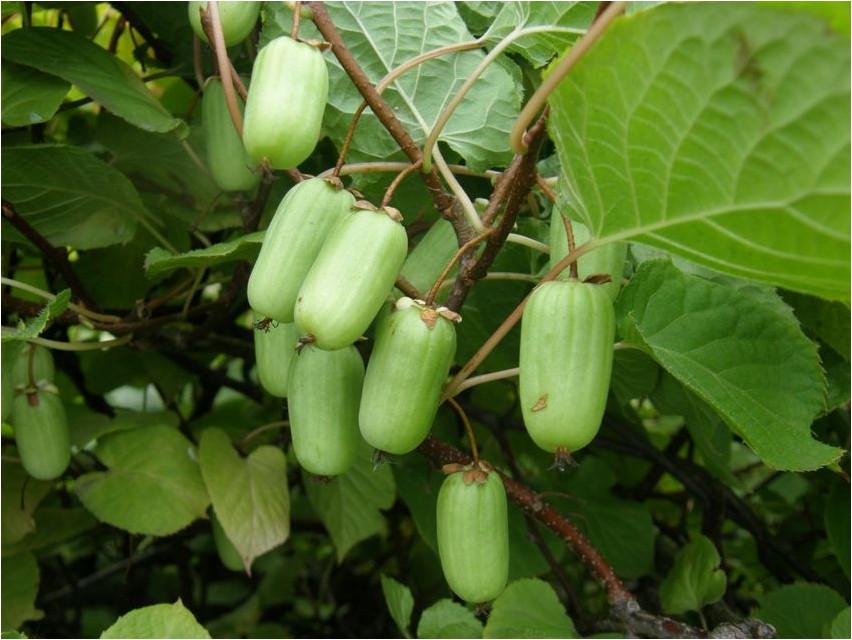
Actinidia (Latin: Actinidia) is a genus of woody vines in the Actinidiaceae family. One of the well-known cultivated species of this genus is the kiwifruit (Actinidia deliciosa).
Currently, there are approximately 40 species. Their natural range is the Himalayas, Southeast Asia, and Central Asia. Some species are found on the island of Java and in Russia (the Far East). In the wild, actinidia grows in deciduous and mountain cedar-broadleaf forests and forest edges.
Cultural Characteristics
Actinidia is a shrubby vine up to 5 m tall with numerous branches thickened at the base. The shoots of all species are of three types: fruiting, vegetative, and mixed. Annual growth averages 1. 5-2 m. Actinidia has a robust, densely branched root system, with the bulk of the roots located at a depth of 20-35 cm, and individual roots at a depth of 100-120 cm.
The leaves are green, entire, with serrated or toothed margins, lacking stipules, and arranged alternately. The buds are partially or completely hidden within leaf scars. The flowers are small, 1-3 cm in diameter, solitary or gathered in axillary inflorescences. The perianth is four- or five-membered, double. The corolla is white, orange, or golden-yellow, cup-shaped. The flowers of most species are unscented, but Actinidia polygamum, for example, boasts a pleasant aroma.
The fruit is an oblong berry, yellow, green, yellow-green, or light orange in color. Actinidia blooms in mid- to late May. The plant begins to bear fruit 3-4 years after planting. Kolomikta anemone is a species that grows not only as a vine but also as a low-growing shrub with non-climbing shoots. Furthermore, this species is distinguished by its increased frost resistance. Species grown in Russia are valuable and nutritious, with fruits reminiscent of pineapple in flavor.
Growing Conditions
Actinidia is a heat-loving plant. To mitigate the negative effects of low temperatures, it is important to place the plants in areas with full daylight, protected from cold, piercing winds. Actinidia thrives in locations with partial shade. Plants can be grown on the southwest or south side of buildings. Loose, moderately moist, fertile soils with a neutral pH are preferred. Support for actinidia is essential, such as ladders, trellises, etc.

Propagation and Planting
Actinidia is propagated by seeds, layering, semi-lignified and lignified cuttings. Cuttings 10-15 cm long are cut in early July; each cutting should have at least 2-3 leaves. The lower leaves and the green part of the shoot are removed, and the upper ones are shortened by half. The cuttings are treated with growth stimulants and planted in an inclined position in a mixture consisting of river sand and peat in a 2:1 ratio. For successful rooting, the layer of substrate must be at least 20 cm. At first, the cuttings are shaded and kept moist. The cuttings take root in 15-20 days. By autumn, young plants are covered with a dense layer of sawdust or humus, and in the spring they are transplanted to a permanent place.
The simplest and most reliable method of propagation is by layering. In mid-to-late May, healthy lower shoots are bent to the surface of the earth, pinned and covered with soil. The next year, the rooted cuttings are separated from the mother bush and transplanted to a permanent place. The seed method is time-consuming but effective. The seeds are subjected to preliminary stratification, which lasts two months. The seeds are sown in seedling boxes and kept in a room with an air temperature of 20-25C until germination. At the end of May, boxes with seedlings are transferred to the garden and shaded. Next spring, young plants are planted in a permanent place. Actinidia grown by sowing seeds begin to bear fruit at 5-7 years. The area for actinidia is prepared in advance: the soil is dug up, good drainage is made from pebbles, sand or gravel, humus (8-10 kg per 1 sq. m), superphosphate (150-200 g), potassium chloride (70-80 g), ammonium nitrate (40-50 g) and wood ash are added.
Care
In the first year of life, actinidia need systematic watering, weeding, fertilizing and careful loosening. In the second year, a support about 2-2. 5 m high is installed in close proximity to the plants. The vines are tied to the lower beam in the same vertical plane. In the third year, young shoots from the main vines are tied up so that they do not intertwine. In the fourth year, one of last year”s shoots is removed and replaced with a new one, and so on. The crop needs pruning; this is done in the fall. Spring pruning is undesirable; as a rule, it leads to drying out of the plants. Sanitary pruning is carried out in the summer, thinning the crown.





