Bilimbi
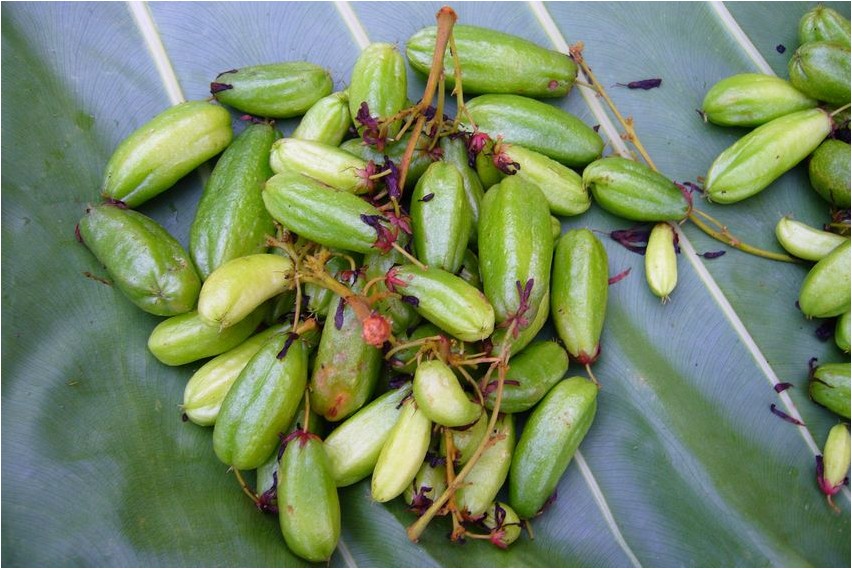
Bilimbi (Latin: Averrhoa bilimbi) is a fruiting plant in the Oxalis family, often called the cucumber tree. This plant is related to the well-known wood sorrel.
Description
Bilimbi is a stunningly beautiful deciduous tree, which can reach a height of ten meters. The short trunks of these trees branch into several upward-sloping branches.
The length of the compound leaflets of bilimbi can vary from thirty to sixty centimeters, with each leaflet formed by an odd number (eleven to thirty-seven) of oval-oblong leaflets. These leaflets always point downward and are arranged oppositely. The leaflets are always darker on top than on the bottom, and they are covered with short hairs.
Bilimbi flowers are pleasantly fragrant and colored in crimson or yellowish-green tones. All of them form beautiful panicle-shaped inflorescences and grow either from old, large branches or directly from the trunks.
After the bilimbi has finished flowering, it produces clusters of fleshy berries, ranging in color from white to yellowish-greenish. These berries average one hundred fifty to two hundred grams in weight and reach seven to twelve centimeters in length. Five elongated indentations run along their sides—if you cut the fruit crosswise, you”ll get a resemblance to a five-pointed star. The bilimbi is called the cucumber tree for the simple reason that these fruits resemble cucumbers.
The flesh of unripe berries is green, very juicy, and crisp, but as they ripen, it softens noticeably, and its color becomes creamy or milky white. The taste of the pulp is usually sour and somewhat reminiscent of a mixture of grapes, apples, and plums. However, sometimes you”ll encounter fruits that taste like a combination of plum and gooseberry. Inside each fruit, you”ll find several disc-shaped seeds, up to 6 mm wide.

Where it grows
The homeland of this culture is Malaysia. However, it is now grown outside its homeland: in Indonesia, Tanzania, Myanmar and India, as well as in Thailand, the Philippines and Sri Lanka. And at the end of the nineteenth century, it was introduced in the Antilles, Northern Argentina, Brazil, Suriname, Colombia, as well as in a number of Central American countries, Ecuador, Guyana, Venezuela and Jamaica. Since this crop is incredibly heat-loving, it is grown exclusively in warm countries.
Application
Since bilimbi is a very sour fruit, it is practically not consumed fresh. But these fruits will be an excellent seasoning for beans, boiled rice, as well as various fish and meat dishes. By the way, unripe fruits are also quite suitable for use as a seasoning. And from the ripened fruits they prepare excellent non-alcoholic drinks, and also add them to marinades and popular curry sauce. In addition, jelly and jam are made from bilimbi, but in order to prepare them, you must first thoroughly soak the fruits in salted cold water — this will help rid them of excess acid.
Bilimbi acid is due to the presence of oxalic acid in these fruits, which gives this crop a lot of useful properties: for example, bilimbi leaves are applied to the bites of poisonous animals and are widely used for skin rashes and rheumatism. And the high content of valuable microelements and vitamins makes these fruits a real boon for athletes and people whose work involves serious physical activity. Bilimbi fruits are also beneficial for the nervous, cardiovascular and musculoskeletal systems.
Contraindications
Since bilimbi fruits contain a lot of oxalic acid, people suffering from urolithiasis or having kidney stones should avoid consuming them. A high content of organic acids can lead to exacerbation of gastrointestinal ulcers. And even with hyperacid gastritis, eating bilimbi is also undesirable.
BILIMBI (Bilimbi)
https://www. youtube. com/watch? v=rJHW9EcqVzA