Chestnut
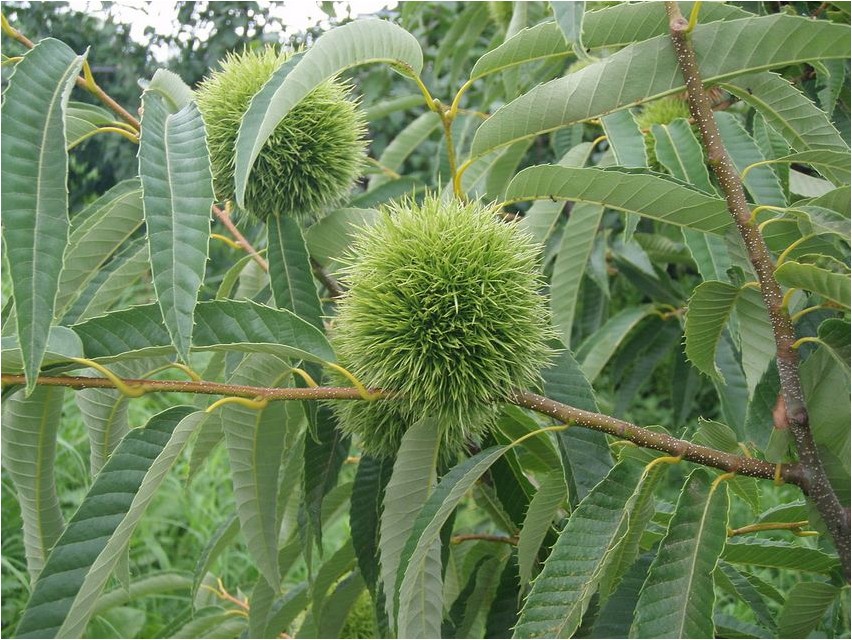
Chestnut (lat. Castanea) is a genus of trees and shrubs of the Beech family. Under natural conditions, chestnut grows in the Mediterranean, on the Atlantic coast of the United States, in the Caucasus and East Asia.
Most often found on mountain slopes, in shaded areas with brown, moderately moist soils. Currently, the genus includes ten species.
Characteristics of culture
Chestnut is a deciduous tree, less commonly a shrub, up to 50 m high. The root system is powerful, the tap root goes 25-40 cm deep in the first year of life. Subsequently, the crop develops a deep root system with several roots going obliquely deep into the soil. The trunk is covered with deeply furrowed, thick brownish-brown bark. The leaves are simple, lanceolate or oblong-oval in shape, dark green in color, serrated edges, reach 6-25 cm in length, arranged on short petioles in a spiral-bi-row arrangement. The buds are leathery, scaly, round-conical. Stipules are pinkish-whitish in color, tongue-shaped.
The flowers are collected in balls, forming cylindrical and thin earrings 5-15 cm long. The plus is spherical, pubescent on the inside, covered on the outside with hard branched spines, which crack into 2 or 4 segments as they grow. One plus contains 1-3 fruits. The fruit is a nut, woody-leathery, shiny, glabrous or pubescent, brown in color, can be spherical or ovoid, and has a wide grayish heel at the base. The seeds are light brown, triangular-spherical, with a large yellow-white embryo.
Growing conditions

Chestnut is a heat-loving crop and prefers moderately shaded areas. The soils for growing chestnuts are sandy, gneiss or slate. Plants react negatively to calcareous, acidic, clayey, dry and waterlogged soils. Chestnuts are moisture-loving, grow and develop well in regions with high humidity. They do not tolerate prolonged temperature drops t o-15C.
Reproduction and planting
One of the most effective and affordable methods of propagation is the seed method. Sowing of seeds is carried out in the fall in open ground. The seeding depth is 3-5 cm. The distance between plants should be 10-15 cm. The seeds do not need preliminary stratification. Chestnut seedlings appear in early spring; they must be systematically fed, watered and freed from weeds.
Chestnut seedlings are planted in the spring. Planting holes are prepared 2-3 weeks in advance. The soil removed from the pit is mixed with humus, sand, dolomite flour and slaked lime. A thick layer of drainage in the form of pebbles or crushed stone is placed at the bottom of the hole, 1/3 of the prepared soil substrate is added, the seedling is lowered, straightening the roots, sprinkled with the remaining mixture and compacted. Immediately after planting, abundant watering and mulching of the tree trunk circle is carried out. Important: the root collar of the seedling should be located 8-10 cm above the soil level.
Care
In general, caring for chestnuts is not difficult. The crop needs regular and abundant watering, especially during periods of prolonged drought. Chestnuts respond well to loosening near the tree trunks (at least 2-3 times per season). High-quality plant care includes feeding with urea, mullein, ammonium nitrate, potassium salt and superphosphate. In winter, the soil near the tree trunks is mulched with sawdust, peat or fallen leaves for insulation. Chestnuts require formative and sanitary pruning. The culture has a positive attitude towards haircuts. Chestnuts are quite resistant to diseases and pests and are rarely affected by fungal infections.
Application
Chestnut is a highly ornamental plant, often becoming a key object in the formation of landscape design of a personal plot. Chestnuts look great both in single and group plantings. Dwarf forms are used to create hedges. They fit harmoniously into compositions consisting of shrubs and trees, whose foliage in texture and color creates a clear contrast with chestnut leaves.
The plant looks advantageous close to garden buildings (gazebos, benches, recreation areas, etc.) and artificial ponds. Chestnut is in demand not only in landscape design; its wood is considered a valuable material that is used for the manufacture of interior items and furniture. The fruits of the plant are widely used in cooking.