Elecampane
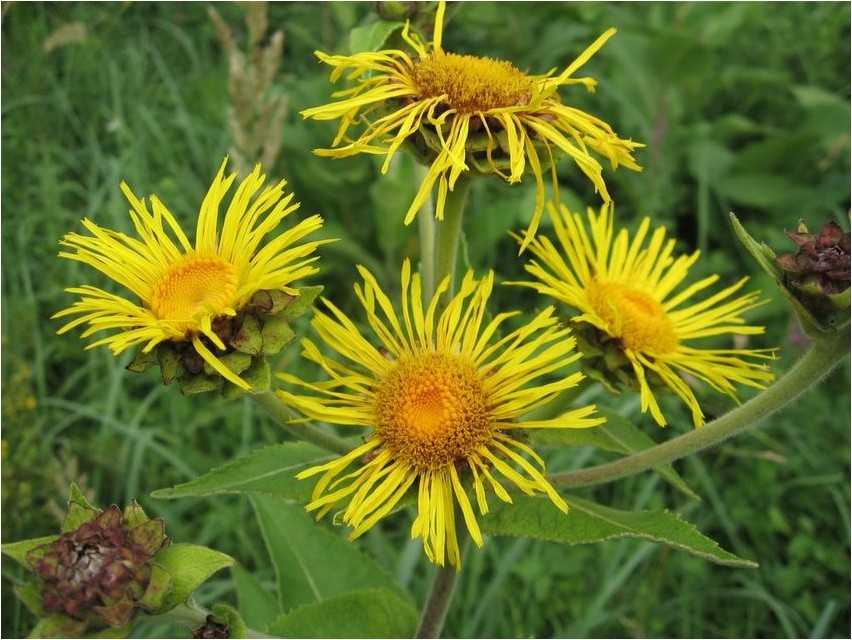
Elecampane is a member of the Asteraceae or Compositae family. Its Latin name is Inula helenium L.
As for the family name itself, it is Asteraceae Dumort.
Description of Elecampane
Elecampane is a perennial herbaceous plant that grows to a height of approximately one to two meters. Its rhizome is quite thick and fleshy, with thick roots and a dark brown color. The stems of Elecampane are straight, felted at the top and softly hairy at the base. The leaves are alternate, petiolate, and basal, oblong-elliptical in shape, and also claspive and cauline. Elecampane’s inflorescences are quite large, reaching six to eight centimeters in diameter, in heads. These inflorescences are gathered at the tops of the main stem and branches into loose racemes or corymbs. The flowers of this plant are golden-yellow, with inner florets being tubular and marginal florets being ligulate. The anthers are located at the base and have long appendages. The involucres of the heads are multi-leafed, also bearing outward-facing leaflets. The fruit of this plant is a brown, prismatic achene, approximately three to five millimeters long.
Elecampane blooms from July to August, and the fruits ripen in August-September. In the wild, this plant can be found in the European part of Russia, Belarus, Central Asia, Western Siberia, and the Caucasus. Elecampane prefers to grow along lake and river banks, in damp meadows, pine forests, and among shrubs in deciduous forests.
Description of Elecampane’s Medicinal Properties
Elecampane has valuable medicinal properties that are widely used. For this purpose, the roots and rhizomes of this plant should be harvested, which is recommended in late autumn, after the above-ground parts of the plant have died back, or in early spring, before new growth begins.
The presence of such valuable healing properties is explained by the content in the rhizomes of this plant of inulenin, inulin, resins, tannins, pseudoinulin, sitosterol isomer, triterpene saponins, bitter substances, as well as the following acids: myristic, acetic, benzoic and palmitic. Also in the rhizomes of this plant there is an essential oil that can dissolve in organic solvents. Elecampane grass contains vitamin E and essential oil, while the leaves contain ascorbic, propionic, acetic and fumaric acid, as well as tannins.

Preparations based on this plant are endowed with diuretic, expectorant, anti-inflammatory, bactericidal, antimicrobial, astringent, antifungal, antiallergic and antispasmodic effects.
In the form of a decoction, this plant is used for chronic bronchitis as an expectorant, and it can also be used for tracheitis, pulmonary tuberculosis with sputum production, bronchial asthma, influenza, inflammation, duodenal and gastric ulcers, enterocolitis, erosive gastritis and duodenitis.
As for traditional medicine, here this plant is used for intestinal atony, hemorrhoids, cholecystitis, liver diseases, jaundice, dropsy, fever, neuroses, benign and malignant tumors.





