Wild strawberry
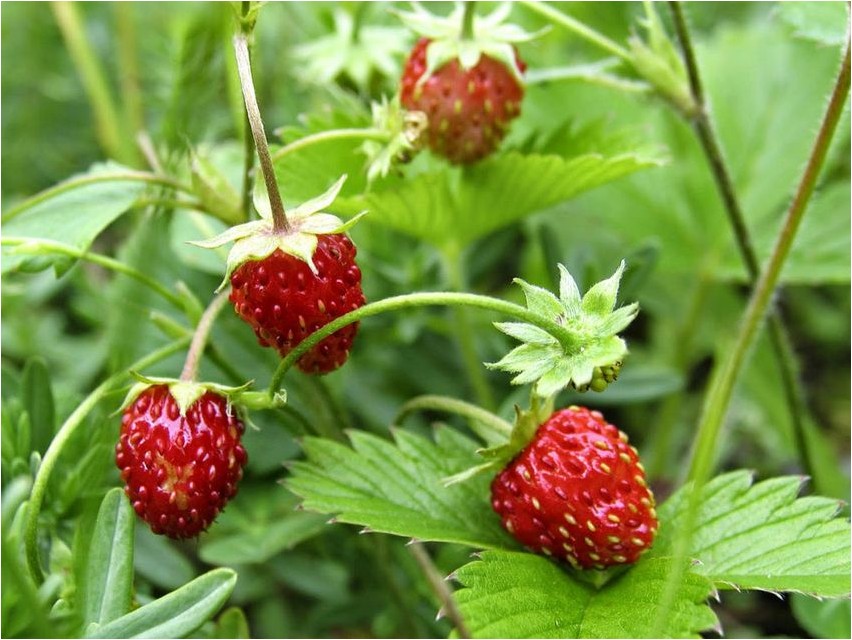
Wild strawberry is one of the plants of the family called Rosaceae; in Latin the name of this plant will be as follows: Fragaria vesca L.
As for the name of the wild strawberry family itself, in Latin it will be: Rosaceae Juss.
Description of wild strawberries
Wild strawberry is a perennial herbaceous plant whose height is about fifteen to twenty centimeters. The plant will be endowed with a short oblique rhizome, as well as numerous thin roots and long thin creeping shoots. Such shoots will take root at the nodes: they are responsible for vegetative propagation. The leaves of this plant are trifoliate, rather large, serrated and silky-fibrous. Wild strawberry flowers are quite large and bisexual; the calyx and the subcups each contain five leaves. There are only five petals, but there are quite a lot of stamens and pistils; the petals are painted white. The fruits of this plant are egg-shaped false berries, they are juicy and bright red in color, the fruits are endowed with sepals bent downwards.
The flowering of wild strawberries begins in May and ends in June, while the fruits ripen between June and July. Under natural conditions, this plant is found in the territory of Belarus, Ukraine, the Caucasus, in the mountains of Eastern Kazakhstan, as well as in forest and forest-steppe regions of Western and Eastern Siberia. In addition, the plant can be seen in the European part of Russia, with the exception of the Far North and the southern part of the steppe zone. For growth, the plant prefers clearings, clearings, edges, places among bushes, light forests and dry grassy slopes.
Description of the medicinal properties of wild strawberries
Wild strawberries are endowed with very valuable healing properties, the presence of which is explained by the content of carotene, ascorbic acid, sugar, malic and salicylic acid, folic acid, tannins, manganese, iron salts, phosphorus, calcium, cobalt, quercitrin and quercetin in this plant. The rhizomes and roots of wild strawberries contain tannins.
The medicinal raw materials will be berries in both fresh and dried water, as well as roots and leaves. It should be noted that wild strawberries have been used for medicinal purposes since ancient times.

As for traditional medicine, here this plant is used as a dietary remedy for various diseases of the kidneys, heart and liver, and in addition, wild strawberries are a source of vitamin C. Remedies based on this plant are used for inflammation of the gastrointestinal tract, to regulate intestinal activity and for diarrhea. The plant improves appetite and quenches thirst. It should be noted that in large quantities, wild strawberries are endowed with a very valuable anti-rheoid effect.
For lichen ruber, you should take a decoction of wild strawberry leaves: one glass three times a day before meals, preheated. This product should be used for one month. At the same time, this decoction is also used locally in the form of applications and baths. Also, such an infusion based on wild strawberry leaves is also a very effective antiscorbutic agent, which will contain a large amount of ascorbic acid. It should be noted that those people who consume two glasses of this product per day will completely cover the need for ascorbic acid during the winter.
For bleeding, take the following remedy: leave twenty grams of crushed leaves in a glass of boiled water for two hours. Take this remedy two tablespoons three to four times a day.





