Myricaria germanica
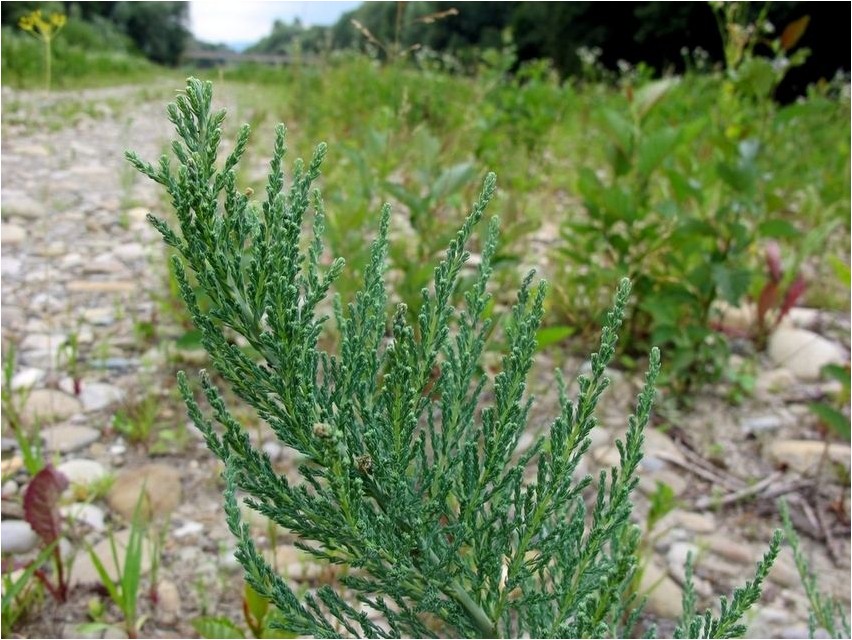
Myricaria germanica is one of the plants of the family called Combaceae; in Latin the name of this plant will be as follows: Myricaria germanica (L.) Desv. (Tamaria germanica L).
As for the name of the Germanic Myricaria family itself, in Latin it will be: Tamaricaceae Link.
Description of Germanic myricaria
Myricaria germanica is a shrub whose height can reach two and a half meters. Such a plant will be endowed with reddish-brown bark and numerous, densely leafy branches. The leaves of Germanic myricaria can be either linear-oblong or linear; they are quite small in size, their length is about two to four millimeters, and their width does not exceed one and a half millimeters. Also, such leaves are pointed. The brushes of this plant are dense at the top, their length is four to ten centimeters, and their width is only slightly more than a centimeter. The petals of Germanic myricaria are painted in white, lilac-red or pink tones, they will be oblong-elliptical in shape, their length is five millimeters, and the width is about two and a half millimeters, and these petals will be blunt and falling. The capsule of this plant is elongated pyramidal, its length is eight millimeters and its width is three millimeters. The seeds of Germanic mycaria will be quite small, and their length will be one millimeter.
This plant blooms from June to July. Under natural conditions, this plant is found in the Caucasus, Crimea and Carpathians in Ukraine. In terms of general distribution, Myricaria germanica can be seen in the northern Mediterranean, southern Scandinavia, Central and Atlantic Europe. For growth, this plant prefers valleys of mountain rivers and streams, pebbles and sand.
Description of the medicinal properties of Germanic myricaria
Myricaria germanica is endowed with very valuable healing properties, and it is recommended to use the leaves, bark, and green twigs of this plant for medicinal purposes. The annual shoots of Myricaria germanica should be called green branches.
The presence of such valuable healing properties should be explained by the content of organic acids, vitamin C, tannins, alkaloids, tamarixetine, kaempferide, isoquercetin and quercetin in this plant.

As for traditional medicine, remedies based on this plant are quite widespread. A decoction prepared from the bark of myricaria germanica is recommended for use for bleeding, hemoptysis, and is also used as an astringent for various diseases of the spleen. A decoction prepared from the green branches of myricaria germanica should be used for bleeding, hemoptysis and various gynecological diseases.
The powder from the dried leaves of this plant should be used as a hemostatic agent for cuts. It is noteworthy that the leaves of Germanic myricaria are used as a tea substitute, and the stems are used to make smoking pipes. It should be noted that the bark of this plant is also a dye and tanning agent, and in the presence of iron salts, this plant will dye the fabric black.
For hemoptysis and bleeding, the following remedy is used: ten grams of crushed bark per glass of water is boiled over low heat for eight minutes. Then the resulting mixture should be infused for one hour, filtered and brought to the original volume with boiled water. Take the resulting medicinal product based on Germanic myricaria three times a day, one-third or one-fourth of a glass.





