Cotinus (Cotinus)
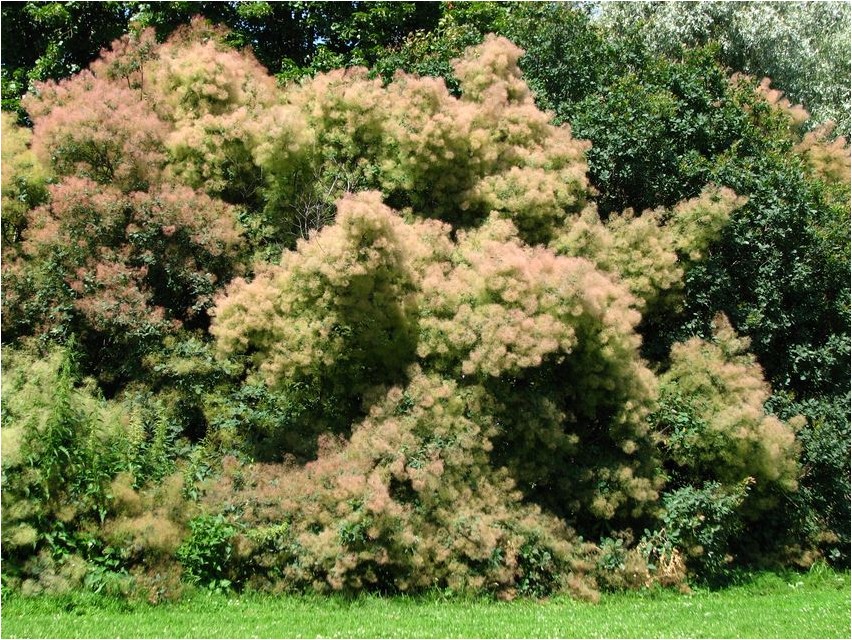
Cotinus (Cotinus) is a sun-loving woody plant in the sumac family. It is also known as sumac.
Description
Cotinus is a beautifully flowering deciduous tree or shrub that can grow to either tall (over three meters) or medium-sized (one to two meters).
Cotinus”s simple, rounded leaves are ovoid in shape. With the onset of autumn, they turn a vibrant, rich brownish-red. Rubbing these leaves in your hand, you can smell the distinct aroma of carrots! The numerous, often underdeveloped, flowers of this beauty are gathered in sparse, fairly large panicles. The flower color can be greenish or yellowish. The panicles of flowers are borne on elongated peduncles densely covered with greenish or reddish, long, splayed hairs. In the fall, these peduncles grow abundantly, making the plants even more decorative.
The genus Ecstasy includes only two species, one of which grows exclusively in North America, and the other in Europe.
Where it grows
As mentioned above, one species of Ecstasy is found only in North America, and the other in Europe. Nowadays, this plant is also easily seen in gardens and parks located south of Moscow, where you can find forms with purple or golden leaves, as well as equally interesting forms with weeping branches.
Uses
Ecstasy is successfully used both as a solitary plant and in incredibly colorful group plantings; it also looks great in combination with a number of other ornamental shrubs. These trees are often planted in shelterbelts. The dried branches of this beauty, along with their blossoms, are used to create magnificent winter bouquets. Incidentally, this plant was first cultivated as far back as 1650!
Yellowstem is also a valuable source of organic dyes (it produces a fairly stable yellow and orange dye called fisetin) and tannins used in leather tanning. Yellowstem is also widely used in the textile industry.
And the yellow, aromatic wood of this plant, for which it is called yellowberry, is actively used in the manufacture of various kinds of inlays, as well as all kinds of crafts and musical instruments. By the way, cabinetmakers also call this wood “fustik”.

Growing and care
Yellowberry should be planted in areas reliably protected from the wind. These trees prefer to grow on air-permeable light loams containing lime; however, they also tolerate acidic soils quite well, but only on the condition that these soils are not characterized by stagnant moisture. As a rule, yellowberry planting is carried out either in the fall or in the spring. And on heavy soils, sand must be added before planting!
It makes sense to water yellowberry only when there are long periods of drought. You can also do pruning from time to time — this plant tolerates it very well. By the way, those trees and shrubs that are grown exclusively for their original flowers do not need to be pruned — in this case, it will be quite enough to simply promptly remove the interfering or dry branches.
Reproduction of yellowberry is carried out by separating root shoots, as well as by semi-lignified cuttings or layering.
57139; Mackerel shrub — planting and care, tanning species of leather plant — cultivation in the Moscow region