Smyrnia pierced leaf
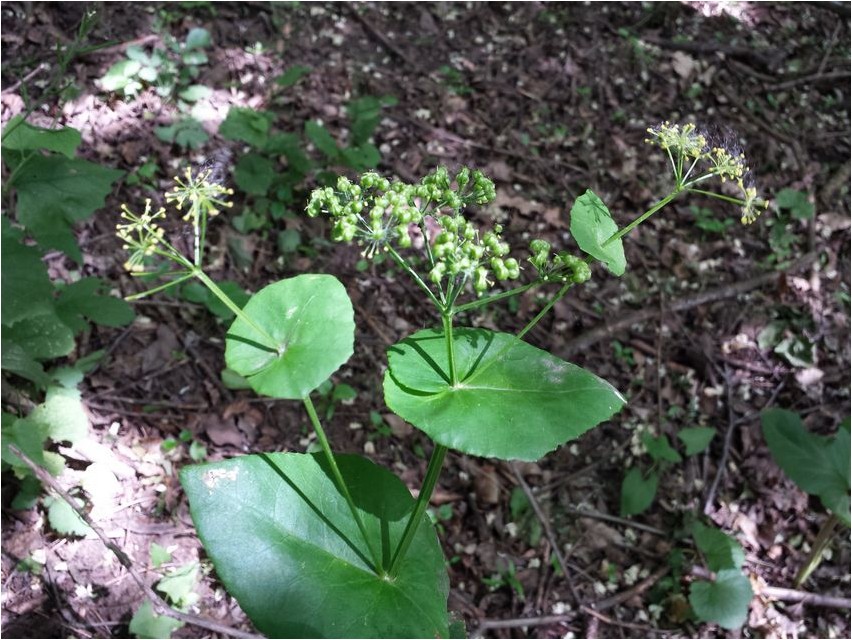
Smyrnia perfoliatum L. is one of the plants of the family called Umbellaceae; in Latin the name of this plant will be as follows: Smirnium perfoliatum L.
As for the name of the myrrhia pierced-leaved family itself, in Latin it will be: Apiaceae Lindl. (Umbelliferae Juss.).
Description of myrrhia pierced leaf
Smyrnia pierced leaf is a biennial or perennial herbaceous and glabrous plant, the height of which will fluctuate between forty and one hundred and twenty centimeters. The root of such a plant is thickened, it can be either spherical or ovoid. The stem of Smyrnia piercefolia will be leafy, and at the top it will be branched and endowed with winged grams. The basal leaves of this plant are on petioles; they are doubly dissected and endowed with crenate-serrate and oblong-ovate leaves. The length of such leaves will be about four to eight centimeters, and the width will be equal to two and a half to four and a half centimeters. Umbrellas of myrrhia pierced leaf can either be on legs or be sessile; they are endowed with about six to ten bare rays, which in turn will vary in length. The petals of this plant are colored greenish-yellow, they are broadly ovate and have an inwardly curved apex, and the length of the petals does not exceed one centimeter. The length of the fruits of myrrh pierced leaves is two and a half to three and a half millimeters, they are shiny and black in color.
This plant blooms from May to June. Under natural conditions, myrrhium pierced foliage is found in the Crimea, as well as all regions of the Caucasus, with the exception of the South Caucasus region. For growth, this plant prefers limestone cliffs, oak forests, shady gorges, broad-leaved and oak-hornbeam forests.
Description of the medicinal properties of myrrhia pierced foliage
Smyrnia pierced leaf is endowed with very valuable healing properties, and it is recommended to use the fruits and leaves of this plant for medicinal purposes.
The presence of such valuable healing properties should be explained by the content of kaempferol, quercetin and quercetin 3-beta-D-glucoside in the herb of this plant, while vitamin C, quercetin, isorhamnetin 3-glucoside and kaempferol were found in the leaves. The fruits will contain essential oil, which contains germacrol, as well as fatty oil with petroselinic acid in its composition.

A decoction and infusion prepared from the fruits of myrrhium pierced folia are indicated for use in cases of flatulence and bronchial asthma. An infusion based on the leaves of this plant should be used as an antiscorbutic agent. the leaves are used as vegetables for salads, and the roots, in turn, can be used as a very aromatic spice for preparing various soups.
For bronchial asthma, it is recommended to use the following very effective medicinal remedy based on this plant: to prepare such a medicinal product, you will need to take one teaspoon of myrrhia pierced leaves seeds per glass of water. The resulting healing mixture should first be boiled over fairly low heat for about three to four minutes, then the mixture is left to infuse for two hours, after which this remedy must be filtered very carefully. Take the resulting medicine based on myrrhia pierced foliage three to four times a day, two tablespoons before meals.