Hevea brasiliensis
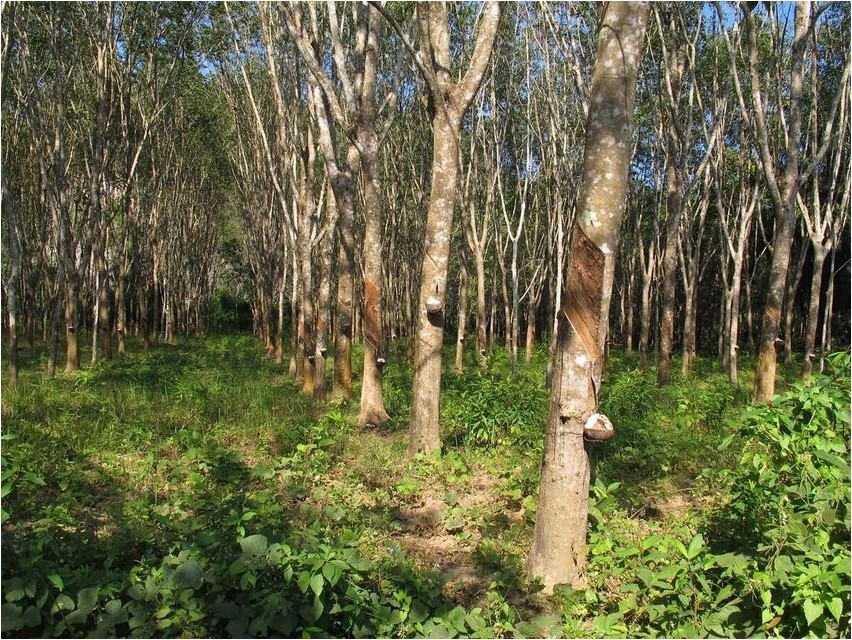
Hevea brasiliensis (lat. Hevea brasiliensis) is a tropical evergreen tree, through the latex vessels of which milky sap slowly flows, which is the main source of natural rubber.
If the Almighty had not planted Hevea brasiliensis on Earth, we would not be driving comfortable cars today, tires rustling on the asphalt or leaving behind a hurricane of dust on the country road leading to the dacha. True, today scientists have invented a method for artificially producing rubber, but Hevea brasiliensis continues to be the main supplier of natural rubber.
History
One of the names of Hevea brasiliensis is “Rubber tree Para”. The word “Para” pays tribute to the Brazilian northern state, which ranks second in area in the country, with the name Para. Translated from the Indian language, it means “river”. This is very symbolic, because the Para rubber tree, through whose vessels a river of milky latex flows, initially grew only in tropical forests along the banks of rivers such as the Amazon and its tributaries, including the Para River.
After a thinking person came up with the vulcanization process, a “rubber fever” began among business people, enriching the especially enterprising and allowing the State of Para to revive its dormant economy. This privilege of the Brazilian state did not suit a crowd of businessmen from other places, and therefore Hevea seeds were smuggled out of the country and the plant quickly spread to the British colonies of Southeast and South Asia, as well as to the tropics of West Africa.
The word “rubber” is also borrowed from the language of the American Indians. They called the milky sap dripping from the wounded trunk “kao-chu,” which meant “tears of the tree.” From these “tears” the boys made a soft ball and strengthened their legs by playing with it.
Description
In the wild, the evergreen Hevea brasiliensis raises its crown to the skies to a height of up to 30 meters. The diameter of a straight trunk with light bark can reach half a meter.

The leathery trifoliate leaves are not devoid of decorativeness, which is given to the oval leaf by clearly defined veins. The tip of the leaf is pointed.
Loose clusters of inflorescences are formed by white-yellow small unisexual flowers. Male and female flowers are on the same tree, that is, Hevea brasiliensis is a monoecious plant.
Hevea seeds are reliably protected by a dense shell and a fruit — a capsule that hides three seeds in its three compartments.
Production life of Hevea brasiliensis
Although botanists don”t fully understand the role of the latex in the plant, aside from its protective role against enemies, it clearly has other functions. Therefore, trees harvested by humans, who extract the latex for their own needs, age faster than wild trees. At 25-30 years old, they become economically unprofitable, producing less and less latex, and are therefore felled. Previously, they were simply burned for firewood, but later, furniture was made from the wood. However, the wood of the Hevea brasiliensis is very dense and difficult to glue.
The process of collecting latex has its own name: “tapping.” A spiral cut is made in the tree bark, cutting through the tree”s latex vessels. If a true professional with a thorough understanding of the tree”s structure is involved, this tapping will produce latex for five years. To prevent the latex from hardening in the hot tropical sun, harvesting is done at night, or ammonia is added to the collection cup, which keeps the latex liquid longer. In Malaysia, special plastic bags are now used instead of cups.
Rubber tree. Rubber production (Hevea brasiliensis)