White cabbage
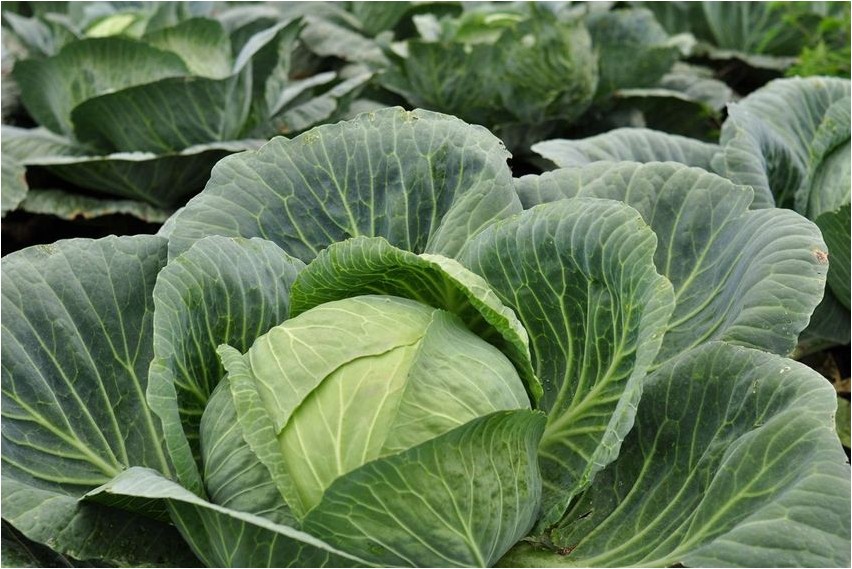
White cabbage (lat. Brassica capitata) is a popular vegetable crop; biennial plant of the Cruciferous family. The plant is native to the Mediterranean regions of Western Europe and North Africa.
Characteristics of culture
White cabbage is a plant that in the first year of life forms a compacted, shortened stem (otherwise known as a poker) with large leaves collected into a head of oval, round, cone-shaped or flat-round shape. The leaves are simple, entire, lyre-shaped, sessile or with petioles. The outer (covering) leaves are green, rarely with a purple tint; internal ones are white or yellowish. The main vein is thick, sharply protruding.
In the second year, the plant develops highly branched flowering stems with yellow or white flowers, reaching 1. 8-2 cm in diameter, and collected in corymbose or racemose inflorescences. The fruit is a pod, the seeds are spherical, black, 2 mm in diameter, and remain viable for 2-4 years.
Growing conditions
White cabbage is a light-loving plant; it prefers well-lit areas protected from northern winds. The culture has a negative attitude towards shade and thickening; the plants become elongated and are more often attacked by pests and affected by various fungal and viral diseases. When planting, a certain distance must be maintained between plants of a certain variety, otherwise the cabbage will not please its owners with high-quality and large heads of cabbage.

The soils for growing white cabbage are loamy, moisture-absorbing, rich in mineral composition, and have a pH of 6. 2-7. 5. The crop grows poorly in areas with excess nitrogen. The best plant predecessors are considered to be tomatoes, onions, potatoes, annual legumes, winter cereals and pumpkins. It is not recommended to grow white cabbage after plants of the Cruciferous family, as well as in areas clogged with field thistle and creeping wheatgrass. Such areas are treated with herbicides and fall plowing to a depth of 27-30 cm.
Growing seedlings
It”s no secret that the quality of white cabbage seedlings largely depends on the planting material, as well as growing conditions and proper care. Before sowing, the seeds are treated in hot water, the temperature of which is 40-45C, and then placed in cold water. Immediately after treatment, the seeds are dipped in a weak solution of potassium permanganate or the Fitosporin preparation for dressing. These procedures allow you to avoid damage to seedlings by blackleg.
The soil mixture for white cabbage is prepared on the basis of turf soil, peat and river sand. Instead of peat, experienced gardeners advise using rotted humus. When sowing, it is not recommended to add fresh manure and mineral fertilizers to the soil. The first fertilizing is done when seedlings are planted; wood ash and superphosphate are used for this purpose.
Sowing seeds of early varieties for seedlings is carried out on March 15-25, mid-season varieties — on April 10-20, late varieties — on April 20-25. The seeds are sown in special seedling boxes. The crops are watered with a spray bottle, covered with glass or film and moved to a room with an air temperature of 20-25C. With the emergence of seedlings, the temperature is reduced to 10C, and after a week it is raised to 15-17C.
Picking of seedlings is carried out at the age of 14-15 days. Until the seedlings take root, the room temperature should be at least 20-21C. Approximately 2-2. 5 weeks before planting seedlings in the ground, they are hardened. Seedlings of early varieties of white cabbage are planted in the tenth of May, and late varieties — in late May — early June.
Preparing the soil and planting seedlings in the ground
The area for growing white cabbage is prepared in the fall: the soil is dug up and organic matter (manure or compost) is added. In the spring, the soil is harrowed and loosened, fed with superphosphate and potassium salt, and beds with shallow holes are formed.
Seedlings should be planted in cloudy weather, in which case they will take root better. The distance between plants should be 20-30 cm, and between rows — at least 40-50 cm. Seedlings are buried down to the first leaves. After planting, the young plants are watered and shaded using available materials for a couple of days.
Care
Since white cabbage is moisture-loving, it needs regular and abundant watering. It is advisable to use warm and settled water for irrigation, this promotes better development of the root system of the crop. Increase the volume of water when watering during the formation of new leaves and, of course, during the formation of a head of cabbage.
In addition to watering, the plant requires timely weeding, loosening and hilling. During the season, two or three feedings are carried out: the first — a couple of weeks after planting the plants in open ground, the second — a month later, the third — during the formation of heads of cabbage. For feeding you can use urea, superphosphate and potassium nitrate.
Very often, the crop is attacked by flea beetles, cutworm caterpillars and cabbage whites, and aphids. If pests are detected, plants are sprayed with insecticides, for example, Aktelik, Volaton, Karate, Intavir, etc.





