Primrose large-cupped
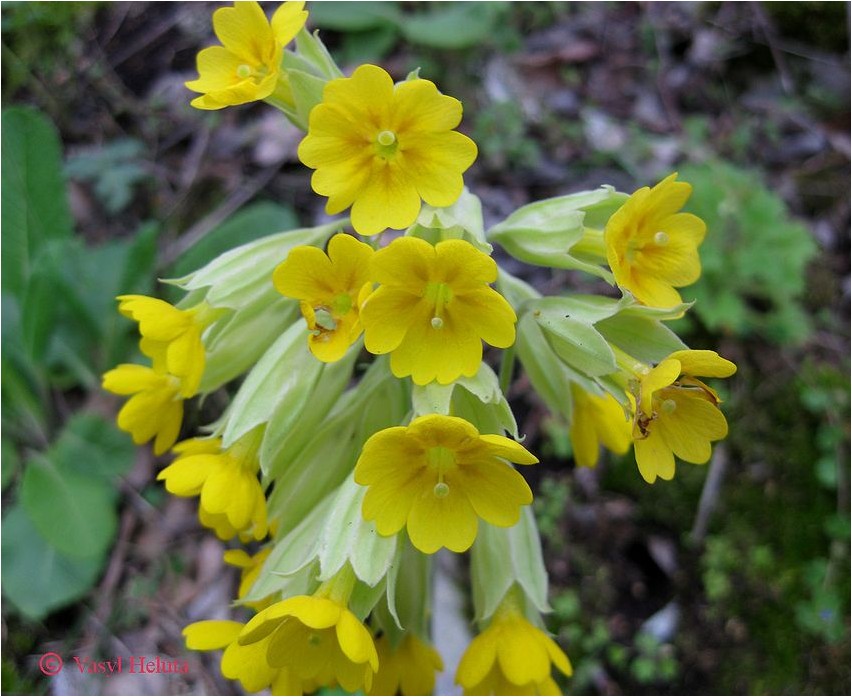
The large-cupped primrose is one of the plants of the family called primroses; in Latin the name of this plant will be as follows: Primula macrocalyx Bunge.
As for the name of the large-cupped primrose family itself, in Latin it will be like this: Primulaceae Vent.
Description of the large-cupped primrose
Primrose large-cupped is a perennial herbaceous plant, the height of which will fluctuate between twelve and thirty-five centimeters. The rhizome of this plant is oblique; it will be endowed with a large number of cord-like adventitious roots, which will be colored in brownish or whitish tones. The leaves of the large-cupped primrose will be ovate-oblong, their length will be equal to four to fourteen centimeters, while the width will be equal to two to seven and a half centimeters. The length of the arrow of this plant is twelve to thirty-five centimeters, the inflorescence will consist of three to fifteen flowers, which will mostly be inclined to one side. The calyx of the large-cupped primrose is broadly bell-shaped, swollen, its length is ten to eighteen millimeters, the corolla will be colored yellow, and inside it will be endowed with orange spots located at the very base of the limb lobes. The capsule of the large-cupped primrose is oval in shape.
This plant blooms from May to June. For growth, the large-cupped primrose prefers places among shrubs, mountains, dry meadows, forest edges and forests up to the upper limit of woody vegetation. Under natural conditions, this plant is found in the Zavolzhsky and Volga-Kama regions of the European part of Russia, Crimea, in the west of the Angara-Sayan region of Eastern Siberia, in the Caucasus, in the Upper Tobolsk region and in the south of the Ob region of Western Siberia.
Description of the medicinal properties of large-cupped primrose
The large-cupped primrose is endowed with very valuable healing properties, and it is recommended to use the leaves, roots, rhizomes and flowers of this plant for medicinal purposes.
The presence of such valuable healing properties should be explained by the content of triterpenoids, carbohydrates, vitamin C, flavonoids, carotene and D-volemite in this plant.

Infusion, tincture and alcohol extract based on primrose macrochassis are recommended for use as a diuretic, as well as an expectorant for bronchitis and pneumonia. A decoction prepared from the roots and rhizomes of this plant is recommended for use as a mild laxative, antispasmodic and sedative. In the form of tea, such healing raw materials should be used as a diaphoretic.
The infusion and powder of the leaves of this plant should be used as a laxative and diuretic, and such healing agents are also used for hypo- and vitamin deficiencies. In the form of tea, primrose flowers should be used for insomnia, dizziness, various colds, kidney diseases, heart disease, paralysis and rheumatism. It is noteworthy that in the Caucasus this healing agent is used for malaria. It should be noted that the leaves of this plant are suitable for food: we are talking about salads and cabbage soup. In addition, the large-cupped primrose is not only a very ornamental plant, but also a valuable honey plant.
For bronchitis and pneumonia, the following remedy is used: one tablespoon of crushed roots of this plant in a glass of water is boiled for three minutes, then this mixture is infused for two hours and filtered very carefully.





