White water lily
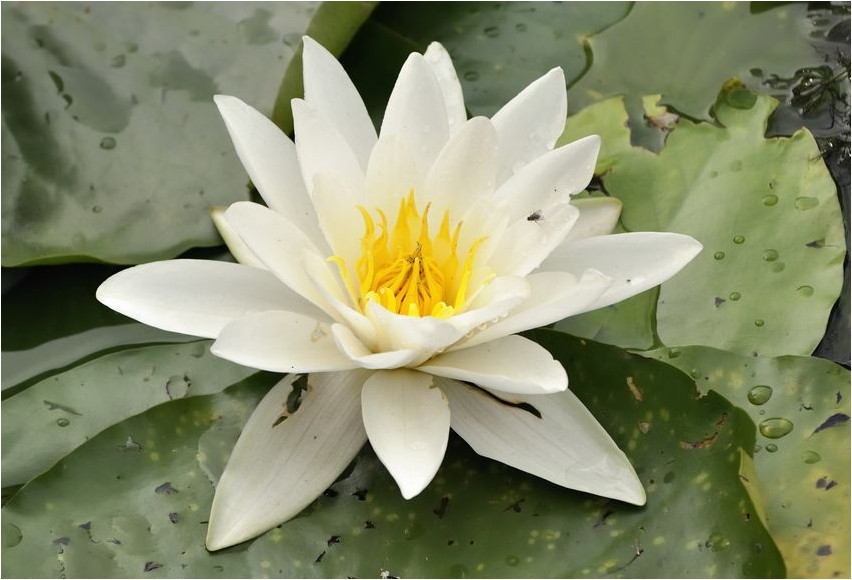
The white water lily is one of the plants of the family called water lilies; in Latin the name of this plant will be as follows: Nymphea alba L.
As for the name of the white water lily family itself, in Latin it will be: Nymphacaceae Salisb.
Description of white water lily
The white water lily is also known by the following popular names: white water lily, adaleni, balabolka, aquarius, white hens, water flower, water crown, water companion, overcomer, lachatte bile and great lapushnik. White water lily is a perennial herbaceous rhizomatous aquatic stemless plant, endowed with floating roots. The rhizomes of this plant are creeping; rounded leaves endowed with a deep-heart-shaped base will extend from such rhizomes. Also, quite long pedicels extend from the rhizome, which will bear single beautiful flowers, painted in white tones. These flowers will float on the surface of the water, are faintly fragrant and have a four-leaf green calyx and white petals. The stamens of the white water lily are numerous, while the stigma of the pistil will be multifidued and radiant. The fruits of this plant are berry-shaped, spherical in shape, they will ripen under water and are colored green.
The white water lily blooms from June to July. Under natural conditions, this plant is found in the European part of Russia, with the exception of the Arctic, in the Crimea, the North Caucasus, eastern Transcaucasia, Belarus, the Urals and the southern regions of Siberia. To grow, this plant prefers standing and slowly flowing waters: lakes, ponds and river bays.
Description of the medicinal properties of white water lily
The white water lily is endowed with very valuable healing properties. The presence of such medicinal properties should be explained by the content of tannins, starch, and the alkaloid nympheira in the composition of this plant, while the leaves contain oxalic acid and flavonoids, and the flower petals contain cardenolide, nymphalin, and the flavonoids glycoside kaempferol and quercetin. White water lily seeds contain fatty oil, starch and tannins.
For medicinal purposes, it is recommended to use the flowers, leaves and rhizomes with the roots of this plant. The roots and rhizomes of the white water lily should be harvested in the autumn, and the leaves and flowers are collected from June to July.

The flowers of this plant are endowed with hypnotic, sedative, analgesic, antipyretic and emollient effects. As for traditional medicine, an infusion prepared from the flowers of the white water lily is very widespread here. This infusion should be used as a valuable antipyretic and as a sedative for excessive activity of the sex glands, which in particular applies to painful emissions. In addition, the infusion of the flowers of this plant is also used to quench the thirst of patients.
An infusion of white water lily flowers is also recommended to be used as a sedative for insomnia and as a very valuable sleeping pill. Preparations made from the roots and rhizomes of this plant will help reduce the inflammatory processes that occur in the skin. In crushed form, the roots and rhizomes of the white water lily will be used as a very valuable external distraction, which in its effect will be very similar to mustard plasters. In the fight against hair loss, it is recommended to use a decoction of the roots of this plant in beer: you should regularly wash your hair with this decoction.





