Abiu
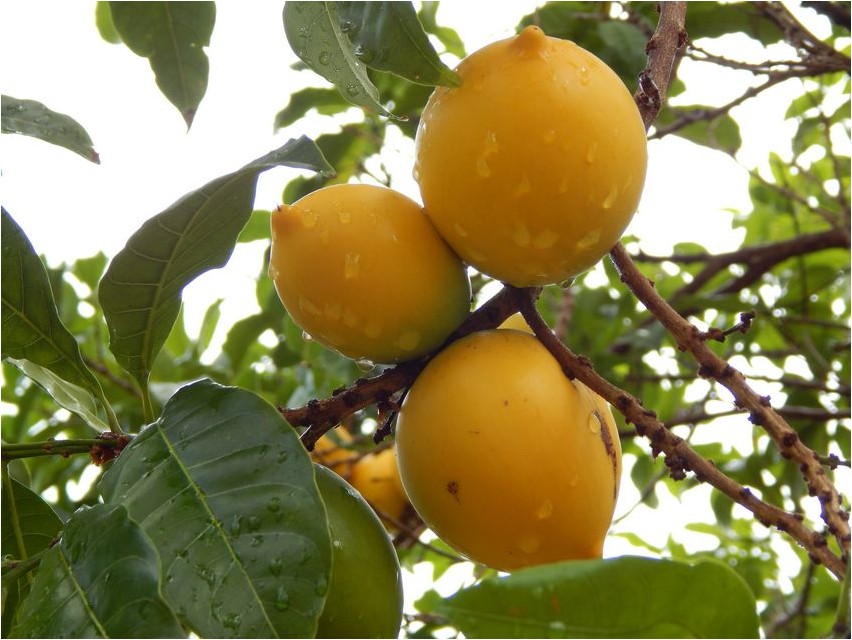
Abiu (lat. Pouteria caimito) is a juicy tropical fruit belonging to the Sapotaceae family, growing on trees reaching a height of ten to thirty meters.
Description
Abiu is a deciduous tree of medium height (the height of most trees is about ten meters) with a brownish bark, very rich in sticky latex (a mastic-like mass of a reddish or whitish color), which quickly hardens in the open air.
The glossy leaves of abiu can be either oval-oblong or elliptical. As a rule, their width varies from three to six centimeters, and their length from ten to twenty centimeters.
Abiu flowers are characterized by a greenish or white color and are located either singly or in miniature groups of two to five pieces each.
The size of the oval or round abiu fruit is identical to the size of the well-known oranges. All fruits are smooth and colored in a rich bright yellow color. And inside each fruit you can find very attractive egg-shaped seeds. The translucent pulp of the fruit is white and has a creamy and slightly jelly-like structure. The barely perceptible aroma of the fruit is vaguely reminiscent of a combination of caramel and cream, and their taste is very sweet and pleasant.
By the way, each tree can bear fruit several times a year.

Where does it grow
In nature, abiu can be seen in the Amazon Valley. And in cultivation, this fruit is grown throughout the year in the tropics with a humid and very warm climate. The largest plantations can be found in Ecuador, Peru, Venezuela, as well as in Colombia, Brazil and even Trinidad. Savvy plant growers tried to grow abiu in some other parts of our planet, but, alas, these attempts were not crowned with success.
It is impossible to find abiu in Russia, and even imported fruits will not be able to please buyers with their wonderful taste. The fact is that they are not able to withstand transportation — within a few hours after being removed from the trees, the abiu will be unfit for consumption. But you can always try abiu at local markets in the above countries.
Usage
Abiu fruits are mostly eaten raw. True, before enjoying them, it is important to follow one important rule. Since the pulp of these attractive fruits also contains sticky latex, just before you put it in your mouth and start chewing, it doesn’t hurt to thoroughly moisturize your lips, otherwise they can quickly stick together, and it will be very painful to open them. By the way, it is for this reason that these fruits are preferred not to be eaten whole, but as an additive to yoghurts, various cocktails or sweet ice cream (abiu is added there pounded).
And one more nuance — since the pulp of abiu is sickly sweet, it is best to wash it down with lemon juice or eat it with lemon. As for calorie content, 100 g of fruit contains 95 kcal.
Rich in various mineral compounds and active substances, abiu has a lot of useful properties. Vitamin A in these fruits helps with hair loss, significant weakening of vision, as well as with various diseases of nails and skin. Vitamin C helps maintain immunity, and vitamin PP helps regulate carbohydrate, fat and protein metabolism. The fiber contained in abiu makes this product very useful for people suffering from metabolic diseases and frequent constipation, as well as for overweight people.
Abiu also has very specific properties. It is no secret that in Brazil, people with bronchitis, cough and some other respiratory diseases willingly eat cellulose — this helps to significantly relieve spasms and coughs. Abiu fruits boast a rich cellulose content!
In addition, abiu is very useful for anemia — these fruits help increase hemoglobin. This property makes them an indispensable tonic. These fruits are also endowed with anti-inflammatory properties — they can stop coughing and severe attacks of fever, and are also excellent for diarrhea. And in dried form, abiu is actively used as an anthelmintic.