Jicama
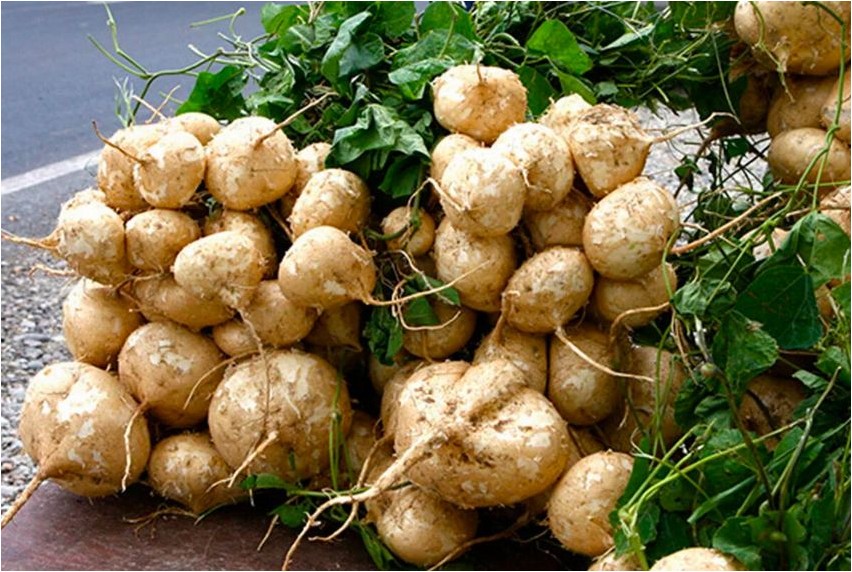
Jicama, or Pachyrhizus erosus (lat. Pachyrhizus erosus) is a vegetable crop; herbaceous liana-like plant of the legume family.
Natural range — South and Central America, tropical forests of South and Southeast Asia. Cultivated as a food plant in countries with hot climates.
Characteristics of culture
Jicama is a vine up to 4-5 m long with a rounded root crop weighing up to 20 kg. The skin of the root crop is yellowish and rather thin. When cut, the root vegetable is creamy white in color and has a sweetish apple aroma. The flowers are yellow. The fruit is a pod and contains a toxin called rotenone. The pods are not used for food purposes.
The crop is grown mainly in countries with warm climates, where night temperatures vary from 18 to 22C, and daytime temperatures from 30 to 40C. Previously, the crop was grown only in America; today it is also cultivated in China, Nigeria and the Philippines.
Application
Root vegetables are eaten raw, as well as with salt, red pepper and lemon juice. Jicama is often used to prepare soups, salads, casseroles, appetizers, main courses and sauces. Root vegetables can be pickled and dried. Storing jicama is difficult; it can only be kept in the refrigerator for 2-3 weeks.
Root vegetables are healthy, containing high amounts of fiber, fructose, inulin and minerals (calcium, potassium, magnesium, sodium, manganese, phosphorus, zinc, iron, selenium, copper and manganese). In addition to the listed substances, root vegetables are rich in vitamins such as A, B1, B2, B3, B4, B5, B6, C, E, K). Traces of proteins and lipids are also present. Jicama seeds are used to produce medical preparations intended for the treatment of dermatological diseases.

General information about cultivation
Unfortunately, there is negligible information on the cultivation of this crop, which is probably why its cultivation in Russia is difficult. Jicama is a heat-loving crop, develops well and produces good yields of root crops only in open sunny areas, protected from heavy winds. Loamy and sandy loam soils with a neutral pH are optimal for jicama. Plants do not tolerate highly acidic, waterlogged, swampy and saline soils. They cannot tolerate frost.
Jicama is propagated by tubers. The seed method is not used, since the seeds lose their viability after 4-5 hours. Crop care is standard: weeding, watering, loosening and fertilizing with mineral fertilizers. Support is required.





