Carissa largefruited
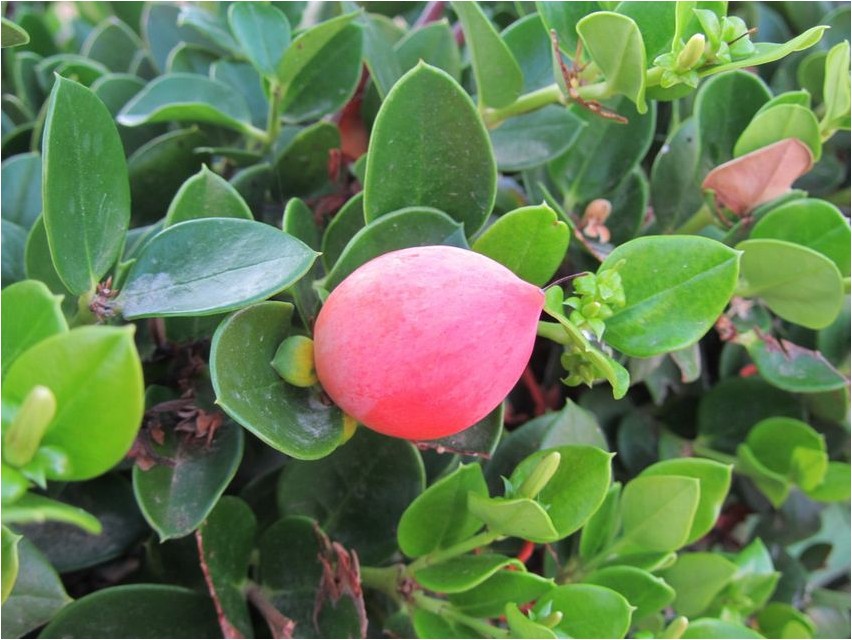
Large-fruited carissa (lat. Carissa macrocarpa) is a fruit crop that is a prominent representative of the Kutrovye family.
Description
Carissa largefruited is an evergreen fruit shrub whose height ranges from four and a half to five and a half meters. Glossy, leathery and rather thick dark green leaves of the plant grow up to seven centimeters in length and are characterized by an ovoid shape.
Carissa largefruited flowers are famous for their pleasant and very strong aroma. All of them are painted white, and their shape is very similar to jasmine flowers.
The oblong or spherical fruits of Carissa largefruited grow up to four centimeters in width and up to six centimeters in length. Unripe fruits are invariably green, but as they ripen they gradually turn red. The pulp of these fruits is surprisingly aromatic and incredibly juicy, with tiny patches of latex. And the taste of the pulp is very similar to plum. Also inside each fruit there are from six to sixteen thin and flat seeds.
Where does it grow
The natural distribution area of carissa largefruited is the coastal South African regions. However, this plant is cultivated almost throughout Africa. In addition, its thickets can be found in India, the Philippines, the Bahamas and the Hawaiian Islands.
Application
Carissa large-fruited is very rich in ascorbic acid, B vitamins and many useful microelements. Quite often, these cute fruits are eaten fresh, although in this case it is recommended to peel them. They are also used to make jams, preserves, syrups, jellies and puddings. Large-fruited carissa is also often added to ice cream, sauces or fruit salads.

Since this fruit tends to spoil very quickly and is completely intolerant of moving over long distances, Russians are practically unfamiliar with it. And in the places where they grow, the ripe fruits of Carissa largefruited are eaten with great pleasure by all kinds of insects and birds.
Large-fruited carissa is grown not only for its fruits — the huge number of V-shaped thorns on its branches makes it an indispensable element of protective plantings.
Contraindications
When consuming large-fruited carissa, allergic reactions are possible, and its green fruits and leaves are completely poisonous, so do not tempt fate.
Growing and care
Carissa large-fruited is very thermophilic — this feature makes it capable of growing only in the subtropical and tropical zones. If the thermometer drops below minus three degrees, this colorful plant will certainly die. And it also reacts extremely negatively to stagnant moisture.
Carissa large-fruited will grow especially well on rocky and sandy soils. It tolerates high soil salinity very well, and this crop is also very drought and wind resistant.
Both in nature and in culture, this plant reproduces mainly by grafting; in addition, under natural conditions it can also reproduce by cuttings. Large-fruited carissa can also be propagated by seeds, although their germination will take about two weeks. At first, the seedlings of this crop grow extremely slowly, but in the second year they begin to delight with their “explosive” growth, and in the third year the large-fruited carissa already bears fruit in full force. By the way, its flowering and fruiting can be observed throughout the year, although their peak always occurs in the summer months.





