Foxglove
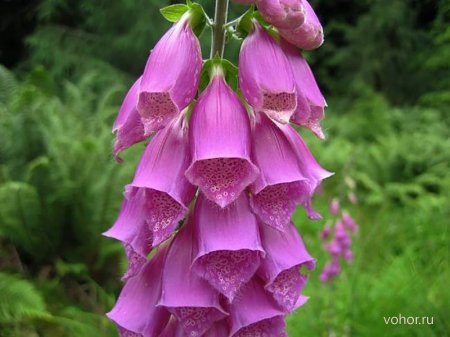
Foxglove gets its name from the bell-shaped ^ shape of its flower, which resembles a thimble. Like many other plants, it has medicinal properties in addition to its beauty. However, treatment with foxglove must be done carefully, as digitalis is not as harmless as it seems and is also considered poisonous. There are an incredible number of varieties of this flower.
For ornamental gardening, purple foxglove and its derived varieties are most often used. Foxglove (digitalis) captivates with its beauty, expressed in the many huge flowers on a single inflorescence and the variety of colors. Flowers come in white, pink, red, and cream, with various color inclusions. Conventionally, foxglove (digitalis) is divided into several species.

& bull; Small-flowered (D. parviflora) – the peduncle is short, reaching a height of about 1 m, the flowers are quite small. The plant is frost-resistant, belongs to perennials. & bull; Large-flowered (D. grandiflora) – huge flowers, the plant reaches a height of 120 cm. Grown as a biennial. & bull; Yellow (D. lutea) – belongs to perennial plants, reaches a height of up to 1 m. The flowers of this species are characteristically yellow. Varieties bred on the basis of this species can be grown in pots. & bull; Woolly (D. lanata) – reaches a height of 1. 5 m. & bull; Rusty (D. ferruginea) is a perennial plant, reaching a height of 1. 5 m. The flowers are not very large, collected in a large inflorescence. The color of the flowers is yellow-chestnut. Ciliated (D. ciliata) is a perennial plant up to 60 cm tall. The species is little known among gardeners. Nevada (D. nevadensis) is a low plant, more often used to decorate hills.
Planting and caring for foxglove Digitalis (digitalis) is an extremely unpretentious plant that will grow charmingly both in clear areas and in areas in the shade. But for better growth, it would not be bad to make more suitable data. Acidic, moist soils are suitable for growing the best. Grows well in partial shade. The plant needs to be fed periodically and best of all, fertilizing should be done in the spring, but too frequent feeding is detrimental to the plant. From time to time, the plant needs watering and loosening the soil. Before cultivation, the soil is prepared by adding humus to the ground or notifying the soil if the soil is acidic. Digitalis flowering begins in June and lasts up to 2 months. To prolong flowering and for re-blooming, you need to remove the faded central peduncles.

reproduction Foxglove is propagated by seeds. Digitalis seeds are collected as the capsules ripen. Especially good seeds are formed from the lower flowers of the inflorescences. Sowing of seeds should be done in late spring-early summer. The seeds are simply scattered on the soil, without the need to cover them with soil in order to not limit the access of light. For early flowering, you can plant the plant with seedlings. Seeds or seedlings are sown (planted) in the ground at a distance of 40 cm from each other, opposite the plant will be narrow. Foxglove can reproduce by self-sowing and sprouts beautifully later. Pests and diseases Foxglove can be affected by powdery mildew or rot, as well as leaf spot. Aphids act as pests.


foxglove