Rapis
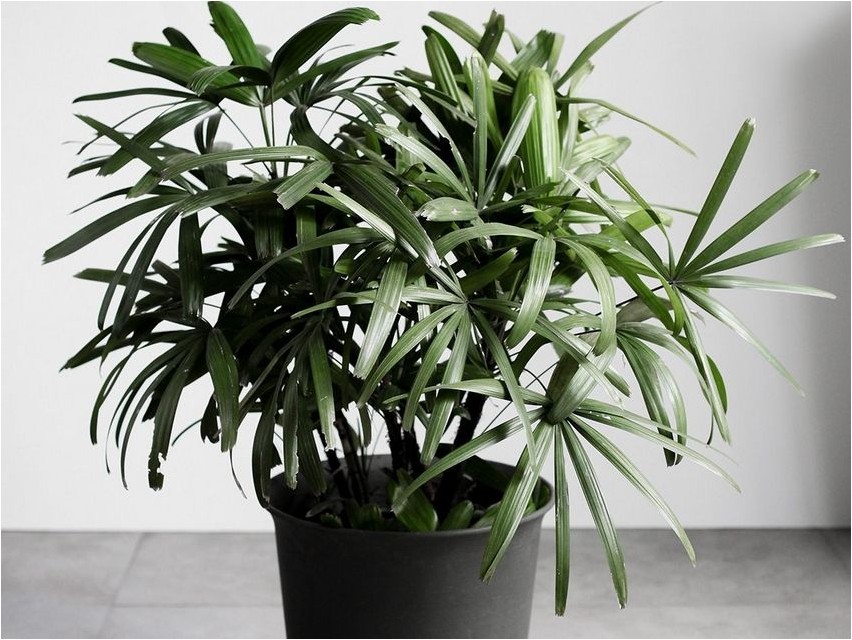
Rapis (lat. Rhapis) – indoor plant; fan bamboo palm of the Palmaceae family. The plant is often called whip or stick palm. China and Japan are considered the homeland.
Translated from Latin, “rhapis” means stick, rod. Rapis was brought to Europe about 240 years ago.
Characteristics
Rapis is a bush-like palm tree 60-200 cm high. The stems are thin, reed-tubular in shape, covered with felt-mesh fibers. The leaves are small, fan-shaped, deeply dissected into 5-10 lobes, the edges are finely serrated, located at the ends of the stems.
The rhizome is powerful, forming a large number of lateral shoots. Rapis is a perennial plant. The growth rate is low. Under favorable conditions, rapis blooms with white or cream-colored flowers, although this phenomenon is quite rare.
Species

*Tall rapis (lat. Rhapis excelsa) – the species is represented by reed fan palms up to 3 m high. The stems are articulated, few in number, externally similar to bamboo stems, reach 3-4 cm in diameter, covered with felt-mesh fibers. The leaves are short, fan-shaped, deeply dissected, green, serrated at the apex, length 25-30 cm, width 5 cm. The petioles are thin, long, covered with fibers at the base. The inflorescence is branched, axillary. In indoor conditions, tall rapis blooms extremely rarely.
*Rapis low (lat. Rhapis humilis) – the species is represented by bush-like plants 1-1. 5 m high. The stems are densely fibrous, very thin, reaching 1-2 cm in diameter. The leaves are hard, glossy on the outside, fan-shaped, deeply dissected into 7-8 lobes, length 20-25 cm. The petioles are thin, long. The inflorescence is branched, axillary.
Growing conditions
Rapis is a light-loving plant, prefers well-lit rooms; it is preferable to place the crop in a tub near the eastern or western window; it is not forbidden to place it near the northern window. From time to time the plant must be turned to the light with the other side. The optimal temperature for normal growth and development is 18-20C, the upper limit is 24C, the lower limit is 7C.
Rapis has a negative attitude towards dry air, but with regular spraying with warm, settled water, it grows well. The soil substrate should consist of turf soil, wet peat, humus and coarse sand or perlite (2:2:2:1). For large and heavily grown plants, the content of turf soil is increased. Pots and containers need to have holes.
Care
Rapis is a plant that requires regular watering. In spring and summer, watering is abundant, as the top layer of soil substrate dries, in autumn and winter – moderate. For irrigation, use only soft, warm and settled water.
Fertilizing of the crop is carried out in spring and summer once every 2-3 weeks. Complex mineral fertilizers for decorative deciduous plants are ideal for this purpose. It is also necessary to periodically wipe the leaves and remove dried parts of the plant. In summer, it is advisable to take the plant out onto the balcony.
Reproduction, planting, transplanting
The crop is propagated by seeds and division of rhizomes. When sowing seeds, the entrances appear only after 2-3 months.
Rapeseed is transplanted by transshipment. Like all palm trees, rapis does not tolerate transplantation well. Adult plants do not need to be replanted; it is necessary to replace the top layer of soil substrate once a year. Rapis pots need to be wide and have good drainage at the bottom.
Difficulties in growing
The cause of leaf spotting may be high temperature or insufficient air humidity. These troubles can be eliminated by spraying with warm, settled water.
Yellowing and drying of leaves often indicates that the plant is affected by scale insects. Pests are removed using a cotton swab dipped in tobacco infusion or soap solution.
The cause of yellowing of the leaves and the appearance of cobwebs on them is the infestation of rapeseed by spider mites. To prevent this kind of problem, it is necessary to adjust the air humidity and room temperature.
Young leaves open prematurely due to damage to the root system or excess moisture. With insufficient nutrition, the growth of rapeseed greatly slows down. Darkening of the leaves may be due to low temperatures.
Application
Rapis is an ornamental plant, used to decorate staircases, spacious rooms and offices, and landscaping winter gardens. Also relevant in ordinary city apartments.