Soapwort officinalis
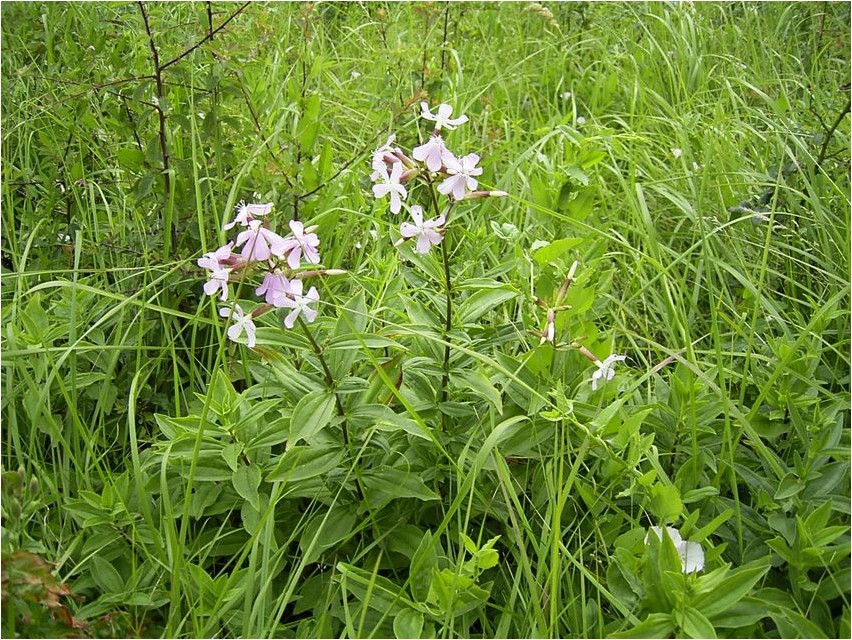
Soapwort is one of the plants of the family called Cloveaceae; in Latin the name of this plant will be as follows: Saponaria officinalis L.
As for the name of the soapwort family itself, in Latin it will be: Caryophyllaceae Juss.
Description of Soapwort officinalis
Soapwort is known by the following popular names: white carnation, bean plant, cokel, air jasmine, Tatar soap, soap grass, bladderwort, jointwort, field violet and dog soap. Soapwort officinalis is a perennial herbaceous plant, the height of which will fluctuate between thirty and ninety centimeters. Such a plant will be endowed with creeping thin rhizomes, as well as quite numerous small roots. The stem of Soapwort officinalis is rounded, it can be either simple or branched in the upper part. The leaves of this plant are sessile and opposite, lanceolate, short-petiolate, elliptical, acute, sometimes they can be oblong, and such leaves are endowed with three veins and a ciliated edge. Soapwort flowers are fragrant and large in shape, they can be colored either pink or white. Such flowers are on rather short stalks and are collected in a corymbose paniculate inflorescence. The fruit of Soapwort officinalis is an oblong-ovoid capsule. The seeds of this plant are small in size, they are numerous and almost black in color.
Soapwort officinalis blooms in June, while the seeds will ripen in August. Under natural conditions, this plant is found in the Caucasus, Ukraine, the south of the European part of Russia, Kazakhstan, Central Asia and the south of Western Siberia. For growth, this plant prefers wastelands, forest edges, places among thickets of bushes and river valleys. It is noteworthy that this plant is bred as an ornamental.
Description of the medicinal properties of soapwort officinalis
Saponaria officinalis possesses valuable medicinal properties, and it is recommended to use the rhizomes and roots for medicinal purposes. This raw material should be harvested in the fall. These valuable medicinal properties are attributed to the ascorbic acid and glycoside saponarin found in the leaves of Saponaria officinalis, while the roots contain saponins, pectins, mucilage, saponaroside, saporubric acid, and saporubrin.
This plant possesses highly effective diuretic, wound-healing, expectorant, choleretic, antimicrobial, diaphoretic, antiviral, and antirheumatic properties. It should be noted that Saponaria officinalis infusion has a surfactant effect against both gram-negative and gram-positive bacteria. In scientific medicine, preparations based on this plant are used for their ability to both liquefy and promote expectoration. Saponaria officinalis is most often used as an expectorant for respiratory and lung conditions, and is sometimes used as a diuretic and laxative.

In folk medicine, an infusion made from the roots and leaves of this plant is used for pneumonia, persistent cough, sore throat, bronchitis, whooping cough, laryngitis, rhinitis, cholecystitis, dropsy, gout, constipation, rheumatism, and various gastrointestinal ailments. This remedy is very effective when used correctly.
Saponaria Medicinal Plant: Beneficial Properties and Contraindications





